Theopolis Logo

Writing

Explore our collection of theological essays, biblical studies, and reflections on faith and culture.

See all
puritans
History

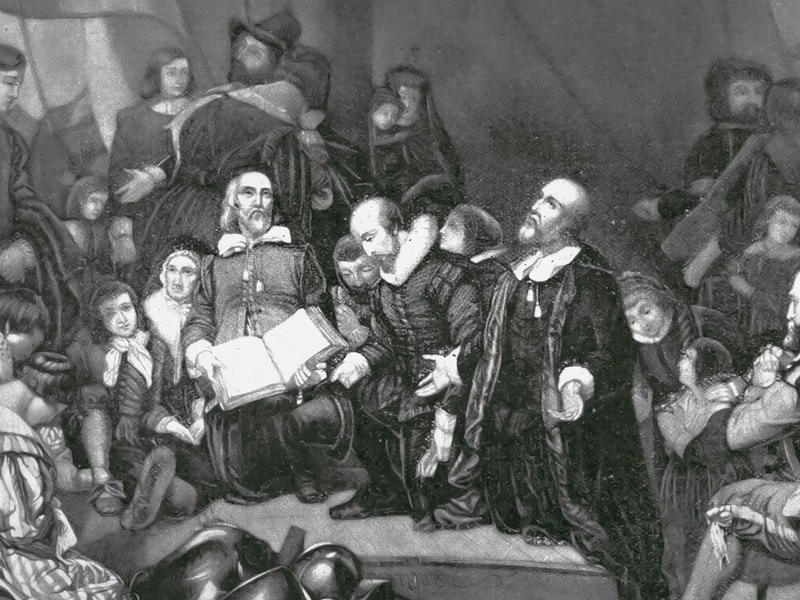
Congregational Theocracy: That Time Theocrats Ran Puritan New England

Timon Cline wrote recently that “theonomists” didn’t run Puritan New England. 1 He is correct, in his major thesis, that the claim that “Puritanism and the natural law tradition are antithetical” is “wildly ahistorical.” Mr. Cline demonstrates that Puritans repeatedly extolled natural law. Besides the Puritan sources Mr. Cline mustered,…

by John CarpenterAugust 9, 2022

screen-shot-2022-08-04-at-9-36-57-am
Mark

The Land of the Walking Trees

The Church is the land of the walking trees. In Mark’s Gospel, the identity of Jesus is slowly and progressively revealed. Though St. Mark announces at the beginning of his narrative that Jesus Christ is “the Son of God” (1:1), this is a reality that must be spoon-fed to His…

by Jackson ShepardAugust 4, 2022
11982-sparrowstockephesians
Ephesians

The Significance of Ephesians (with a comparison to Romans)

All Scripture is of ultimate significance as the word of God, but it may be helpful to think about what makes a book (in this case, a letter) possibly unique within the canon. In this case, the “general” nature of Ephesians should stand out, but it often is not recognized…

by Mark HorneAugust 2, 2022
davide-ragusa-g32g_ibprfa-unsplash
Ecclesiastes

A Time to Kill (Ecclesiastes 3:3)

Where do we draw the lines between what is right and wrong? This question is fundamental to civilization, fundamental to a free society. To put this question in the bluntest and most offense terms: if there is a time to kill — which Solomon says there is — whom shall…

by Ralph Allan SmithJuly 28, 2022
screen-shot-2018-04-12-at-9-48-08-am
Biblical Horizons

Broadening Our View of the Trinity

This article was originally posted in May of 1994. We speak of God as Father, Son, and Holy Spirit. The early Church tended to speak of Him as Father, Word, and Spirit. In this short essay, I want to suggest some other ways to think of the Trinity, ways that…

by James B. JordanJuly 26, 2022
jonahwhale-1552x900
Jonah

Journeying Prophets in Kings

Jonah’s Home The story of JONAH belongs in the book of KINGS. JONAH balances the story of the unnamed Judean prophet (1K13) in KINGS’ literary structure. Each story describes a journeying prophet that crosses land or sea to confront a wayward king. The two stories are located during the reigns…

by Scott FairbanksJuly 21, 2022

Showing page 41 of 309

See all
See all

Pentecost

Citing Deut 16:9-12 and the Gezer Calendar, K. Lawson Younger says in NIV Application commentary on Ruth, “the time period from the beginning of the barley harvest to the end of the wheat harvest was normally seven weeks, concluding at Pentecost.” Presumably, this was the festival that Boaz was celebrating…

February 20, 2008
Theology

Fall toward nothingness

Augustine is sometimes accused of ontologizing the effects of sin. City of God 14.13 seems to support this: “When [Adam] turned toward himself . . . his being became less complete than when he clung to Him Who exists supremely. Thus, to forsake God and to exist in oneself -…

February 18, 2008
Theology

Eschatology against the Stoics

Augustine rebuts Stoic notions of apatheia and eupatheia in Book 14 of the city of God. He says that Christian experience even those emotions that Stoics denounce - distress and pain and desire - and he roots these experiences in the fact that Christians live in the present age “because…

February 18, 2008
Literature

Hamlet the hero

A colleague, Jayson Grieser, pointed me to Paul Cantor’s little book on Hamlet a few months ago, but I have only recently been able to look at it. It’s superb. Cantor argues that the play dramatizes a conflict between the classical heroism revived by the Renaissance and the Christian constraints…

February 18, 2008
Economics

Augustine the Marginalist

In City of God, 11.16, Augustine observes the reality of marginal utility: “So far as the freedom of judgment is concerned . . . the reason of the thoughtful man is far different from the necessity of one who is in need, or the desire of the pleasure-seeker. For reason…

February 18, 2008

Sermon notes, Third Sunday of Lent

INTRODUCTION Jesus gives the Twelve authority to heal, raise the dead, cleanse lepers, cast out demons. He does not give them authority to escape persecutors. Persecution is an inevitable part of the mission of the Crucified. THE TEXT “Behold, I send you out as sheep in the midst of wolves.…

February 18, 2008

Showing page 1566 of 2212

Browse by Category

In Medias Res

Your weekly digest for all things Theopolis.

Donate

Theopolis is nearly 100% donor-supported. Consider joining us on our mission.