Theopolis Logo

Writing

Explore our collection of theological essays, biblical studies, and reflections on faith and culture.

See all
sacre-bleu-r__kixb0i5m-unsplash
Death

Integrity

Integrity seems to have two meanings. It can mean the quality of being honest and having strong moral principles. A man of integrity is a person of honour, rectitude and probity, truthful and trustworthy. Integrity also describes a state – the quality of being whole and undivided. If things are…

by Arthur KayMarch 19, 2015

emmanuel-phaeton-1bwmfmvybi8-unsplash
Psalms

Psalm 32 Commentary

Get the Psalm 32 Translation here Psalm 32 is the first part of Ps. 32-33, ending with a call to praise that is answered by what follows. Ultimately the psalm needs to be considered as a whole, but what we call Psalm 32 does have its own structure and logic,…

by James B. JordanMarch 18, 2015
laughter
Humor

On Crude Humor

You wouldn’t hit a man with glasses would ya? No, of course not. I’d hit him with a bat. In our culture of frivolity it is tempting for Christians to think that solemnity should be our defining attribute. The coarseness of the world impedes us from enjoying any sort of…

by Remy WilkinsMarch 17, 2015
standingonamountain
Creation

Maker of Heaven and Earth, Part 2

Taking a cue in my last post from early Christian apologetics, I suggested that if we wish to articulate and defend a doctrine of creation ex nihilo in contemporary theology, we would do well to offer a thick description of Yahweh’s divine monarchia (his sole rule or sovereignty). Rather than…

by Stephen LongMarch 12, 2015
mountain-top-2
Creation

Catechism of the Universe

I’m not sure we really understand the insidiousness of unbelief. It is not merely to reject the gospel of Jesus, the existence of a Creator God, or to question biblical morality. At its core, unbelief is ingratitude, and by the very nature of this ingratitude, it must ultimately reject every…

by Toby SumpterMarch 10, 2015
jonah-under-gourd
Mark

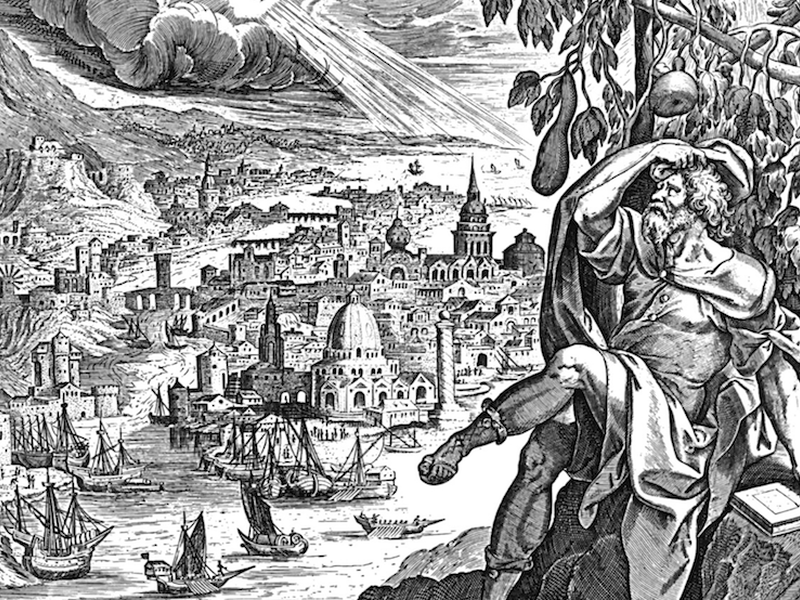
The True Jonah and Lenten Fasting

Mark’s narrative of the baptism of Jesus is characteristically brief: “In those days Jesus came from Nazareth of Galilee and was baptized by John in the Jordan. And when he came up out of the water, immediately he saw the heavens being torn open and the Spirit descending on him…

by Arthur KayMarch 9, 2015

Showing page 158 of 309

See all
See all
Philosophy

Heidegger and the gift

Marion works from both Husserl and Heidegger, and we’ll focus on the latter, as he is slightly easier to grasp. (I am summarizing Robyn Horner’s discussion.) Heidegger begins from Husserl, but seeks to go beyond him. Husserl’s phenomenology was an effort, Heidegger says, to “let that which shows itself be…

November 28, 2007

Sermon Notes, First Advent

INTRODUCTION Isaiah is the great prophet of the incarnation, but Isaiah is a bit too large to cover during the four weeks of Advent. Micah, though, prophesied at the same time as Isaiah (Micah 1:1; Isaiah 1:1), and the prophecies overlap (Micah 4:1-3; Isaiah 2:1-4) and Micah includes a major…

November 26, 2007

Eucharistic meditation

Psalm 128:5-6: The LORD bless you out of Zion, and may you see the good of Jerusalem all the days of your life. Yes, may you see your children’s children. Peace be upon Israel. We saw in the sermon this morning that the man who fears Yahweh can hope for…

November 25, 2007
Theology

Exhortation

As soon as Adam sins, his marriage is disrupted, as he becomes Eve’s accuser instead of her guardian. In the next generation, sibling rivalry escalates to the first murder. The family is a fallen institution. It cannot redeem. It needs to be redeemed. The story continues throughout the Old Testament.…

November 25, 2007
Literature

Meta-Theater

During one scene of King Lear, Edgar, disguised as Mad Tom, leads his father, Gloucester to the cliffs of Dover, where his father intends to throw himself down to his death. Only Edgar doesn’t go to Dover. He tells his father that he has reached Dover, and Gloucester ceremoniously throws…

November 24, 2007
History

Stoic and Christian

For the Stoics, as for most ancient philosophers who reflected on signs, signs were examined as part of a theory of inference. A sign was a symptom, and the medical usage is often overt in examples; or a sign is a premise of an argument, from which something unknown can…

November 24, 2007

Showing page 1601 of 2212

Browse by Category

In Medias Res

Your weekly digest for all things Theopolis.

Donate

Theopolis is nearly 100% donor-supported. Consider joining us on our mission.