Theopolis Logo

Writing

Explore our collection of theological essays, biblical studies, and reflections on faith and culture.

See all
kristina-flour-bcjdbykwquw-unsplash
Culture

On Foul Language

The Stranger: Do you have to use so many cuss words? The Dude: What the f*ck you talking about? - The Big Lebowski There was a man I knew, an elder at his church, who, whenever he was called upon to announce a pregnancy, preferred the euphemism “with child” because…

by Remy WilkinsJanuary 12, 2016

organ-pipes
How to Worship

Pipes Worth Playing

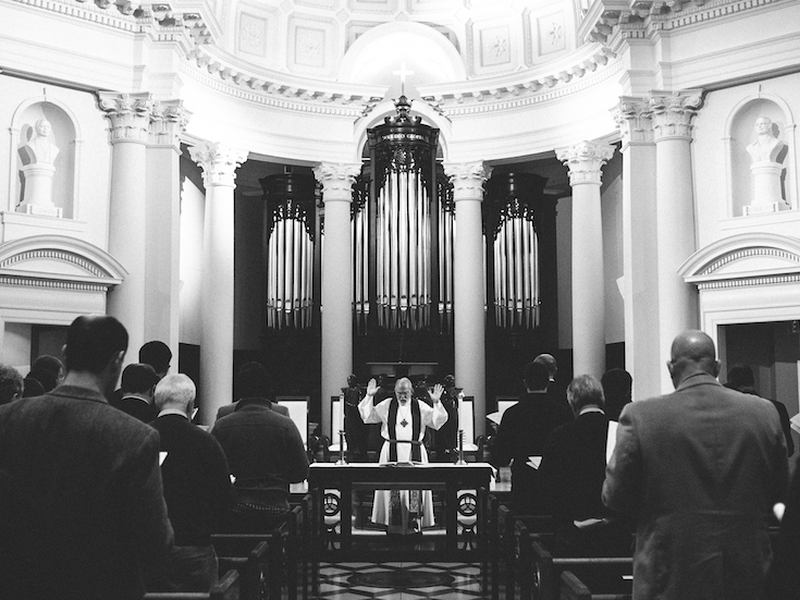
I know what you’re thinking. Organ: funeral, ball game, grand dusty cathedral. Why should modern Christians of such a technological age revisit a thousand year-old instrument? Don’t worry, I will not be trying to punch another hole in my Weird Music Preferences and Opinions card here. The truth is, our…

by Jarrod RicheyJanuary 7, 2016
tree-2
James

Do Things Have Natures?

Do things have natures? As I am posing the question, it is not simply a question of whether there are particular kinds of things in the world that have characteristic features, patterns of behavior, trajectories of growth and development. If that is what the word means, then the answer is…

by Peter LeithartJanuary 5, 2016
jim-leading-worship
Theopolis News

2016 Nevin Lectures with Father John Behr

We are excited to announce our 2016 Nevin Lectures featuring Father John Behr. Fr. John is the Dean of St. Vladimir's Seminary and Professor of Patristics, as well as the author of multiple works. He will be delivering three lectures over the course of two days dealing with "What Protestants…

by Brian MoatsJanuary 4, 2016
times-square
Creation

Time, Curse or Gift?

New Year's Day makes one reflective, at least about the past year, perhaps about life, perhaps, more broadly, about time itself. Many view time as a curse. Some see it as a curse because of missed chances. As one day or year moves on to the next, all we can…

by Peter LeithartDecember 31, 2015
nativity-2
Advent

The Manger

It seems a truism to say that we live in the world: that the world is outside of us. In reality the world is very much inside of us too. In fact the world passes through us as much as we pass through it. We breathe in its air, using…

by Arthur KayDecember 29, 2015

Showing page 138 of 309

See all
See all

Tale of Two Women

In Numbers 12, Miriam and Aaron object to Moses’ Cushite wife. Miriam becomes leprous, is excluded from the camp, and restored on the eighth day. That is to say: The Messiah’s Jewish sister objects to the Gentile bride, and is cast out of the camp, but then she is cleansed…

November 9, 2007

Sacrificial sequence

Hicks again: He organizes his discussion of the New Covenant fulfillment of the sacrificial system in the phrases “life surrendered,” “life transformed,” and “life shared.” Reconciliation is made on the basis of life surrendered, blood shed, but that’s not the end point of the reconciling sacrifice. This enables him to…

November 8, 2007

Burning flesh

FCN Hicks writes in his 1946 book on sacrifice that the burning of an animal on the altar was not destructive but transforming: “The offering is not destroyed but transformed, sublimated, etherealised, so that it can ascend in smoke to the heaven above, to the dwelling-place of God.” He cites…

November 8, 2007
Philosophy

Signs and domination

Only God, Augustine argues in his treatise on music, acts on rational souls directly, “per seipsum.” Human beings operate on one another’s souls through intervening bodies, that is, through the words and other signs. God has arranged the world this way, he says, as a check on human ambition and…

November 8, 2007

Signa data

Many translators and interpreters of Augustine’s de doctrina Christiana translate “signa data” as “conventional signs.” But there’s something to be said for taking the phrase literally (as some commentators do). The difference between naturalia and data, Augustine says, is that the latter occur by the will of a sign-user while…

November 7, 2007
History

Sixteenth-century exchanges

Shakespeare recognized that something new was in the offing, but the actual situation of England and Europe in the sixteenth and seventeenth centuries was far more complicated that Timon of Athens suggests. The gift-society to which Timon is attached was not being completely replaced, nor was the market the main…

November 7, 2007

Showing page 1609 of 2212

Browse by Category

In Medias Res

Your weekly digest for all things Theopolis.

Donate

Theopolis is nearly 100% donor-supported. Consider joining us on our mission.