Theopolis Logo

Writing

Explore our collection of theological essays, biblical studies, and reflections on faith and culture.

See all
preston-goff-xncifslw0jw-unsplash
Biblical Theology

The Old Testament Precursor to the Pastor

WHAT IS THE OT PRECURSOR OF THE NT OFFICE OF PASTOR? HOW DOES THE FORMER ILLUMINATE THE LATTER? The first problem to address is: how do we know that there is an office of pastor in the New Testament? 1 Perhaps the way the question is put may permit me…

by Mark HorneJune 5, 1999

nasa-vhsz50aafas-unsplash
Biblical Horizons

The Geocentricity Question

[This essay was originally published in December, 1981, in The Biblical Educator , a publication of the Institute for Christian Economics, and again with slight revisions in Contra Mundum 7 (Spring, 1993). It is reprinted here as a supplement to my book Creation in Six Days .] In 1979, Dr.…

by James B. JordanJune 4, 1999
screen-shot-2022-05-12-at-12-07-23-pm
Biblical Horizons

Call Me Ishmael, Part 2

Anyone seeking to reverse the meaning of this promise needs to come to grips not only with the phrase "God was with the lad" later on, but also with Hagar’s response in 16:13. She worships Yahweh, putting her trust in Him and obeying Him. In fact, Hagar is at the…

by James B. JordanJune 4, 1999
aaron-burden-h8s0pf2rcqs-unsplash
Biblical Horizons

Call Me Ishmael, Part 1

Ishmael is the narrator of Melville’s fantasy-romance Moby Dick. Melville takes up the traditional view of Ishmael as a wayward son of Abraham, driven out solely because of the Divine "caprice" of election, an angry man with his hand raised against all other men. He is a fitting "anti-hero," or…

by James B. JordanMay 4, 1999
aaron-burden-1ebsmyrau-s-unsplash
Isaiah

Five Cities and Isaiah 19

There were five cities at the center of the Canaanite culture in the circle of the Jordan, a place like the Garden of Eden, like the land of Egypt, before it became the Dead Sea at the destruction of the cities (Genesis 13:10). Genesis 14:2 tells us their names: Sodom,…

by James B. JordanApril 4, 1999
phillip-medhurst-abraham-and-lot
Biblical Horizons

Lot

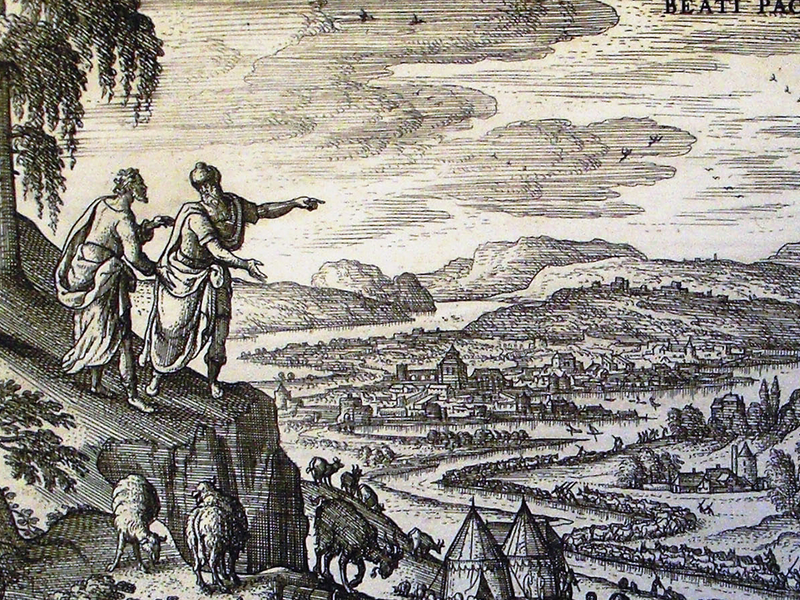
Meditations by James B. Jordan Genesis 19, the destruction of Sodom and the rescue of Lot, is part two of a story that begins in Genesis 18. These two chapters happen in one 24-hour period: noon and evening in Mamre, and midnight and daybreak in Sodom. God and two angels…

by James B. JordanApril 4, 1999

Showing page 244 of 309

See all
See all
Uncategorized

1 & 2 Kings

Uriah Y Kim reviews my Kings commentary in a recent issue of Reviews in Religion and Theology . He’s got some criticisms, but overall it’s a fair review. A couple of responses on specific points: 1) He thinks my contention that there is a “seventh-king” pattern is suspect; my counting…

October 22, 2007
History

Patronage

Richard Saller defines patronage by three features (summarized by Griffin): “(1) it involves the reciprocal exchange of goods and services; (2) that it is a personal relationship of some duration; (3) that it is asymmetrical, in the sense that the two parties are of unequal status and offer different kinds…

October 22, 2007

Gratitude in ancient thought

Griffin begins her essay: “The exchange of beneficia - gifts and services - was an important feature of Greek and Roman society at all periods. Its prominence was reflected in the number of philosophical works that analyzed the phenomenon. From the fourth century B.C. onwards, euergesia and charis became subjects…

October 22, 2007
History

Seneca and Roman Society

Miriam Griffin has a richly detailed discussion of Seneca’s de Beneficiis in a 2003 issue of The Journal of Roman Studies . The article discusses the appropriateness of “patronage system” as a description of Roman social relations, Seneca’s use of exaggeration for moral effect, the and similarities between Seneca and…

October 22, 2007
History

Pointy Greeks

Seneca found Chrysippus’s treatment of the Three Graces too subtle: He was a great man but “a Greek, whose intellect, too sharply pointed, is often bent and turned back upon itself; even when it seems to be in earnest it only pricks, but does not pierce.” Seneca himself found in…

October 22, 2007
Philosophy

Kant on Ingratitude

In his Lectures on Ethics, Kant says that ingratitude is among the vices that “are the essence of vileness and wickedness.” He adds, “It is inhuman to hate and persecute one from whom we have reaped a benefit, and if such conduct were the rule it would cause untold harm.…

October 22, 2007

Showing page 1617 of 2212

Browse by Category

In Medias Res

Your weekly digest for all things Theopolis.

Donate

Theopolis is nearly 100% donor-supported. Consider joining us on our mission.