Theopolis Logo

Writing

Explore our collection of theological essays, biblical studies, and reflections on faith and culture.

See all
tonik-haz3tnzqp6w-unsplash
Anxiety

Viral Anxiety Requires Infectious Wisdom

At the time I write this, many in the United States are under some kind of “lock-down” order. But, thanks to the internet, people are still able to communicate with each other. And people have differing opinions on which medical or scientific projection about our current pandemic is most likely…

by Mark HorneApril 21, 2020
screen-shot-2020-04-14-at-8-53-04-am
Gospels

Shall We Receive Good From God, But Not Calamity?

So Jesus came again to Cana in Galilee, where he had made the water wine. And at Capernaum there was an official whose son was ill. When this man heard that Jesus had come from Judea to Galilee, he went to him and asked him to come down and heal…

by Jeff MeyersApril 14, 2020
morgan-vander-hart-s-m2pamjcvg-unsplash
Family

A Family Liturgy

Throughout the world, pastors and leaders are making sometimes excruciating decisions about whether or not to hold public worship services during the coronavirus pandemic and, if so, how. We at Theopolis encourage you to find creative, safe, reasonable, and submissive ways to meet in person with other believers. For many,…

by Peter LeithartApril 8, 2020
the-destruction-of-jerusalem-by-nebuzar
Covenant

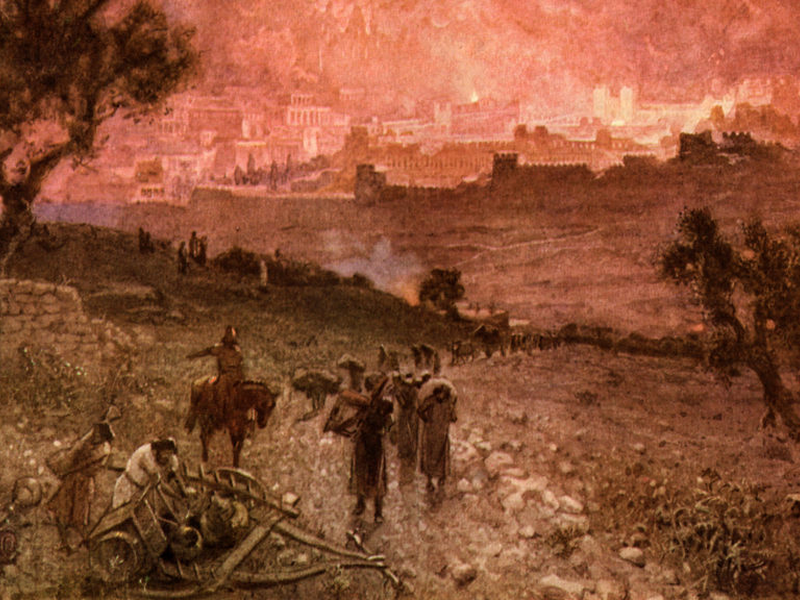
Zion as an Ascension

An excerpt from The End of Israel: Jesus, Paul & AD70 by Michael Bull The Hebrew word olah, translated “whole burnt offering” literally means “go up.” The explanatory “translation” is helpful in its description of the offering but unfortunately for English readers it veils the symbolic meaning. As far as…

by Mike BullApril 7, 2020
e99a2549
Coronavirus

Worship in Exile

The # Coronavirus is trending more frequently than your favorite five celebrities put together. Our culture has exchanged TMZ stories for the primacy of the geeks who once made their living in the privacy of their laboratory. These are now our modern-day celebrities. It’s safe to say the experts surrounding…

by Uri BritoMarch 31, 2020
screen-shot-2020-03-26-at-11-54-58-am
Baptism

A Baptism Letter

In the name of Jesus Christ, our Savior, Lord, and Friend. Dear sister in Christ, Your baptism is firm and certain not because of anything you have done or the pastor who administered your baptism in Christ’s stead and command. Your baptism is firm and certain because of God and…

by Todd HainsMarch 26, 2020

Showing page 68 of 309

See all
See all

Exhortation

Most of the Beatitudes in Matthew are stated in third person. “Blessed are the poor in spirit, for theirs is the kingdom of heaven.” ” They shall be comforted,” ” they shall inherit the earth,” ” they shall be called the sons of God.” At the end, Jesus changes the…

September 2, 2007
Theology

Music, Time, and Augustine

One of the best discussions of Augustine’s views on time comes from Jeremy Begbie’s Theology, Music, and Time (ch. 3). Following Ricoeur’s discussion, Begbie claims that Augustine’s distentio “is conceived as the three-fold present, and the threefold present as distentio . The distentio consists in the non-coincidence of the mind’s…

August 30, 2007
Theology

Escaping time

John Rist offers some important insights into Augustine’s view of time. He notes, as many commentators do, that Augustine is not aiming to provide a definition of time but to answer the question of how time can be measured. The dilemma is: If the past no longer is, and the…

August 30, 2007

Distention and eschatology

In a 1957 essay in Man and Time , Gilles Quispel claims that Augustine’s views of time have been extracted from the “great struggle between a cyclical and a historical view of the world, between archaism and Christianity,” and therefore have been misunderstood. Augustine “comes to grips with the Neoplatonists…

August 30, 2007
Philosophy

Augustine’s non-Aristotelian Universe

Augustine argues in Confessions that time is not reducible to the movement of the celestial bodies. Aristotle agreed; but, as Ricoeur points out, the arguments that Augustine used departed radically from Aristotle. First, if the sun and stars stopped moving, and yet a potter’s wheel continued to move, time would…

August 30, 2007

Showing page 1638 of 2212

Browse by Category

In Medias Res

Your weekly digest for all things Theopolis.

Donate

Theopolis is nearly 100% donor-supported. Consider joining us on our mission.