Theopolis Logo

Writing

Explore our collection of theological essays, biblical studies, and reflections on faith and culture.

See all
aaron-burden-h8s0pf2rcqs-unsplash
Galatians

The Restoration of the Galatians

While controversies over the writings of Paul continue in various corners of the intellectual globe, the word of God given through Paul and his scribe and all of the church’s interpreters and translators over the last two millennia is still readily available to the lofty and the lowly. Paul, as…

by Grace LangnessMarch 25, 2013

kiwihug-l4gw27xzn1i-unsplash
Deuteronomy

Law and History: How to Read the Law of Moses (Part 2)

The second in a series of studies in Deuteronomy. Deuteronomy 22:30: A man shall not take his father’s wife, and shall not uncover his father’s wing (Hebrew: kanaf ). There are a number of unusual features in this law that mark it out from the previous context, indicating that it…

by Ralph Allan SmithMarch 20, 2013
200403-moss-pilate-tease_pncfq5
History

Victimhood and the Gospel

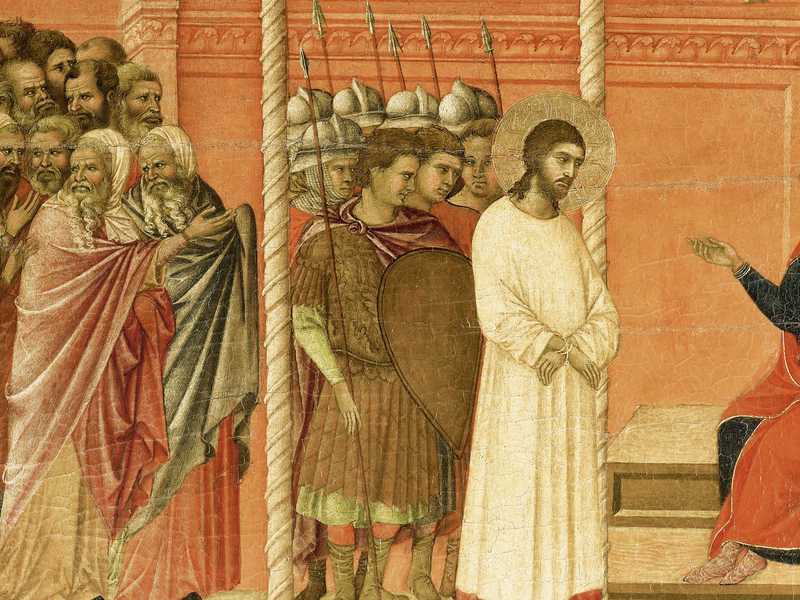
The texts of Christianity have been slowly at work, under the power of the Holy Spirit for 2000 years now. If we could be magically transported back into the world of two millennia ago, modern Americans would be shocked at the cruelty of that world. There was no concern for…

by Richard BledsoeMarch 18, 2013
aaron-burden-1ebsmyrau-s-unsplash
Luke

The Dysfunctional Family of the Gadarene Madman

The Story of the Gadarene Madman is told in all three synoptic Gospels (Matthew 8:28-34, Mark 5:1-20, Luke 8:26-37). Jesus ventures into a Gentile area when He passes over the Sea of Galilee. Upon disembarking from his boat, he is immediately met by a demon-possessed madman. Upon meeting Jesus, he…

by Richard BledsoeMarch 13, 2013
aaron-burden-1ebsmyrau-s-unsplash
Deuteronomy

Law and History: How to Read the Law of Moses

Part 1 of a multi-part series of studies on Deuteronomy 22:30-23:8. Eric Auerbach, in his classic work on Western literature, devotes his first chapter to contrasting Homer with the Bible. Of Homer, he writes of the “need of Homeric style to leave nothing which it mentions half in darkness and…

by Ralph Allan SmithMarch 12, 2013
markus-winkler-aid-xyrtlec-unsplash
Theopolis News

James Jordan in Korea, Japan

Trinity House Fellow James B. Jordan will be a speaker at an International Conference on Biblical Symbolism that will be held in Seoul on Monday, May 27 in 2013. He will address "The Importance of Biblical Symbolism and Symbolic Interpretation of the Bible." The conference will have three other speakers…

by Peter LeithartMarch 9, 2013

Showing page 197 of 309

See all
See all
History

Chinese and Hebraic thought

In his fascinating Faith of Our Fathers , Chan Kei Thong points to many biblical images embedded in Chinese characters. His argument could be made even stronger by looking at Hebrew terminology. For instance, he says of the character “zui,” which means sin, that “The top part is . .…

May 11, 2007
History

Chinese Creation

At the beginning of the Great Sacrifice performed by the Chinese emperor for centuries, singers sang the song of creation, addressed to the “Sovereign Lord” known as “Shang Di”: “Of old in the beginning, there was the great chaos, without form and dark. The five planets had not begun to…

May 11, 2007

Perichoretic imagination

One of the differences between those associated with “Federal Vision” theology and those opposed to it is a difference of theological imagination. The opponents operate with a theological imagination that distinguishes and clarifies; ontology is distinguished from relationality, nature from supernature, ecclesiology from soteriology. On the other side are theologians…

May 11, 2007
History

Bos and Bobos

According to Adolf Loos, a turn of the 20th-century Viennese architect and critic, modern style combines beauty and practicality. Both are necessary: “By beautiful, what we mean is that something has achieved fullness, completion. But no useless, impractical object can really be described as ‘full’ or ‘complete.’” One can imagine…

May 8, 2007

Kiuchi on Leviticus

Some initial observations on Nobuyoshi Kiuchi’s recent commentary on Leviticus in the Apollos series from IVP. 1) Kiuchi intriguingly translates hata and hatta’t , traditionally rendered in terms of “sin” or “purification” in terms of “hiding”: ” hata and hatta’t mean ‘to hide oneself’ and the condition of ‘hiding oneself,’…

May 8, 2007

The Spoken Son

A student points out that Hebrews 1-2:4 contains seven quotations from the Old Testament. Through these seven words, God speaks His Son as the new creation.

May 7, 2007

Showing page 1682 of 2212

Browse by Category

In Medias Res

Your weekly digest for all things Theopolis.

Donate

Theopolis is nearly 100% donor-supported. Consider joining us on our mission.