Theopolis Logo

Writing

Explore our collection of theological essays, biblical studies, and reflections on faith and culture.

See all
little-girl
Children

Honor God With Your Body

I am making a new rule in our house! We are actually kind of skimpy on the house rules. I try very hard to keep things simple: love God, love others, be joyful. It’s not complicated to avoid discipline here. But I have found myself repeating this new rule over…

by Lindsey TollefsonApril 9, 2015

giotto-noli-me-3
John

The Gardener and the Beloved, (Part 3)

Click HERE for Part 2 The voice of Jesus transforms and changes Mary when she hears him speak her name. This is her last “turning.” So also the woman in the Song of Songs longs to hear the voice of her beloved. Let me see your face, let me hear…

by Jeff MeyersApril 6, 2015
giotto-noli-me-2
John

The Gardener and the Beloved, (Part 2)

Click HERE for Part 1. The details of this story call the attentive reader back to the drama of Solomon’s Song of Songs. And the Song of Song’s alludes to, ties us into the story of Adam and Eve in the Garden and the promise of a coming Messiah that…

by Jeff MeyersApril 4, 2015
easter-term-2015-2
Theopolis News

Easter Term, 2015

“The course was a paradigm shift for me,” said Jonathan Sedlak, a Milwaukee electrical contractor who attended Theopolis’s course on Revelation. “I am left with a book that is far more practical than it has ever seemed before.” Jonathan Anderson of Louisville, Kentucky found the course “refreshing.” “I finished with…

by TheopolisApril 2, 2015
psalm-singing
Genesis

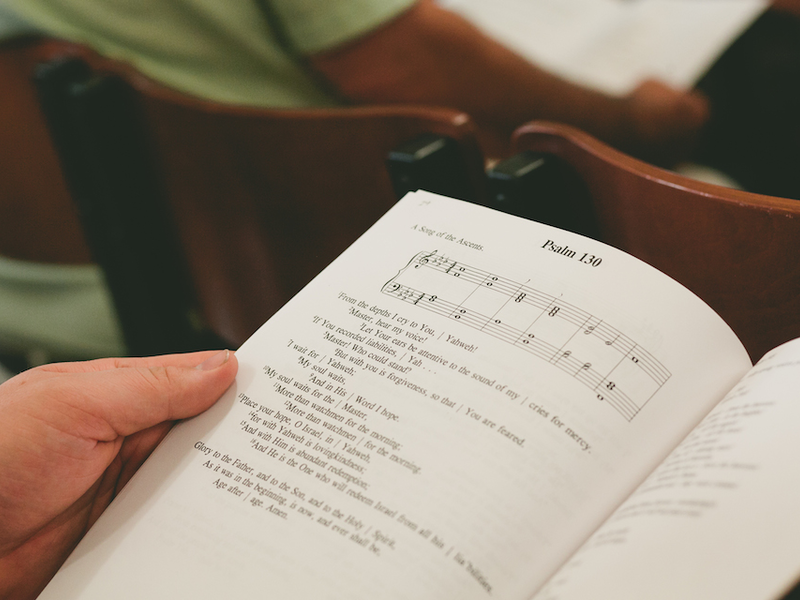
Worship as Response: Liturgical Logic, (Part 1)

“It is only by participation in a rational, practice-based community that one becomes rational.” – Alasdair MacIntyre It may be perfectly clear to a chef why adding unsifted powdered sugar to a hot frosting is a bad idea. But for an amateur cook, this may be the kind of rule…

by Jonathan BarlowApril 2, 2015
giotto-noli-me
John

The Gardener and the Beloved, (Part 1)

On a fresco in a chapel in Padua, Italy, there is a famous painting depicting the dramatic post-resurrection scene in John 20 with Mary and Jesus outside of the garden tomb. Giotto di Bondone painted it in the early 14th century. Jesus is striding from the tomb with a victor’s…

by Jeff MeyersApril 1, 2015

Showing page 156 of 309

See all
See all

Exegetical progress

If the fathers have already explained the Scriptures, Andrew of St. Victor asked, why do I need to? He answered that truth dwells “deep” and “screens herself from mortal sight.” There is always more truth to dig up because truth “hides, yet so as never wholly to be hidden. Careful…

April 4, 2007
Literature

Jane Austen, Economist

England’s economy in Austen’s time was still dominated by land ownership. Land was the most settled and permanent form of wealth, and writers like Coleridge and Burke asserted that landownership formed a “natural” governing class that had a physical stake in the nation. In 1710, Parliament enacted property qualifications for…

April 4, 2007
History

Equality and fashion

In 1767, one N. Foster wrote, “In England the several ranks of men slide into each other almost imperceptibly, and a spirit of equality runs through every part of their constitution. Hence arises a strong emulation in all the several stations and conditions to vie with each other; and the…

April 3, 2007
History

Consumer revolution

In the 1982 symposium, The Birh of a Consumer Society , Neil McKendrick identifies some of the chief features of the demand-side of the social and economic of the 18th century. What did it mean for England to become a “consumer society”? 1. More people than ever could acquire material…

April 3, 2007
History

Mimetic adverts

Samuel Johnson recognized the character of avertising quite early. he noted in 1761 that “advertisements are now so numerous that they are very negligently perused, and it is therefore become necessary to gain attention by magnificence of promises and by eloquence sometimes sublime and sometimes pathetic.” And he saw that…

April 3, 2007
History

Early advertising

Seen in the advertising section of many 18th-century English newspapers: “a fine young breast of milk willing to enter a gentleman’s household.” Presumably attached to a wet nurse. And an advertisement for a bed that “at the head . . . in the full centre front, appears sparkling with electrical…

April 3, 2007

Showing page 1697 of 2212

Browse by Category

In Medias Res

Your weekly digest for all things Theopolis.

Donate

Theopolis is nearly 100% donor-supported. Consider joining us on our mission.