Theopolis Logo

Writing

Explore our collection of theological essays, biblical studies, and reflections on faith and culture.

See all
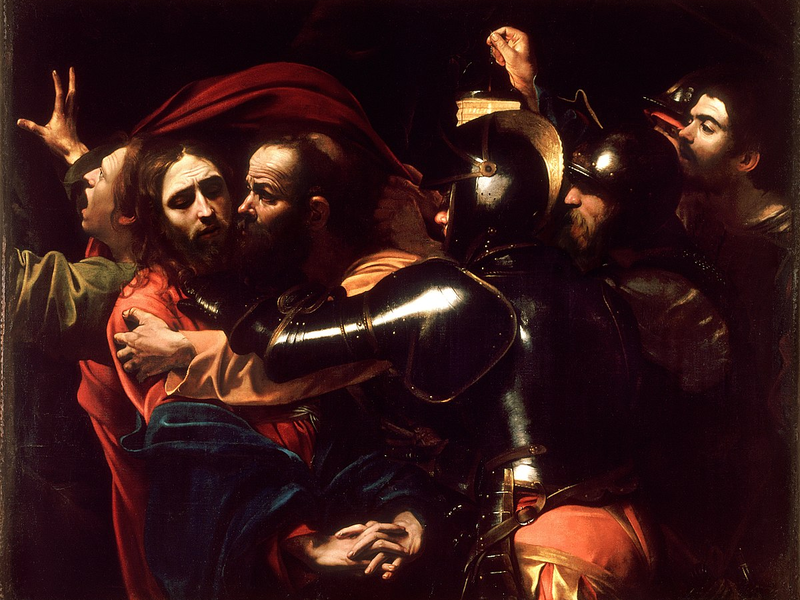
1200px-the_taking_of_christ-caravaggio_c-1602
John

Jesus, David, Adam: A Reading of John 18:1-11

John 18:1-11 appears on the surface to be a straightforward, if somewhat unusual, narrative of Jesus’ arrest by officers of the chief priests and Pharisees accompanied by an apparently large group of Roman soldiers, all of them led by the betrayer, Judas. But there is much more here than what…

by Ralph Allan SmithJuly 3, 2013

taylor-brandon-y8r0rtnriwm-unsplash
American Politics

Not So Special

Why is the US embroiled in the Middle East? There are two primary answers: Oil and Israel. Both are fairly intractable problems, the latter in significant part because of the unique convergence of theology and politics that has forged American policy in the region. Dispensationalists insist that we must bless…

by Peter LeithartJuly 1, 2013
screenshot-2023-09-20-at-11-21-06-am
Hermeneutics

Raven of the Gospel

There’s a common theme that arises in the study of theologians James B. Jordan and Peter Leithart. It is this: Context matters. Details matter. This is God’s Word. The details are not arbitrary “filler” hiding the kernel of truth in the husk of the text. The husk and the kernel…

by Troy GreeneJune 26, 2013
zoriana-stakhniv-puvghybgzn8-unsplash
Anxiety

Marriage and Betrayal

Perhaps the most fearful of all possibilities in the world is the possibility of betrayal on the part of someone who is in a “position of trust.” This, unfortunately, is the first block in what ought to be the foundation of every marriage in the world. Every woman has a…

by Richard BledsoeJune 24, 2013
markus-winkler-aid-xyrtlec-unsplash
Theopolis News

One More Week

Only one more week to register to the Trinity Term class on "How to Read the Bible," taught by James Jordan and Peter Leithart. Sign up today!

by Peter LeithartJune 24, 2013
korney-violin-b6ihcrsxnke-unsplash
Homosexuality

Reorienting our Sex Talk

The way we talk about the world matters. Our doctrine of creation tells us that words do not simply reflect reality. They also shape it and the way we inhabit it. Among the world’s many language groups, the Church is distinct. She is called to name things with Scriptural language,…

by Matthew MasonJune 19, 2013

Showing page 192 of 309

See all
See all
History

Converted Jerusalem

In his fascinating Rise of Christianity , Rodney Stark cites estimates that there were between 10,000 and 20,000 inhabitants of Jerusalem in the first century. Stark uses this to falsify Luke’s claims that there were 5000 Christians in Jerusalem (Acts 4:4) and “many thousands” of Jews (Acts 21:20): “Had there…

March 30, 2007

Hebraic hermeneutics

One Rhonda Wauhkonen discusses Nicholas of Lyra’s “Hebraic” semiotics and hermeneutics in a 1992 article on Chaucer. She begins by contrasting Augustine’s signum/res distinction to Lyra’s Hebraic viewpoint: “In the Hebrew system as evidenced in Scripture and as adapted by Nicholas, such stratification of signification did not exist, for the…

March 29, 2007

Last and first

Nicholas of Lyra is known for his notion of a “double literal” sense to Scripture. For him, interpretation ad litteram includes both the historical and the doctrinal/christological senses, and he suggests that the ancient Hebrews could well have seen the Messianic sense as the literal sense. He also suggests that…

March 29, 2007

Nicholas of Lyra’s afterlife

In Book 3 of Gargantua and Pantagruel, Rabelais attributes an odd opinion to the 14th-century exegete, Nicholas of Lyra: “Pantagruel, having wholly subdued the land of Dipsody, transported thereunto a colony of Utopians, to the number of 9,876,543,210 men, besides the women and little children, artificers of all trades, and…

March 29, 2007

Thomas on the Parable of the Workers

Steinmetz summarizes Thomas’s remarkably “NTWrightian” commentary on Matthew 20:1-16. While acknowledging an Origenist tradition that sees the hours as moments of an individual life, Thomas is more interested in the Irenaean tradition that interprets the parable in terms of redemptive history: “The hours mentioned in the parable are not stages…

March 29, 2007

Showing page 1699 of 2212

Browse by Category

In Medias Res

Your weekly digest for all things Theopolis.

Donate

Theopolis is nearly 100% donor-supported. Consider joining us on our mission.