Theopolis Logo

Writing

Explore our collection of theological essays, biblical studies, and reflections on faith and culture.

See all
kristina-flour-bcjdbykwquw-unsplash
Culture

On Foul Language

The Stranger: Do you have to use so many cuss words? The Dude: What the f*ck you talking about? - The Big Lebowski There was a man I knew, an elder at his church, who, whenever he was called upon to announce a pregnancy, preferred the euphemism “with child” because…

by Remy WilkinsJanuary 12, 2016

organ-pipes
How to Worship

Pipes Worth Playing

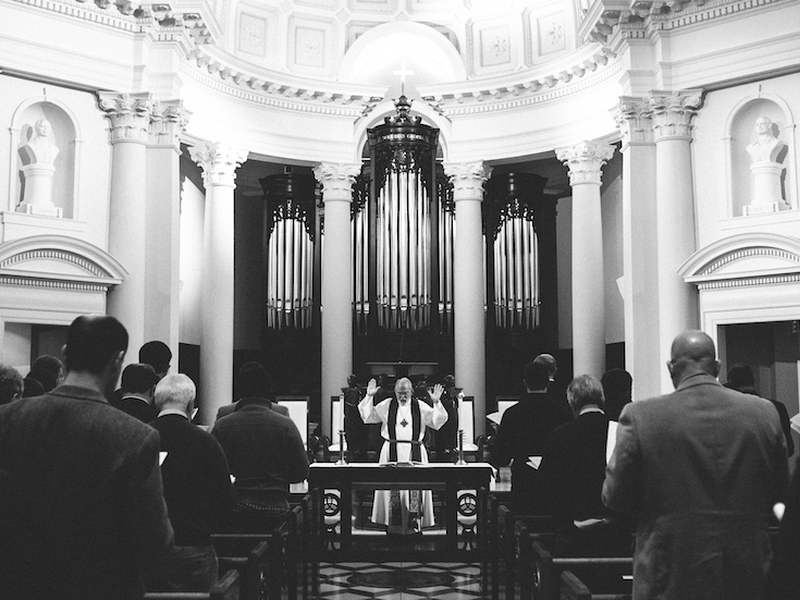
I know what you’re thinking. Organ: funeral, ball game, grand dusty cathedral. Why should modern Christians of such a technological age revisit a thousand year-old instrument? Don’t worry, I will not be trying to punch another hole in my Weird Music Preferences and Opinions card here. The truth is, our…

by Jarrod RicheyJanuary 7, 2016
tree-2
James

Do Things Have Natures?

Do things have natures? As I am posing the question, it is not simply a question of whether there are particular kinds of things in the world that have characteristic features, patterns of behavior, trajectories of growth and development. If that is what the word means, then the answer is…

by Peter LeithartJanuary 5, 2016
jim-leading-worship
Theopolis News

2016 Nevin Lectures with Father John Behr

We are excited to announce our 2016 Nevin Lectures featuring Father John Behr. Fr. John is the Dean of St. Vladimir's Seminary and Professor of Patristics, as well as the author of multiple works. He will be delivering three lectures over the course of two days dealing with "What Protestants…

by Brian MoatsJanuary 4, 2016
times-square
Creation

Time, Curse or Gift?

New Year's Day makes one reflective, at least about the past year, perhaps about life, perhaps, more broadly, about time itself. Many view time as a curse. Some see it as a curse because of missed chances. As one day or year moves on to the next, all we can…

by Peter LeithartDecember 31, 2015
nativity-2
Advent

The Manger

It seems a truism to say that we live in the world: that the world is outside of us. In reality the world is very much inside of us too. In fact the world passes through us as much as we pass through it. We breathe in its air, using…

by Arthur KayDecember 29, 2015

Showing page 138 of 309

See all
See all
Creation

Universal Harmony

I n the course of a discussion of the “harmony” of the economy of grace, the great English Puritan John Owen remarks on the incomprehensible universal harmony of creation ( Doctrine of Justification by Faith , 55) : There is a harmony, a suitableness of one thing unto another, in…

June 23, 2017
Jane Austen

Dear Jane

W e may think that Jane Austen has only recently entered pop culture consciousness. We'd be wrong. Devoney Looser's The Making of Jane Austen traces Austen's fortunes between 1833, when her novels were republished, and 1975, the bicentenary of her birth. Looser examines book illustrations, dramatizations of the plays, political…

June 23, 2017

Beatitude

A s the title suggests, Jonathan Pennington's The Sermon on the Mount and Human Flourishing sees the Sermon on the Mount as Jesus' instruction in a way of virtue and wisdom that leads to flourishing. As Pennington puts it, “Jesus provides in the Sermon a Christocentric, flourishing-oriented, kingdom-awaiting, eschatological wisdom…

June 23, 2017

Genealogy of Rights

I n The Sacredness of the Person , Hans Joas offers an “affirmative genealogy” of the notion of human rights. He traces the historical origins of the concept not, in Nietzchean fashion, to debunk, but to validate. Isolating the origins of a set of cultural values or practices need not,…

June 23, 2017

Ally of Convenience

D avid Goldman argues that Trump sent “a clear message to America’s Muslim clients in Saudi Arabia: No more double games with non-state actors will be tolerated.” The double games have been going on a long time: “Saudi royal family members are funding every radical madrassa in Asia, including those…

June 22, 2017

Sources of “Justification”

I n Paul's letters, the verb “justify” (Gr. dikaioo ) means “acquit, judge favorably,” with overtones of forgiveness and reconciliation. It has an invariably positive meaning. Paul didn't learn to use “justify” that way from ancient or contemporary Greek. As James Prothro explains in a 2016 article, outside the Septuagint…

June 21, 2017

Showing page 170 of 2212

Browse by Category

In Medias Res

Your weekly digest for all things Theopolis.

Donate

Theopolis is nearly 100% donor-supported. Consider joining us on our mission.