Theopolis Logo

Writing

Explore our collection of theological essays, biblical studies, and reflections on faith and culture.

See all
aaron-burden-h8s0pf2rcqs-unsplash
Galatians

The Restoration of the Galatians

While controversies over the writings of Paul continue in various corners of the intellectual globe, the word of God given through Paul and his scribe and all of the church’s interpreters and translators over the last two millennia is still readily available to the lofty and the lowly. Paul, as…

by Grace LangnessMarch 25, 2013

kiwihug-l4gw27xzn1i-unsplash
Deuteronomy

Law and History: How to Read the Law of Moses (Part 2)

The second in a series of studies in Deuteronomy. Deuteronomy 22:30: A man shall not take his father’s wife, and shall not uncover his father’s wing (Hebrew: kanaf ). There are a number of unusual features in this law that mark it out from the previous context, indicating that it…

by Ralph Allan SmithMarch 20, 2013
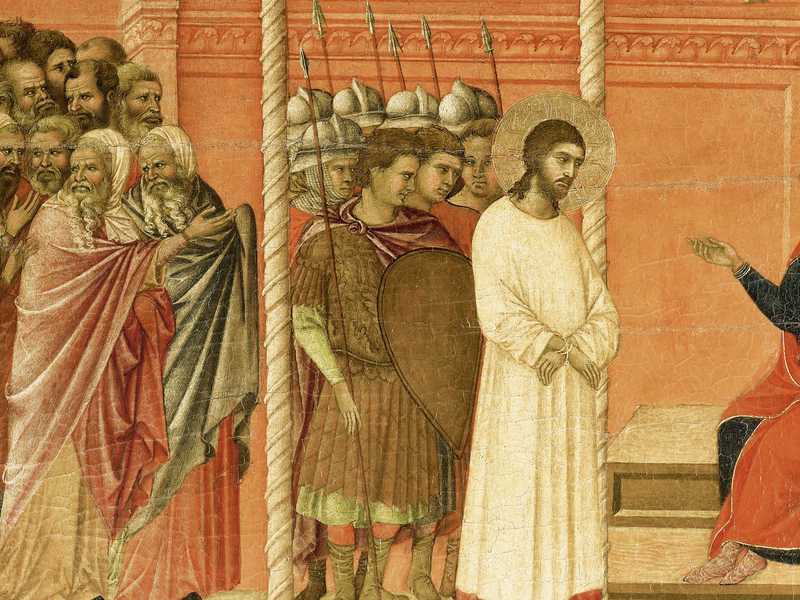
200403-moss-pilate-tease_pncfq5
History

Victimhood and the Gospel

The texts of Christianity have been slowly at work, under the power of the Holy Spirit for 2000 years now. If we could be magically transported back into the world of two millennia ago, modern Americans would be shocked at the cruelty of that world. There was no concern for…

by Richard BledsoeMarch 18, 2013
aaron-burden-1ebsmyrau-s-unsplash
Luke

The Dysfunctional Family of the Gadarene Madman

The Story of the Gadarene Madman is told in all three synoptic Gospels (Matthew 8:28-34, Mark 5:1-20, Luke 8:26-37). Jesus ventures into a Gentile area when He passes over the Sea of Galilee. Upon disembarking from his boat, he is immediately met by a demon-possessed madman. Upon meeting Jesus, he…

by Richard BledsoeMarch 13, 2013
aaron-burden-1ebsmyrau-s-unsplash
Deuteronomy

Law and History: How to Read the Law of Moses

Part 1 of a multi-part series of studies on Deuteronomy 22:30-23:8. Eric Auerbach, in his classic work on Western literature, devotes his first chapter to contrasting Homer with the Bible. Of Homer, he writes of the “need of Homeric style to leave nothing which it mentions half in darkness and…

by Ralph Allan SmithMarch 12, 2013
markus-winkler-aid-xyrtlec-unsplash
Theopolis News

James Jordan in Korea, Japan

Trinity House Fellow James B. Jordan will be a speaker at an International Conference on Biblical Symbolism that will be held in Seoul on Monday, May 27 in 2013. He will address "The Importance of Biblical Symbolism and Symbolic Interpretation of the Bible." The conference will have three other speakers…

by Peter LeithartMarch 9, 2013

Showing page 197 of 309

See all
See all

Intention and sense

Does the intention of the author determine the sense? There are problems with saying Yes, particularly when “intention” is assumed to be the mental state of the author, which is unrecoverable. There are also problems with saying No, because that seems to introduce (as ED Hirsch argues) a hermeneutical free-for-all.…

March 29, 2007

Tragic hermeneutics

In an article in Theology Today (1980), David Steinmetz quotes Benjamin’s Jowett’s essay on the interpretation of Scripture (1859), which insists on a single meaning in a text - the meaning intended by the author and understood by the original audience. Steinmetz admits that critical scholarship has moved on since…

March 29, 2007

Victorious righteousness

Dahood takes “righteous” in Psalm 118:15, 19 as “victory.” The joyful shouting is heard from the tents of the victorious, and the gates are the gates of victory. He cites Isaiah 41:2 and 49:24 as other texts where this nuance of ZDK comes to the fore. The meaning could be:…

March 29, 2007

More notes on Psalm 118

More notes, taken from or inspired by Michael Dahood’s Anchor Bible commentary. 1) Dahood makes good sense of the entire Psalm by assuming that it moves from a place of battle and victory (vv. 5-14), to the victory celebration in the tents of the war camp (vv. 15-18), and then…

March 29, 2007
Literature

Auden on Austen

With his usual critical insight, Auden captured Austen’s knowingness in a poem about Byron: You could not shock her more than she shocks me; Beside her Joyce seems innocent as grass. It makes me most uncomfortable to see An English spinster of the middle class Describe the amorous effects of…

March 28, 2007

Be the river

Gregory the Great again: “he that treats of sacred writ should follow the way of a river, for if a river, as it flows along its channel, meets with open valleys on its side, into these it immediately turns the course of its current, and when they are copiously supplised,…

March 28, 2007

Showing page 1700 of 2212

Browse by Category

In Medias Res

Your weekly digest for all things Theopolis.

Donate

Theopolis is nearly 100% donor-supported. Consider joining us on our mission.