Theopolis Logo

Writing

Explore our collection of theological essays, biblical studies, and reflections on faith and culture.

See all
screenshot-2023-07-27-at-10-25-35-am
Federal Vision

Zacharias Ursinus & the Imputation of Christ’s Righteousnes

While I think Zacharias Ursinus’ thinking would be profitable to consider, I am not recording his reflections in order for readers to come to agreement with his position as a whole. Rather, my interest is twofold. First, I think the way the Heidelberg Catechisms is used as a “proof” of…

by Mark HorneJune 5, 2006

karsten-wurth-imegmbunara-unsplash
Covenant

Does the New Covenant have its own distinctive sanctions as well as blessings? We affirm

On this question Hebrews 10 is quite clear and really needs no additional argument. For if we go on sinning deliberately after receiving the knowledge of the truth, there no longer remains a sacrifice for sins, but a fearful expectation of judgment, and a fury of fire that will consume…

by Mark HorneMay 21, 2006
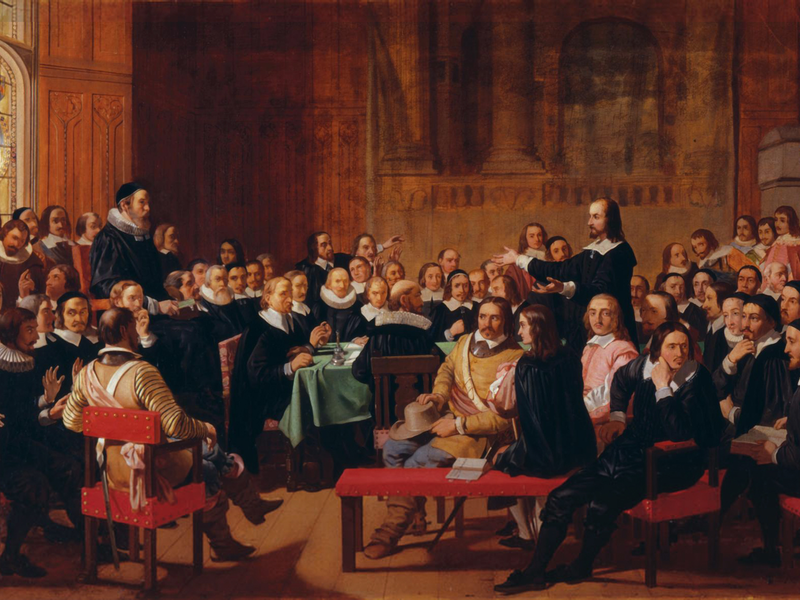
assertion_of_liberty_of_conscience_by_the_independents_of_the_westminster_assembly_of_divines_1644
Biblical Horizons

FV, NPP, PCA, AAPC, ETC.

Not all readers of this essay letter may be aware of it, but a tempest has been brewing in the Presbyterian Church in America (PCA), a tempest created by the liberal party in that denomination. It came about this way. In January 2002, a Pastor’s Conference on covenant theology was…

by James B. JordanAugust 5, 2005
screenshot-2023-09-18-at-12-32-26-pm
Biblical Horizons

The Closing of the Calvinistic Mind

Once upon a time there was such a thing as Calvinistic thought. It existed when I was younger, but seems to have largely disappeared in recent years. But let me elaborate. When I became a Calvinist, back in 1970, I bought a bunch of books. Over the next few years,…

by James B. JordanAugust 5, 2005
kelly-sikkema-ggs0_g6wi-i-unsplash
Ephesians

The Centrality of Preaching

CHRIST THE PREACHER How Ephesians Shows Us Why Preaching is Essential to Salvation & Sanctification Listen to me, O coastlands, and give attention, you peoples from afar. The Lord called me from the womb, from the body of my mother he named my name. He made my mouth like a…

by Mark HorneJune 5, 2005
screenshot-2024-04-04-at-4-49-39-pm
Baptism

Baptismal Theology Within Reformed Evangelicalism

Tracking the informal shifts in Protestant opinion regarding Baptism can be a difficult business. For example, in 1849 Anglican clergyman William Goode published his defense of Evangelicalism against the Anglo-Catholics under the title, The Doctrine of the Church of England as to the Effects of Baptism in the Case of…

by Mark HorneMay 29, 2005

Showing page 221 of 309

See all
See all

By the Spirit

Paul says that one can only say “Jesus is Lord” by the Spirit (1 Corinthians 12:3). He adds later in the same chapter that we are incorporated into the body, the one-and-many body of the visible church, by “one Spirit” (12:13). Surely Paul exaggerates. Anybody can say Jesus is Lord.…

February 22, 2007

Righteousness by faith

ERH sees faith not as a “religious” issue but as one of the driving forces of history. All revolutions begin in faith, and the faith that drives historical change is a faith that is reckoned as justice: “Faith is a belief in things unseen; it goes against hope, it defies…

February 22, 2007
History

American Revolution

Was the American Revolution a Revolution? ERH concludes it was a “half-revolution” rather than a total revolution on the scale of the Russian, French, Puritan, Reformation, and Papal revolutions. Evaluating the revolutionary character of the American Revolution rests partly on the question of what “revolution” meant to the participants. ERH…

February 22, 2007

Liturgical uniformity

To outsiders, the Roman Catholic church appears to have a uniform liturgical tradition, of long standing. Rosenstock-Huessy points out that the uniformity of the Mass is a rather late development. During the 19th century, “the movement of Solesmes united all the churches of the Catholic world by introducing the Roman…

February 22, 2007

Receiving brothers

Within two verses, John accuses Diotrephes of refusing to “receive us” and refusing to “receive the brethren” (3 John 9-10). The first refers to an acknowledgement of authority; receiving “us,” the elder and his co-workers, would mean listening and obeying. The second refers to hospitality; receiving the brothers means welcoming…

February 22, 2007

In manner of God

John commends Gaius not only for receiving traveling brothers but for sending them on their way “in a manner worthy of God” (3 John 6). What does this mean? Stott is certainly right to say that they are to be treated as servants of God. But John’s language is more…

February 22, 2007

Showing page 1713 of 2212

Browse by Category

In Medias Res

Your weekly digest for all things Theopolis.

Donate

Theopolis is nearly 100% donor-supported. Consider joining us on our mission.