Theopolis Logo

Writing

Explore our collection of theological essays, biblical studies, and reflections on faith and culture.

See all
denise-jans-dpemksg59la-unsplash
Art

Glorifications Versus Debasement

Because of sin, the arts sometimes do not serve to glorify but to debase. Sinful men make their environments ugly, and create ugly art to “enhance” their ugly words. But since all men are still God’s images, no men are able to live with such ugliness all the time. Thus,…

by James B. JordanMay 25, 1994

jeremy-yap-j39x2xx_8cq-unsplash
Art

Words and Glory

Arts and literature reviews in most evangelical Christian publications generally approach their subjects in terms of ideology. We are told whether or not the film or book is acceptable in terms of morals, sexual graphicness, and theological accuracy. While there is definitely a place for such reviews, I fear that…

by James B. JordanMay 25, 1994

screen-shot-2018-04-12-at-9-48-08-am
Biblical Horizons

Broadening Our View of the Trinity

We speak of God as Father, Son, and Holy Spirit. The early Church tended to speak of Him as Father, Word, and Spirit. In this short essay, I want to suggest some other ways to think of the Trinity, ways that I have found pastorally helpful in my own life…

by James B. JordanMay 5, 1994
Biblical Studies

Thousands of Generations

I, Yahweh your God, am a jealous God, visiting the iniquity of the fathers on the children, on the third and fourth of those who hate Me, but showing lovingkindness to thousands, to those who love Me and guard My commandments (Ex. 20:5-6). The Second Word forbids acts of ceremonial…

by James B. JordanMay 5, 1994
ben-white-w8qqn1pmqh0-unsplash
Biblical Chronology

The Chronology of the Pentateuch (Part 3)

8. The Table of Nations If we assume births every two years, and about 30 years between generations (cp. Gen. 11:12-24), we can come up with an approximate series of dates for the generations recorded in Genesis 10. We shall assume that all three of Noah’s sons had their firstborn…

by James B. JordanMay 5, 1994
49980-nicolas_poussin_-_the_judgment_of_solomon_-_wga18330-800w-tn
Biblical Studies

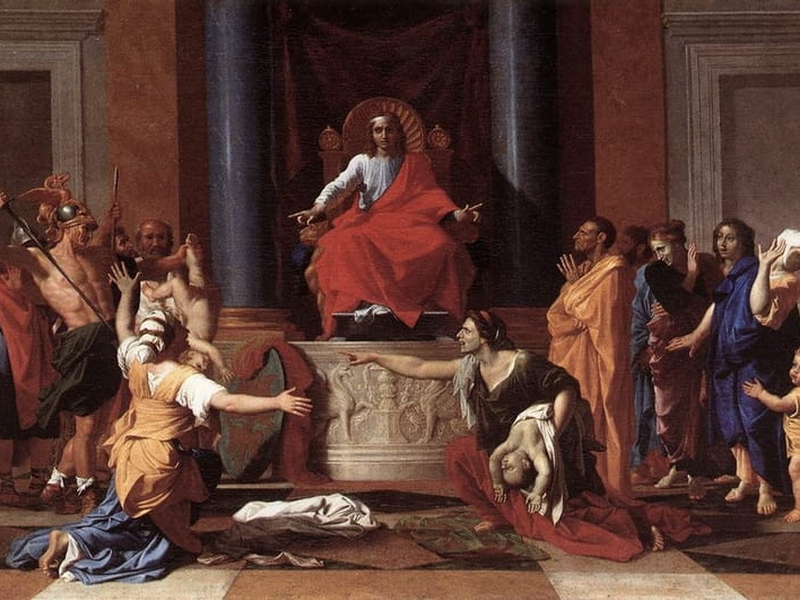
The Eighth Month

Zechariah’s first prophecy (Zech. 1:1-6) was delivered in the eighth month of the second year of Darius. The notation of this date serves a number of purposes. Most obviously, it relates Zechariah’s prophecies to those of Haggai. By the time Zechariah delivered his first prophecy, Haggai had already chided the…

by Peter LeithartApril 23, 1994

Showing page 279 of 309

See all
See all
Philosophy

Giving and receiving

Pickstock offers a theological alternative to Derrida’s concern that giving is impossible since any hope of a return robs the gift of its character as gift and puts it instead into the category of mutually advantageous capitalist exchange. Pickstock points out that in renouncing “the return” as “an ethical category,”…

July 14, 2005
Philosophy

Lists

Pickstock uses the “list” as a crucial example of the dominance of asyndeton of modern discourse. Lists provide “a powerful organization of random phenomena,” but at the same time the order slips into chaos because there is nothing linking the “unrelated elements” of the list. They are merely juxtaposed spatially,…

July 14, 2005
Philosophy

Derrida’s indifference

Pickstock again: For Derrida, there is ultimately no real difference, since all difference is univocally violent. There are particular differences of this and that, but they are all different in the same way - violently different - so there is a “transcendent” sameness. Derrida’s absolute difference collapses is really penultimate…

July 14, 2005
Philosophy

Derrida’s indifference

Pickstock again: For Derrida, there is ultimately no real difference, since all difference is univocally violent. There are particular differences of this and that, but they are all different in the same way - violently different - so there is a “transcendent” sameness. Derrida’s absolute difference collapses is really penultimate…

July 14, 2005
Theology

Socrates and the erotic gaze

Catherine Pickstock argues that Socrates does not articulate a “metaphysical” view of self-presence or interiority. She focuses on the erotic character of knowledge in the Phaedrus, which she points out, radically undermines the interior/exterior boundary. Knowledge on this view always involves ecstasy, an attraction to an object outside, and the…

July 14, 2005

Structure in 2 Kings 16

2 Kings 16 is organized chiastically: 1. Formulaic introduction, 16:1-4 2. Threat to Jerusalem, and bribe of Tiglath-pileser, 16:5-9 3. State visit to Damascus, 16:10-11 (altar) 4. Ahaz ministers at the altar, 16:12-14 3’. Continuing worship at the altar, 16:15-16 2’. Tribute to Tiglath-pileser and plunder of temple, 16:17-18 1’.…

July 13, 2005

Showing page 1962 of 2212

Browse by Category

In Medias Res

Your weekly digest for all things Theopolis.

Donate

Theopolis is nearly 100% donor-supported. Consider joining us on our mission.