Theopolis Logo

Writing

Explore our collection of theological essays, biblical studies, and reflections on faith and culture.

See all
denise-jans-dpemksg59la-unsplash
Art

Glorifications Versus Debasement

Because of sin, the arts sometimes do not serve to glorify but to debase. Sinful men make their environments ugly, and create ugly art to “enhance” their ugly words. But since all men are still God’s images, no men are able to live with such ugliness all the time. Thus,…

by James B. JordanMay 25, 1994

jeremy-yap-j39x2xx_8cq-unsplash
Art

Words and Glory

Arts and literature reviews in most evangelical Christian publications generally approach their subjects in terms of ideology. We are told whether or not the film or book is acceptable in terms of morals, sexual graphicness, and theological accuracy. While there is definitely a place for such reviews, I fear that…

by James B. JordanMay 25, 1994

screen-shot-2018-04-12-at-9-48-08-am
Biblical Horizons

Broadening Our View of the Trinity

We speak of God as Father, Son, and Holy Spirit. The early Church tended to speak of Him as Father, Word, and Spirit. In this short essay, I want to suggest some other ways to think of the Trinity, ways that I have found pastorally helpful in my own life…

by James B. JordanMay 5, 1994
Biblical Studies

Thousands of Generations

I, Yahweh your God, am a jealous God, visiting the iniquity of the fathers on the children, on the third and fourth of those who hate Me, but showing lovingkindness to thousands, to those who love Me and guard My commandments (Ex. 20:5-6). The Second Word forbids acts of ceremonial…

by James B. JordanMay 5, 1994
ben-white-w8qqn1pmqh0-unsplash
Biblical Chronology

The Chronology of the Pentateuch (Part 3)

8. The Table of Nations If we assume births every two years, and about 30 years between generations (cp. Gen. 11:12-24), we can come up with an approximate series of dates for the generations recorded in Genesis 10. We shall assume that all three of Noah’s sons had their firstborn…

by James B. JordanMay 5, 1994
49980-nicolas_poussin_-_the_judgment_of_solomon_-_wga18330-800w-tn
Biblical Studies

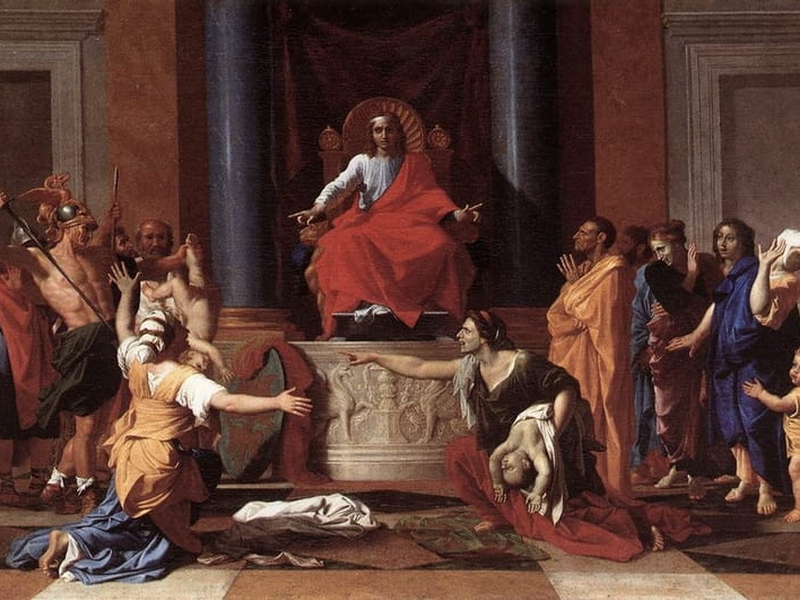
The Eighth Month

Zechariah’s first prophecy (Zech. 1:1-6) was delivered in the eighth month of the second year of Darius. The notation of this date serves a number of purposes. Most obviously, it relates Zechariah’s prophecies to those of Haggai. By the time Zechariah delivered his first prophecy, Haggai had already chided the…

by Peter LeithartApril 23, 1994

Showing page 279 of 309

See all
See all

Decolonized World

I n their just-released Decolonization: A Short History , Jan Jansen and Jurgen Osterhammel observe that decolonization not only remade the maps of former colonies, but also involved the “Europeanization of Europe” and produced changes in political norms and expectations. “Decolonization,” they write “led to ‘Europe falling back on itself,'…

January 13, 2017

Caldwell on America's Fighting Faith

Christopher Caldwell's review of Walter McDougall's The Tragedy of U.S. Foreign Policy is sooo good. McDougall explains (as his subtitle has it) “How America's Civil Religion Betrayed the National Interest.” That betrayal arises from several sources. One is the vagueness of American civil religion, which means, Caldwell says, that it…

January 13, 2017

Eucharistic Sacrifice

T he joint Lutheran-Catholic reflection on the Reformation, From Conflict to Communion , acknowledges that medieval Catholicism was muddled on Eucharistic sacrifice. As a result of a “loss of an integrative concept of commemoration, Catholics were faced with the difficulty of the lack of adequate categories with which to express…

January 12, 2017

Iustus et Peccator?

F rom Conflict to Communion , the Lutheran-Catholic commemoration of the 500th anniversary of the Reformation, offers a summary of Luther's theology, particularly on the points of dispute between Catholics and Lutherans. They offer the following summary of Luther's claim that believers remain simul iustus et peccator , simultaneously just…

January 12, 2017

David's Ammonite War

1 Chronicles 18–20 record David's wars with immediate neighbors of Israel. The chapters are organized chiastically: A. War with Philistia and Moab, 18:1 B. War with Ammon, Aram, and Edom, 18:2-13 C. David reigns with justice and righteousness, 18:14-17 B'. War with Ammon and Aram, 19:1-20:3 A'. War with Philistia,…

January 11, 2017

The Geography of David's Conquest

1 Chronicles 18–20 brings together David's conquests into a neatly packaged unit. (In Samuel, the same wars are scattered over several chapters.) By the end of chapter 20, David has established control over greater Israel, the ideal kingdom promised to Abraham (Genesis 15), stretching from the Euphrates (18:4) to the…

January 10, 2017

Showing page 218 of 2212

Browse by Category

In Medias Res

Your weekly digest for all things Theopolis.

Donate

Theopolis is nearly 100% donor-supported. Consider joining us on our mission.