Theopolis Logo

Writing

Explore our collection of theological essays, biblical studies, and reflections on faith and culture.

See all
denise-jans-dpemksg59la-unsplash
Art

Glorifications Versus Debasement

Because of sin, the arts sometimes do not serve to glorify but to debase. Sinful men make their environments ugly, and create ugly art to “enhance” their ugly words. But since all men are still God’s images, no men are able to live with such ugliness all the time. Thus,…

by James B. JordanMay 25, 1994

jeremy-yap-j39x2xx_8cq-unsplash
Art

Words and Glory

Arts and literature reviews in most evangelical Christian publications generally approach their subjects in terms of ideology. We are told whether or not the film or book is acceptable in terms of morals, sexual graphicness, and theological accuracy. While there is definitely a place for such reviews, I fear that…

by James B. JordanMay 25, 1994

screen-shot-2018-04-12-at-9-48-08-am
Biblical Horizons

Broadening Our View of the Trinity

We speak of God as Father, Son, and Holy Spirit. The early Church tended to speak of Him as Father, Word, and Spirit. In this short essay, I want to suggest some other ways to think of the Trinity, ways that I have found pastorally helpful in my own life…

by James B. JordanMay 5, 1994
Biblical Studies

Thousands of Generations

I, Yahweh your God, am a jealous God, visiting the iniquity of the fathers on the children, on the third and fourth of those who hate Me, but showing lovingkindness to thousands, to those who love Me and guard My commandments (Ex. 20:5-6). The Second Word forbids acts of ceremonial…

by James B. JordanMay 5, 1994
ben-white-w8qqn1pmqh0-unsplash
Biblical Chronology

The Chronology of the Pentateuch (Part 3)

8. The Table of Nations If we assume births every two years, and about 30 years between generations (cp. Gen. 11:12-24), we can come up with an approximate series of dates for the generations recorded in Genesis 10. We shall assume that all three of Noah’s sons had their firstborn…

by James B. JordanMay 5, 1994
49980-nicolas_poussin_-_the_judgment_of_solomon_-_wga18330-800w-tn
Biblical Studies

The Eighth Month

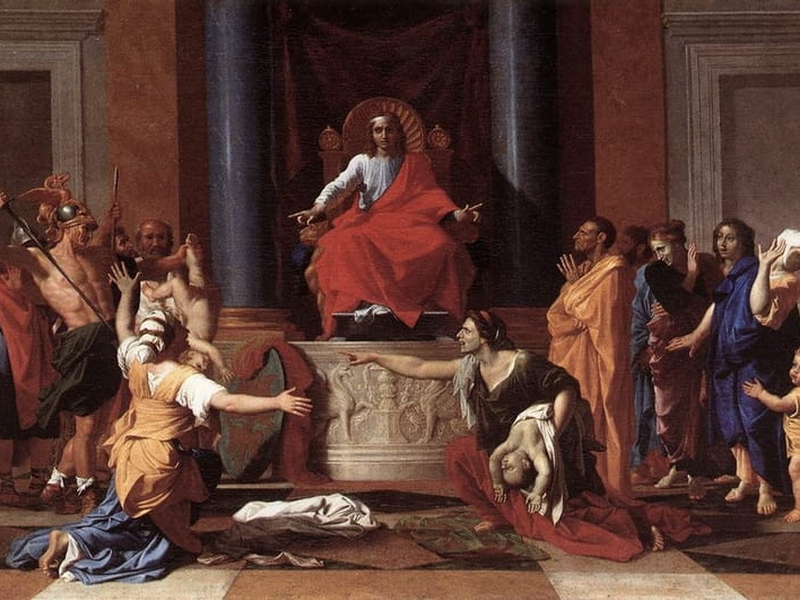
Zechariah’s first prophecy (Zech. 1:1-6) was delivered in the eighth month of the second year of Darius. The notation of this date serves a number of purposes. Most obviously, it relates Zechariah’s prophecies to those of Haggai. By the time Zechariah delivered his first prophecy, Haggai had already chided the…

by Peter LeithartApril 23, 1994

Showing page 279 of 309

See all
See all

Logic of Impurity

It's an inventive solution. In an essay on the Logic of Impurity , David Kraemer argues, counterintuitively, that impurity marks something as God's possession. He argues from the strange anomalies associated with corpse defilement and its cleansing: “The human corpse is, according to the Torah, the most powerful source of…

March 23, 2016
Easter

Through the Darkness

Holy Week is a passage through darkness, as we commemorate the betrayal, arrest, trial, and crucifixion of Jesus. But Holy Week doesn't end on the cross. Easter dispels the darkness. Good Friday followed by Easter means that darkness and death no longer mark an end, but mark a beginning. It…

March 22, 2016

Erotic Politics

Paul Ludwig ( Eros and Polis ) observes that “A recurrent feature of ancient Greek political discourse was the assertion that erotic passion was a causal factor in the emergence and maintenance, as well as the decline, of the Greek polis.” But this didn't make the Greek proto-Foucauldians: “the term…

March 22, 2016

Dreamworks

Kelley Bulkeley's Big Dreams is about the big subject of religion, examined from the perspective of our dreaming. He begins with the simple, well-known observation that most of our dreams are quickly forgotten, while “a few are highly memorable.” Any account of dreaming should try to account for this. Taking…

March 22, 2016

Paul Provoked

As Paul strolls through Athens, what impresses him is not the architecture, culture, or art. He sees that the city is full of idols, and he is provoked in spirit (Acts 17:16). That provokes a few reflections. What did Paul see that others in Athens did not see? What would…

March 21, 2016

Crowds

Gustave Le Bon's The Crowd was first published in 1895. It reads like something taken from today's headlines about the crowds generated by Donald Trump's campaign. Le Bon argued that a crowd involved the “disappearance of conscious personality and the turning of feelings and thoughts in a definite direction, which…

March 21, 2016

Showing page 308 of 2212

Browse by Category

In Medias Res

Your weekly digest for all things Theopolis.

Donate

Theopolis is nearly 100% donor-supported. Consider joining us on our mission.