Theopolis Logo

Writing

Explore our collection of theological essays, biblical studies, and reflections on faith and culture.

See all
timothy-eberly-djj49s6ud2o-unsplash
Leviticus

Yahweh's War Against Death

Stories, frankly all human stories are practically always about one thing aren’t they? Death. The inevitability of death. . . . “There is no such thing as a natural death. Nothing that happens to man is ever natural, since his presence calls the whole world into question. All men must…

by Brian MarrApril 14, 2014

screenshot-2023-09-21-at-4-52-42-pm
Matthew

Inescapable Blood

Matthew is organized around 5 discourses, which trace out the history of Jesus as a recapitulation of the history of God and Israel in the Old Testament. Jesus first speaks as a new Moses, instructing His disciples on a mountain about a righteousness that surpasses the righteousness of the scribes…

by Peter LeithartApril 10, 2014
screen-shot-2022-05-12-at-12-07-23-pm
Angels

Did Angels Marry People? The Sin of Cultural Intermarriage

The fall of the Sethites in Genesis 6 is the third fall of mankind, or the third degree of Adam’s original fall. Adam sinned in a Garden against his Father by stealing something he was supposed to wait to obtain. (“Every tree shall be food for you” Genesis 1:29.) Cain…

by James B. JordanApril 7, 2014
sixteen-miles-out-al48tflf4e8-unsplash
Angels

Did Angels Marry People? The Sons of God in Genesis 6

The recent fantasy film Noah and a slightly related blog comment by my friend Douglas Wilson have stirred up again the question of whether the “sons of God” in Genesis 6 who married the “daughters of men” were fallen angels or the priestly line of Seth. Doug argues for angels,…

by James B. JordanApril 4, 2014
kiwihug-l4gw27xzn1i-unsplash
Angels

The Angels of Jude

The prophecy of Jude concerns apostasy. An illustration of apostasy and its consequences is found in verse 6, which the New American Standard Bible translates this way: "And angels who did not keep their own domain, but abandoned their proper abode, He has kept in eternal bonds under darkness for…

by James B. JordanApril 3, 2014
screenshot-2023-09-21-at-4-22-42-pm
Matthew

Women at the Cross

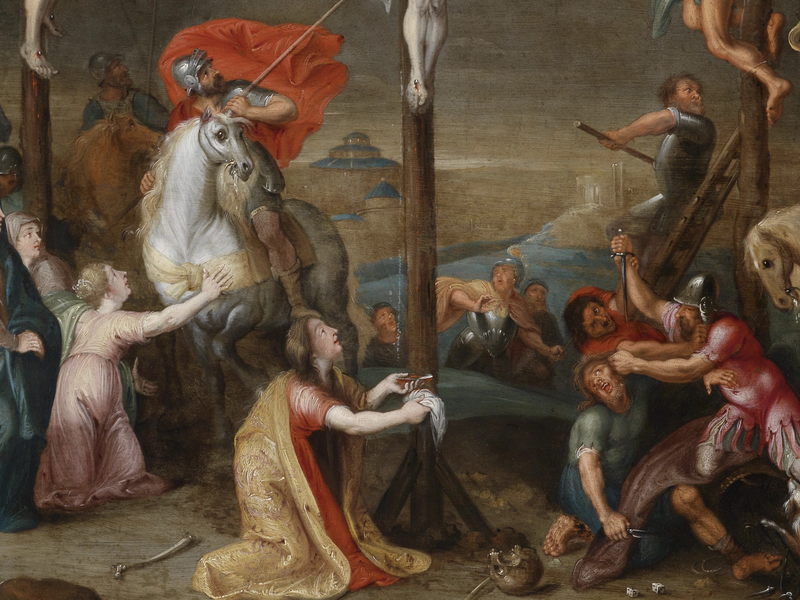
At His death, Jesus is surrounded by a Roman centurion and his cohort of Gentile solders. Matthew doesn't say that any disciples are there. But women are, and so is Joseph of Arimathea, identified as a “disciple” but, as John tells us, a “secret disciple for fear of the Jews,”…

by Peter LeithartMarch 31, 2014

Showing page 176 of 309

See all
See all
Uncategorized

Not Monolithic

Many Protestants still think of the Catholic church as a monolithic, uniform church. It’s been a long time since Catholics have thought of the church that way. Aloys Grillmeier sums up the results of Vatican II’s embrace of communio ecclesiology: “catholicity is understood as a union of opposites. The people…

May 24, 2014

What Science Cannot Know

Nicholas Rescher argues in Unknowability that there are certain things that logically cannot be known, such as “an idea that will never occur to any human being.” Prominent among unknowables are the unknowables of science. Given the way scientific research and discovery work, it is impossible for present science to…

May 24, 2014

Can the Dead Praise?

Heaven, earth, sea: That three-decker universe is standard-issue in biblical cosmology (Exodus 20:11; Psalm 69:34; 96:11; 135:6; 146:6; Revelation 10:6). Occasionally a second heaven is added to the scheme (Nehemiah 9:6). But when the Lamb ascends to take the book, praise arises from four dimensions of creation: heaven, earth, under…

May 23, 2014

Semper, ubique, ab omnibus?

Thomas Guarino ( Vincent of Lerins ) outlines Newman’s arguments against the Vincentian canon (orthodoxy is what is taught always, everywhere, by everyone). In his Essay on Development , Newman provides historical examples “to demonstrate that the first rule is, at beast, a leaky and dubious criterion. As Newman boldly…

May 23, 2014
Uncategorized

Fresh Logic

In his preface to Receptive Ecumenism , Paul Murray explains that the “driving assumption is that if all were to be asking and acting upon this question, even relatively independently of each other, then all would be moving, albeit somewhat unpredictably, and in such a fashion as might open up…

May 23, 2014

Receptive Ecumenism in Practice

As Avery Dulles recounts it in The Catholicity of the Church , the reforms of Vatican II came partly from what Paul Murray calls “ receptive ecumenism ,” an ecumenism of attentive listening to the other. Dulles wasn’t exactly a receptive ecumenist himself. While acknowledging that “the Church can certainly…

May 23, 2014

Showing page 603 of 2212

Browse by Category

In Medias Res

Your weekly digest for all things Theopolis.

Donate

Theopolis is nearly 100% donor-supported. Consider joining us on our mission.