Theopolis Logo

Writing

Explore our collection of theological essays, biblical studies, and reflections on faith and culture.

See all
denise-jans-dpemksg59la-unsplash
Art

Glorifications Versus Debasement

Because of sin, the arts sometimes do not serve to glorify but to debase. Sinful men make their environments ugly, and create ugly art to “enhance” their ugly words. But since all men are still God’s images, no men are able to live with such ugliness all the time. Thus,…

by James B. JordanMay 25, 1994

jeremy-yap-j39x2xx_8cq-unsplash
Art

Words and Glory

Arts and literature reviews in most evangelical Christian publications generally approach their subjects in terms of ideology. We are told whether or not the film or book is acceptable in terms of morals, sexual graphicness, and theological accuracy. While there is definitely a place for such reviews, I fear that…

by James B. JordanMay 25, 1994

screen-shot-2018-04-12-at-9-48-08-am
Biblical Horizons

Broadening Our View of the Trinity

We speak of God as Father, Son, and Holy Spirit. The early Church tended to speak of Him as Father, Word, and Spirit. In this short essay, I want to suggest some other ways to think of the Trinity, ways that I have found pastorally helpful in my own life…

by James B. JordanMay 5, 1994
Biblical Studies

Thousands of Generations

I, Yahweh your God, am a jealous God, visiting the iniquity of the fathers on the children, on the third and fourth of those who hate Me, but showing lovingkindness to thousands, to those who love Me and guard My commandments (Ex. 20:5-6). The Second Word forbids acts of ceremonial…

by James B. JordanMay 5, 1994
ben-white-w8qqn1pmqh0-unsplash
Biblical Chronology

The Chronology of the Pentateuch (Part 3)

8. The Table of Nations If we assume births every two years, and about 30 years between generations (cp. Gen. 11:12-24), we can come up with an approximate series of dates for the generations recorded in Genesis 10. We shall assume that all three of Noah’s sons had their firstborn…

by James B. JordanMay 5, 1994
49980-nicolas_poussin_-_the_judgment_of_solomon_-_wga18330-800w-tn
Biblical Studies

The Eighth Month

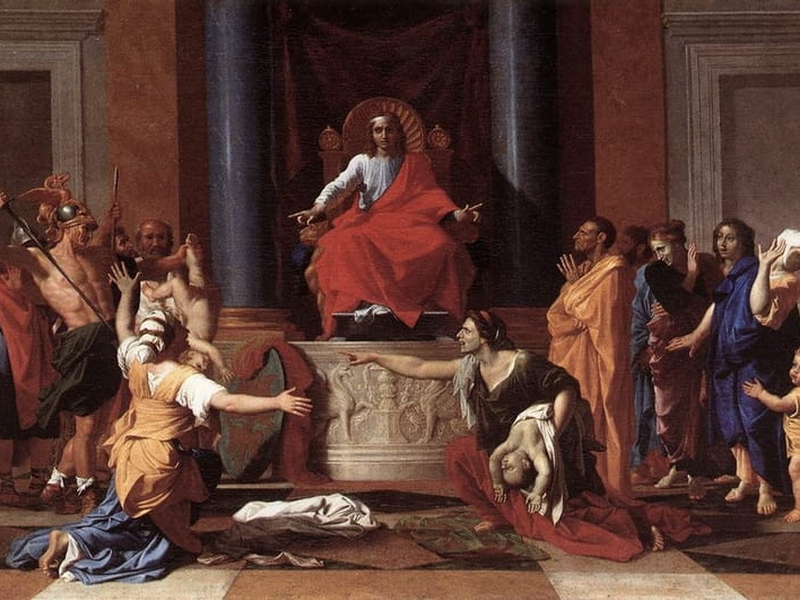
Zechariah’s first prophecy (Zech. 1:1-6) was delivered in the eighth month of the second year of Darius. The notation of this date serves a number of purposes. Most obviously, it relates Zechariah’s prophecies to those of Haggai. By the time Zechariah delivered his first prophecy, Haggai had already chided the…

by Peter LeithartApril 23, 1994

Showing page 279 of 309

See all
See all

Typical Beauty

Ruskin's concept of "typical beauty" is a piece of theological aesthetics. In the second volume of Modern Painters , Ruskin distinguished kinds of beauty, the typical and the vital. Of the first, he says: "that external quality of bodies already so often spoken of, and which, whether it occur in…

July 26, 2018

Of Subject and Objects

In the third volume of Modern Painters , Ruskin addresses the "German dulness, and English affectation" that has "multiplied among us the use of two of the most objectionable words that were ever coined by the troublesomeness of metaphysicians,—namely, 'Objective,' and 'Subjective.'" The words are "exquisitely . . . useless"…

July 25, 2018

Hopkins and Typology

George Landow argues ( Victorian Types, Victorian Shadows ) that the poetry of Gerald Manley Hopkins would look less bizarre, though no less innovative, if we placed Hopkins more firmly in the poetics of his time. Which is to say, placed him in the context of a typological poetics. Hopkins's…

July 24, 2018

Architecture of Sacrifice

Architecture, Ruskin claims ( Seven Lamps of Architecture ), isn’t the same as building. Architecture refers to the specifically artistic features of a building, and the specifically artistic features have to do with adornment and not function: “Architecture concerns itself only with those characters of an edifice which are above…

July 23, 2018

Types of Color

John Ruskin was the main art critic of his time; he was an artists himself, and also wrote on a variety of other topics, especially on the state of English politics and economy. He abandoned explicit attachment to Evangelical Christianity but remained deeply indebted. He provides an excellent example of…

July 19, 2018

The Typological Imagination

Typological forms of thought weren't confined to sermons and commentaries, but made their way into 19 th -century English poetry. -Some poets put typology to orthodox uses, though here we can see divergent deployments of a similar typology. Elizabeth Barrett Browning wrote a poem, Casa Guidi Windows (1851) about the…

July 18, 2018

Showing page 64 of 2212

Browse by Category

In Medias Res

Your weekly digest for all things Theopolis.

Donate

Theopolis is nearly 100% donor-supported. Consider joining us on our mission.