Theopolis Logo

Writing

Explore our collection of theological essays, biblical studies, and reflections on faith and culture.

See all
aaron-burden-h8s0pf2rcqs-unsplash
Galatians

The Restoration of the Galatians

While controversies over the writings of Paul continue in various corners of the intellectual globe, the word of God given through Paul and his scribe and all of the church’s interpreters and translators over the last two millennia is still readily available to the lofty and the lowly. Paul, as…

by Grace LangnessMarch 25, 2013

kiwihug-l4gw27xzn1i-unsplash
Deuteronomy

Law and History: How to Read the Law of Moses (Part 2)

The second in a series of studies in Deuteronomy. Deuteronomy 22:30: A man shall not take his father’s wife, and shall not uncover his father’s wing (Hebrew: kanaf ). There are a number of unusual features in this law that mark it out from the previous context, indicating that it…

by Ralph Allan SmithMarch 20, 2013
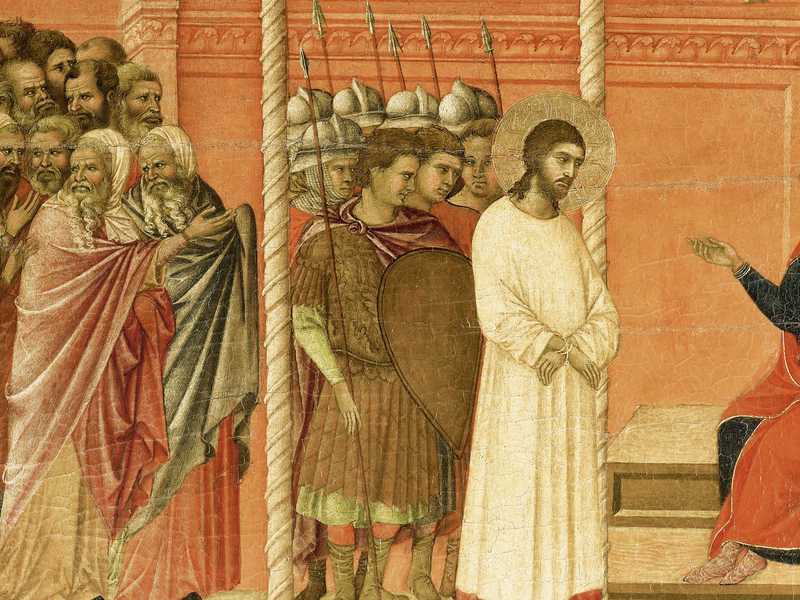
200403-moss-pilate-tease_pncfq5
History

Victimhood and the Gospel

The texts of Christianity have been slowly at work, under the power of the Holy Spirit for 2000 years now. If we could be magically transported back into the world of two millennia ago, modern Americans would be shocked at the cruelty of that world. There was no concern for…

by Richard BledsoeMarch 18, 2013
aaron-burden-1ebsmyrau-s-unsplash
Luke

The Dysfunctional Family of the Gadarene Madman

The Story of the Gadarene Madman is told in all three synoptic Gospels (Matthew 8:28-34, Mark 5:1-20, Luke 8:26-37). Jesus ventures into a Gentile area when He passes over the Sea of Galilee. Upon disembarking from his boat, he is immediately met by a demon-possessed madman. Upon meeting Jesus, he…

by Richard BledsoeMarch 13, 2013
aaron-burden-1ebsmyrau-s-unsplash
Deuteronomy

Law and History: How to Read the Law of Moses

Part 1 of a multi-part series of studies on Deuteronomy 22:30-23:8. Eric Auerbach, in his classic work on Western literature, devotes his first chapter to contrasting Homer with the Bible. Of Homer, he writes of the “need of Homeric style to leave nothing which it mentions half in darkness and…

by Ralph Allan SmithMarch 12, 2013
markus-winkler-aid-xyrtlec-unsplash
Theopolis News

James Jordan in Korea, Japan

Trinity House Fellow James B. Jordan will be a speaker at an International Conference on Biblical Symbolism that will be held in Seoul on Monday, May 27 in 2013. He will address "The Importance of Biblical Symbolism and Symbolic Interpretation of the Bible." The conference will have three other speakers…

by Peter LeithartMarch 9, 2013

Showing page 197 of 309

See all
See all

Adorned with Gentiles

Isaiah 49 is reassurance to Zion that Yahweh has not forgotten her. Her walls are continuously ( tamid ) before Yahweh, like the sacrifices and showbread (v. 16). And Yahweh goes beyond the assurance of His concern to promise that Zion will be surrounded by gathered people, returned exiles and…

November 2, 2012

Euphony in Isaiah 49

The Hebrew of Isaiah 49:17 is beautifully symmetrical. Transliterated, it reads: miharu banayik meharsayik umacharivayik mimmek yetze’u . The endings of the six words form a neat pattern: one - u followed by four words ending with the second person singular pronomial suffix ( k ), and then another -…

November 2, 2012

Wombs

The Hebrew word beten frequently means “womb” (Genesis 25:23; Number 5:22; Psalm 22:9-10; 71:6; Jeremiah 1:5). In a few instances, though, the word is used in unusual contexts. When Yahweh offers Ezekiel a scroll to eat, He orders him to eat it with his beten and to fill his “bowels”…

November 1, 2012

God Needs Nothing

God has no needs. Philo, Seneca, and classic Christian theology agree on that. But I think the explanation differs. Seneca ( On Benefits (The Complete Works of Lucius Annaeus Seneca) , bk. 4) explains that “God bestows upon us very many and very great benefits, with no thought of any…

November 1, 2012
History

Plagues and purity

The Christian conviction that Jesus had defeated the powers and brought an end to old rites had major effects on early Christian social engagement, Gary Ferngren implies in his 2009 Medicine and Health Care in Early Christianity . “Before the advent of Christianity,” he says, “there was no concept of…

November 1, 2012
Literature

Joyce, Synopticist

For all its reputation for iconoclasm, modernism, says Robert Alter in Canon and Creativity: Modern Writing and the Authority of Scripture (The Franz Rosenzweig Lecture Series) , is more accurately described as a “paradoxical amalgam of iconoclasm and hypertraditionalism” (p. 8). Alter’s book explores this phenomenon, along with the “double…

November 1, 2012

Showing page 854 of 2212

Browse by Category

In Medias Res

Your weekly digest for all things Theopolis.

Donate

Theopolis is nearly 100% donor-supported. Consider joining us on our mission.