Theopolis Logo

Writing

Explore our collection of theological essays, biblical studies, and reflections on faith and culture.

See all
johann-siemens-epy0gbjzzzu-unsplash
Apologetics

A Sabbath Conversation: How Old is the Earth?

As Adam and Eve walked to the center of the Garden of Eden to meet with the LORD on their first Sabbath they conversed about the origin and age of the earth. Adam: You know, honey, we spent a lot of time yesterday making preparations for our house, and we…

by Jeff MeyersOctober 3, 1997

img_1043
Biblical Horizons

Psalms for Exile: The Narrative Progression in the Fifth Book of the Psalter

Some of our forefathers believed in reading/singing the psalms in order. Today, when the psalms are even used at all, they tend to be used randomly, though sometimes tied to a church calendar or to the pastor’s sermon. The Bible does not bind us to any particular practice, but there…

by James B. JordanSeptember 4, 1997
jordan-wozniak-xp_agmeea6s-unsplash-2
Biblical Chronology

The Anthropomorphic Days of C. John Collins, Part 2

Dr. Collins begins his essay with a brief statement of the Day Age view and then a brief statement of the Six Day view, focussing on the challenge to that view posed by modern "science." He ends this discussion by writing: "Two crucial points are at stake here: first, the…

by James B. JordanSeptember 4, 1997
john-salzarulo-wtjrpjzabcq-unsplash
Biblical Horizons

Paperweights and the Puzzles of Secularism

In his The Construction of Social Reality , Berkeley philosopher John Searle puzzles over the ontology of the products of human construction. Certain things – granite, platypi, weeping willows – occur naturally; while other realities – stone walls, zoos and parks, Chase Manhattan Bank – exist only as products of…

by Peter LeithartAugust 27, 1997
ales-krivec-4mibe6zg5r0-unsplash
Biblical Chronology

The Anthropomorphic Days of C. John Collins, Part 1

In the journal Presbyterion 20 (1994):109-130, published by Covenant Theological Seminary, Dr. C. John Collins sets forth a revision of the Day Age approach in his essay, "How Old Is the Earth? Anthropomorphic Days in Genesis 1:1–2:3." Dr. Collins’s essay has been widely accepted in evangelical Presbyterian circles as an…

by James B. JordanAugust 4, 1997
screenshot-2023-09-04-at-10-37-01-am
Biblical Horizons

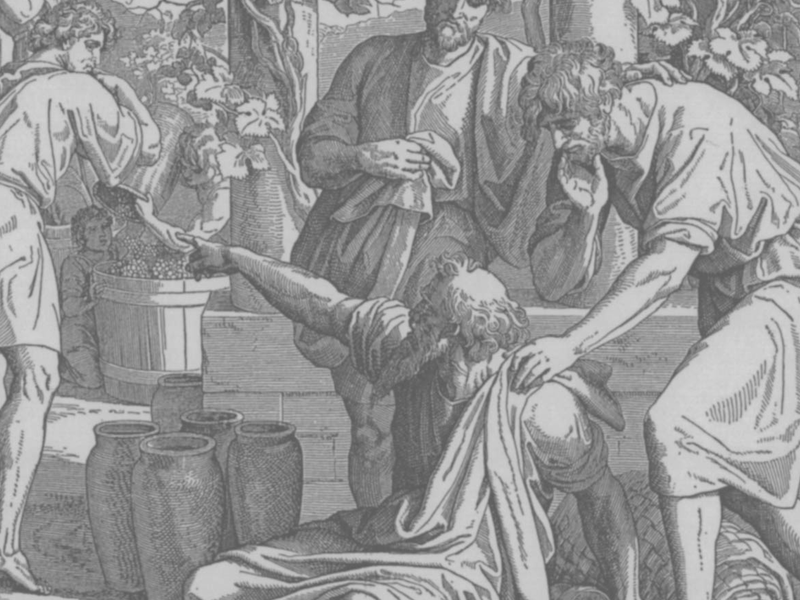
The Sin of Ham and the Curse of Canaan, Part 3 (An Exposition of Genesis 9:20-27)

The Righteousness of Shem and Japheth As noted above, the action of Shem and Japheth was purely symbolic. They did not need to cover Noah with a garment, for he was already covered by the tent. Their action was a symbolic affirmation of Noah’s authority, a symbolic rejection of Ham’s…

by James B. JordanAugust 4, 1997

Showing page 254 of 309

See all
See all

Adorned with Gentiles

Isaiah 49 is reassurance to Zion that Yahweh has not forgotten her. Her walls are continuously ( tamid ) before Yahweh, like the sacrifices and showbread (v. 16). And Yahweh goes beyond the assurance of His concern to promise that Zion will be surrounded by gathered people, returned exiles and…

November 2, 2012

Euphony in Isaiah 49

The Hebrew of Isaiah 49:17 is beautifully symmetrical. Transliterated, it reads: miharu banayik meharsayik umacharivayik mimmek yetze’u . The endings of the six words form a neat pattern: one - u followed by four words ending with the second person singular pronomial suffix ( k ), and then another -…

November 2, 2012

Wombs

The Hebrew word beten frequently means “womb” (Genesis 25:23; Number 5:22; Psalm 22:9-10; 71:6; Jeremiah 1:5). In a few instances, though, the word is used in unusual contexts. When Yahweh offers Ezekiel a scroll to eat, He orders him to eat it with his beten and to fill his “bowels”…

November 1, 2012

God Needs Nothing

God has no needs. Philo, Seneca, and classic Christian theology agree on that. But I think the explanation differs. Seneca ( On Benefits (The Complete Works of Lucius Annaeus Seneca) , bk. 4) explains that “God bestows upon us very many and very great benefits, with no thought of any…

November 1, 2012
History

Plagues and purity

The Christian conviction that Jesus had defeated the powers and brought an end to old rites had major effects on early Christian social engagement, Gary Ferngren implies in his 2009 Medicine and Health Care in Early Christianity . “Before the advent of Christianity,” he says, “there was no concept of…

November 1, 2012
Literature

Joyce, Synopticist

For all its reputation for iconoclasm, modernism, says Robert Alter in Canon and Creativity: Modern Writing and the Authority of Scripture (The Franz Rosenzweig Lecture Series) , is more accurately described as a “paradoxical amalgam of iconoclasm and hypertraditionalism” (p. 8). Alter’s book explores this phenomenon, along with the “double…

November 1, 2012

Showing page 854 of 2212

Browse by Category

In Medias Res

Your weekly digest for all things Theopolis.

Donate

Theopolis is nearly 100% donor-supported. Consider joining us on our mission.