Theopolis Logo

Writing

Explore our collection of theological essays, biblical studies, and reflections on faith and culture.

See all
sixteen-miles-out-al48tflf4e8-unsplash
Food

Gluttony In The Bible (As Opposed To Gluttony In The American Church)

In the Bible, fatness is such a blessing, that it is especially hard to understand why wicked men are permitted to enjoy such a state. It requires a theodicy and faith in God. Thus: “For they have no pangs until death; their bodies are fat and sleek . They are…

by Mark HorneAugust 12, 2013

jeremy-yap-j39x2xx_8cq-unsplash
How to Worship

Biblical Worship (Video with James B. Jordan)

[fve]http://vimeo.com/71901553[/fve]

by Peter LeithartAugust 8, 2013
chris-bair-ndczc5739ck-unsplash
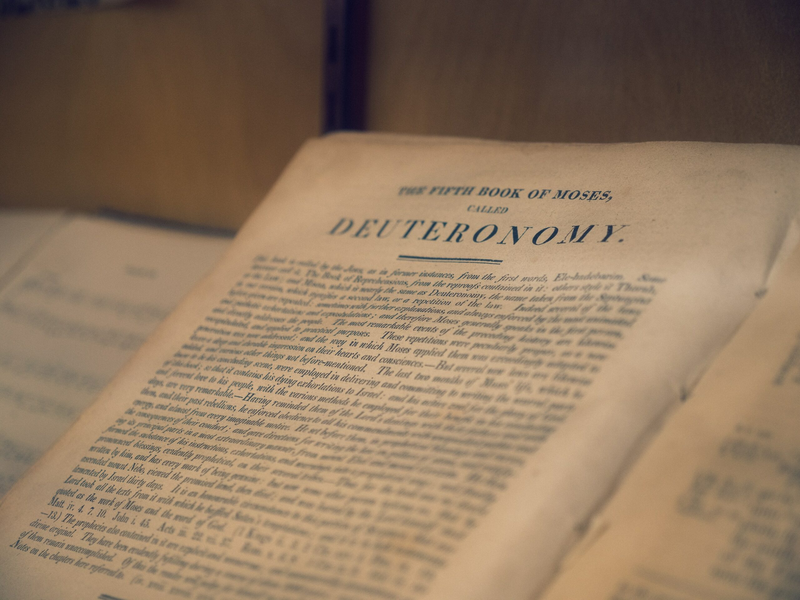
Deuteronomy

Holy Things for Holy People

The allusion to the Exodus story is contained in the first words of Deuteronomy 14:1 — “ye are the sons of Yahweh your God” — as well as in 14:2 in the use of the technical term translated “treasured possession,” “His own possession,” “peculiar people,” “precious people,” and so forth.…

by Ralph Allan SmithAugust 5, 2013
adam-and-eve-in-the-garden-of-eden-wenzel-peter
Deuteronomy

Forbidden Foods

I have argued that Deuteronomy 14:1-21 is an independent literary unit that applies the Third Word to the lives of Israelites from the time of Moses and Joshua. In this short pericope, Moses suggests broad and deep meaning by means of literary allusion to the stories of the creation and…

by Ralph Allan SmithJuly 31, 2013
david-weber-fwuo_zluhnw-unsplash
How to Worship

Pro-Sacramental Reformation

In his recently republished The New Creation , the late, delightful Herbert McCabe defends the priesthood of the plebs as roundly as anyone could want. Citing Hebrews, he claims that "there is an essential difference between the Christian community and the community of the Old Law, or any other religious…

by Peter LeithartJuly 29, 2013
eric-ward-7kqe_8meex8-unsplash
Augustine

Sexual Idolatry

Augustine famously prayed, “Our hearts our restless until they rest in You.” True indeed. Being creatures, we inherently sense our ontological poverty—our innate condition of dependence—and are compelled to find a sense of security. And it is also true—as Augustine’s own narrative painfully illustrates—that one of the things we most…

by Gerald HiestandJuly 24, 2013

Showing page 190 of 309

See all

Showing page 21 of 43

See all
History

Shakespeare’s audience

Arthur F. Kinney writes that “Until very recently - and in some scholarly circles still today - it has been argued that the working class - the journeymen, apprentices, and men and women servants sometimes known as subalterns - had neither the money nor the liberty to attend plays. There…

October 18, 2006
History

Shakespeare’s audience

Arthur F. Kinney writes that “Until very recently - and in some scholarly circles still today - it has been argued that the working class - the journeymen, apprentices, and men and women servants sometimes known as subalterns - had neither the money nor the liberty to attend plays. There…

October 18, 2006
Literature

Shakespeare’s bawdy

A couple of selections from Eric Partridge’s book on the bawdy in Shakespeare. “Flatulence was, in Shakespeare’s day, the source and the target of humour and wit among all classes: nowadays, its popularity as a subject is, in the main, confined to the lower and lower-middle classes and to morons…

October 18, 2006
Literature

Shakespeare’s bawdy

A couple of selections from Eric Partridge’s book on the bawdy in Shakespeare. “Flatulence was, in Shakespeare’s day, the source and the target of humour and wit among all classes: nowadays, its popularity as a subject is, in the main, confined to the lower and lower-middle classes and to morons…

October 18, 2006
History

Revolution and Papal Supremacy

Michael Burleigh details the decimation of the bishoprics and clergy in Franch during the Revolution. This had the unintended consequence of raising the profile of the Pope: Without local or regional authorities to look to, the remaining French clergy looked all the way to Rome: “Ineluctably, the papacy assumed a…

October 18, 2006
Music

Sacred music

Levine again: The German pianist Hans von Bulow toured the US in 1876. At one location, he was preceded by Emma Thursby who sant Schubert and Schumann, and then a popular song by Franz Abt: “Von Bulow’s ‘rage knew no bound’ at this ‘desecration’ of a program composed of the…

October 17, 2006

Showing page 1774 of 2212

Browse by Category

In Medias Res

Your weekly digest for all things Theopolis.

Donate

Theopolis is nearly 100% donor-supported. Consider joining us on our mission.