Theopolis Logo

Writing

Explore our collection of theological essays, biblical studies, and reflections on faith and culture.

See all
sculptor
Art

The Artist's Litany

If we say that we have no sin, we deceive ourselves, and the truth is not in us. (1 John 1:8) O God the Father, creator of heaven and earth, Alpha and Omega, beginning and end, who inspired Creation with the breath of your nostrils, who placed Adam in the…

by Christian LeithartFebruary 2, 2016
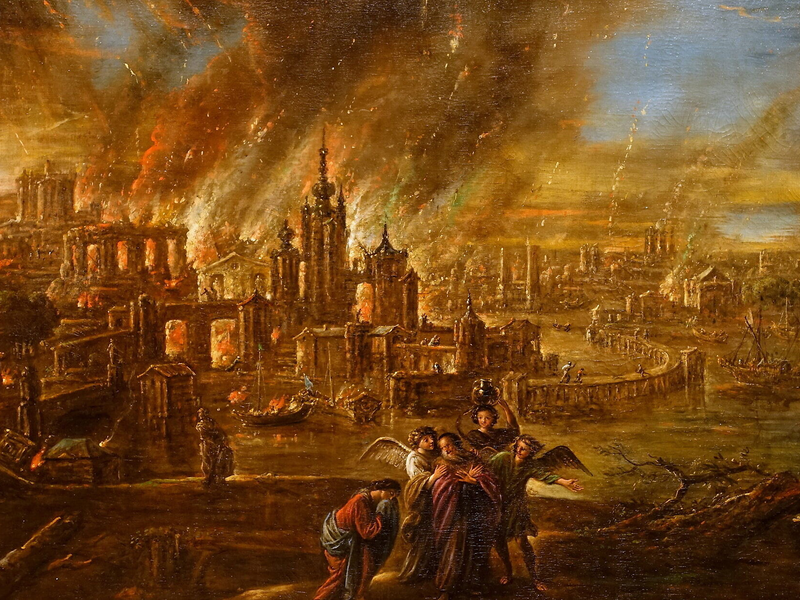
sodom_and_gomorrah_afire_by_jacob_jacobsz-_de_wet_d-_j-_probably_koln_c-_1680_oil_on_canvas_-_hessisches_landesmuseum_darmstadt_-_darmstadt_germany_-_dsc01149-e1632540497247
American Culture

American Sodom

For nearly a half-century, Sodom has been a key symbol in the American culture wars. On the one side, we have an aggressive movement among homosexuals that has first decriminalized homosexual conduct, then to force cultural and legal recognition of homosexuals as a minority and to normalize homosexual behaviors, finally…

by Peter LeithartJanuary 28, 2016
image-20150409-15244-1r08rsu
Biblical Theology

The Meaning of the Mount of Olives

Speaking of the Church, Romans 11:16-17 says, "And if the root be holy, the branches are also. But if some of the branches were broken off, and you, being a wild olive were grafted in among them and became partaker with them of the root of the fatness of the…

by James B. JordanJanuary 26, 2016
img_6134
Isaiah

No Sabbath for God

At the end of Isaiah 61, Yahweh's Servant rejoices because the Lord clothes Him with salvation and righteousness. He decks Him like a bridegroom with a garland on His head. He wears jewels like a bride. He is a new bridegroom in a new garden of Eden, a garden of…

by Peter LeithartJanuary 21, 2016
hebrew-manuscript-2
Biblical Law

Approaching the Torah

Before anything else, a word about “Torah” may be in order. I have been persuaded that “law” is a bad translation of “Torah,” even though it is evident that what is called “Torah” does have commandments, statutes, and ordinances in abundance. Why not “law?” “Law” as a translation for “Torah”…

by Ralph Allan SmithJanuary 19, 2016
jane-austen-2
Biblical Horizons

Jane Austen, Pundit

Few novelists seem as innocent of the temptation to punditry as Jane Austen. Though living through a period that witnessed the birth of an independent United States, the French Revolution and the Terror, the Napoleonic wars and the rise of revolutionary romanticism, and the upheavals of the Industrial Revolution, she…

by Peter LeithartJanuary 14, 2016

Showing page 137 of 309

See all

Showing page 21 of 43

See all

Ritual and Spontaneity

For the first 1500 years of its existence, Christianity was a liturgical faith. That began to change with Wyclif and the Hussites, and the Reformation produced permanent forms of un- and even anti-liturgical Christianity. Ceremony took on negative connotations, synonymous with hollowness and superstition. Ritual was no longer seen as…

October 13, 2015

Locusts and Honey

John the Baptist is presented in the gospels as the fulfillment of the Old Testament promise that God would send His messenger to prepare the way for the coming of the glory of the Lord (Isaiah 40), and the promise to send Elijah before Him to turn the people to…

October 12, 2015
Eucharist

Showing the Lord's Death

How does the Lord’s Supper proclaim the death of Jesus until He comes? (1 Corinthians 11:26). Historically, liturgists have attempted to locate some act in the rite of the Supper that corresponds to the death of Jesus: the fraction (breaking of bread), or the fact that bread and wine are…

October 12, 2015

Eucharistic Modalism

One of the earliest Trinitarian heresies is called “modalism.” It taught that the “persons” of the Trinity are not distinct persons, but only the masks or roles that the one Person of God adopts at various times. The fundamental problem with modalism is that it stretches out a veil, or…

October 12, 2015

Irritability and Intellect

We like to pretend our notions are the product of careful study and rational analysis. We like to pretend our likes and dislikes are deeply rooted in principle. Montaigne thought otherwise. In “An Apology for Raymond Sebond,” he wrote, “I have seen some, who without infringing their patience, could not…

October 12, 2015

From the Mouth

Four times Revelation refers to the sword that comes from the mouth of Jesus, twice at the beginning of the book (1:16; 2:16) and twice at the end (19:15, 21). Jesus' mouth-sword frames the book, and the four uses hint at His universal conquest: Jesus will extend the reign of…

October 9, 2015

Showing page 365 of 2212

Browse by Category

In Medias Res

Your weekly digest for all things Theopolis.

Donate

Theopolis is nearly 100% donor-supported. Consider joining us on our mission.