Theopolis Logo

Writing

Explore our collection of theological essays, biblical studies, and reflections on faith and culture.

See all
tanner-mardis-xuxghzhibn4-unsplash-1-2
Biblical Studies

Tweets-turned-Notes on the Bible’s Chronology

Summary In what follows, I will consider the “year-stamps” employed in Scripture, i.e., statements of the form, “Such-and-such an event took place in the Xth year of Y.” In the process, I will suggest some ways in which the Biblical narrative might relate to events in the extra-Biblical world, though…

by James BejonJuly 16, 2019
durer-prodigal-son-2
Luke

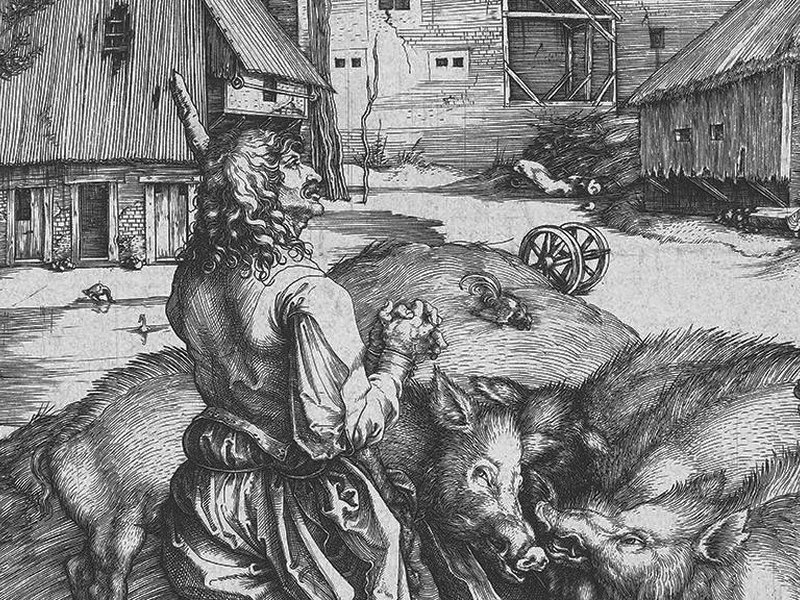
Perspectives on the Prodigal, (Part 2)

In the first essay on the parable of the Prodigal Son, I suggested that the problems commentators and others encounter in interpreting Jesus three-part parable are not accidental. These are not just problems in our ignorance of cultural background. They are intentional features of the stories —stories designed to poke…

by Ralph Allan SmithJuly 11, 2019
durer-prodigal-son-2
Luke

Perspectives on the Prodigal, (Part 1)

The story of the Prodigal Son is perhaps the most well-known story in the Bible. As others have observed, it may also be one of the most misunderstood. In two short essays, I will point out features of this story that are commonly neglected, aspects of Jesus’ parable that might…

by Ralph Allan SmithJuly 9, 2019
de-rijke-man-en-de-arme-lazarus-by-jacopo-da-ponte-16th-century
Luke

Lazarus and the Rich Man

The parable of Lazarus and the nameless rich man is not an independent story. It is part of a long context that begins in Luke 15:1, where Jesus is eating with tax collectors and sinners and the scribes and Pharisees grumble. In response to their hardheartedness, Jesus tells a three-part…

by Ralph Allan SmithJuly 4, 2019
aaron-burden-uynrnfdkjwg-unsplash
Luke

Everybody has Dropsy - Luke 14:1-24

The Bible is written so that even when a reader cannot pick up on what might be deeper or more detailed aspects of a text, there is virtually always a message to be heard. In the ancient world, where the “reader” of Scripture would likely be a church official facing…

by Ralph Allan SmithJuly 2, 2019
communion
Biblical Theology

Fruit Trees and Grain Plants

The distinction between garden (or vineyard) and field begins in Genesis 2. This relates to the ordering of the formless world. Plants of the field are contrasted with the garden planted by God in Genesis 2:5&8. Later on, under the Old Covenant the Israelites will be required to keep their…

by James B. JordanJune 27, 2019

Showing page 77 of 309

See all

Showing page 21 of 43

See all

Risen City

Sanballat hears about Nehemiah’s project of rebuilding Jerusalem after the exile, he becomes angry and mocks the Jews: “Can they finish in a day? Can they revive the stones from the heaps of dust even the burned ones” (Nehemiah 4:2). The taunt is theologically significant. “Finish” is kalah , the…

December 16, 2014

Right Hand

John describes the angel’s position in Revelation 10 in great detail. The angel straddles land and sea, but for some reason John thinks it important to record that the angels right foot is on the sea and left foot on the land. Assuming that the shoreline in question is the…

December 16, 2014

The Story of Pastor Tom Clark

Several months ago, I wrote a First Things essay on the life and ministry of Pastor Tom Clark of Tri-City Covenant Church in Somersworth, New Hampshire. Tom died shortly after that essay appeared, but during his last days we were able to spend a couple of days listening to and…

December 16, 2014

Impure Feminism

Irene Gedalof argues in Against Purity that feminists have been too much in the grip of a binary logic that actually undermines feminism. What she has in mind is the notion that women can be defined in terms of a pure category of “Woman” or “Feminine.” On the contrary, women’s…

December 15, 2014
Anthropology

Early Ethnography

Brian Pennington’s Was Hinduism Invented? includes a brief outline of William Ward’s 1817 treatise on the History, Literature and Religion of the Hindoos . He describes the missionary Ward as one of the “first Europeans to adopt an ethnographic stance” (79). Pennington continues: “He turned from linguistic and textual studies…

December 15, 2014
Shakespeare

Shakespeare’s Trials

David Wootton’s TLS review of Quentin Skinner’s Forensic Shakespeare is a primer on Elizabethan law and legal rhetoric. Wootton tells us, “We tend to think rhetoric is about using figures of speech, but that was only a small part of the orator’s training, which relied both on textbooks inherited from…

December 15, 2014

Showing page 486 of 2212

Browse by Category

In Medias Res

Your weekly digest for all things Theopolis.

Donate

Theopolis is nearly 100% donor-supported. Consider joining us on our mission.