Theopolis Logo

Writing

Explore our collection of theological essays, biblical studies, and reflections on faith and culture.

See all
david-weber-fwuo_zluhnw-unsplash
Books

For the Life of This World

Russian Orthodox liturgist Alexander Schmemann died in 1983, but his importance continues to grow, sometimes in surprising ways. A Russian transplanted to Paris and then to Crestwood, New York, he was an acute observer of the American religious scene. He possessed the clarity of vision the Spirit often grants to…

by Peter LeithartApril 15, 2013

aaron-burden-h8s0pf2rcqs-unsplash
Deuteronomy

Law and History: How to Read the Law of Moses (Part 5)

This is the fifth in a series of studies of Deuteronomy 22:3-23:8. "A bastard ( mazmer ) shall not enter into the assembly of Yahweh; even to the tenth generation shall none of his enter into the assembly of Yahweh" (Deuteronomy 23:2). [i] The translation “bastard” here for mazmer ,…

by Ralph Allan SmithApril 11, 2013
pawel-czerwinski-jbg6al282wq-unsplash
Christian Nationalism

Christian Imperialism

The Enlightenment project is very comprehensible in terms of the “Wars of Religion” that followed the Reformation. It's questionable whether all that is said about the Wars of Religion is entirely fair (R. J. Rushdoony’s Christian Survey of World History has some very helpful things to say about this). Still,…

by Richard BledsoeApril 8, 2013
aaron-burden-1ebsmyrau-s-unsplash
Deuteronomy

Law and History: How to Read the Law of Moses (Part 4)

The fourth in a series of studies on Deuteronomy 22:30-23:8. One wounded by crushing, or cut in the member shall not enter into the assembly of Yahweh (Deuteronomy 23:1. [i] The translation of this verse varies in different English versions. The basic idea is clear enough, however: a eunuch is…

by Ralph Allan SmithApril 3, 2013
markus-winkler-aid-xyrtlec-unsplash
Theopolis News

Leithart at Wheaton

Trinity House President Peter Leithart will give a lecture on violence at the 2013 Wheaton Theology Conference later this week.

by Peter LeithartApril 2, 2013
kiwihug-l4gw27xzn1i-unsplash
Deuteronomy

Law and History: How to Read the Law of Moses (Part 3)

The third in a series of studies on Deuteronomy 22-23. This continues the second essay, which examines Deuteronomy 22:30: "A man shall not take his father’s wife, and shall not uncover his father’s wing" (Hebrew: kanaf ). The Sin of Ham Another story would almost certainly occur to an ancient…

by Ralph Allan SmithMarch 27, 2013

Showing page 196 of 309

See all

Showing page 22 of 43

See all
Pentecost

Pentecost and Public Life

What has Pentecost to do with public life? As Paul would say, much in every way. The Bible does not permit us to confine the work of the Spirit to the inner man or to private experience. Through Isaiah (44:3), the Lord promised to pour out water on the land…

May 15, 2018
Pentecost

Pentecostal Enlightenment

It’s the season of the Spirit, a time to muse on the politics of Pentecost. When Israel’s prophets predict the future coming of the Spirit, their next thought is almost always about the renewal of creation. According to Joel, the Spirit’s coming will turn Israel into Big Rock Candy Mountain”wine…

May 14, 2018

Anarchy and the Second Word

In Discourses on Livy , Machiavelli exposes the ruse of Roman law. Numa, the true founder of Rome, "mistrusted his own authority, lest it should prove insufficient to enable him to introduce new and unaccustomed ordinances in Rome." And so he claimed that the law came from the gods. All…

May 11, 2018
rembrandt-main

How To Pray

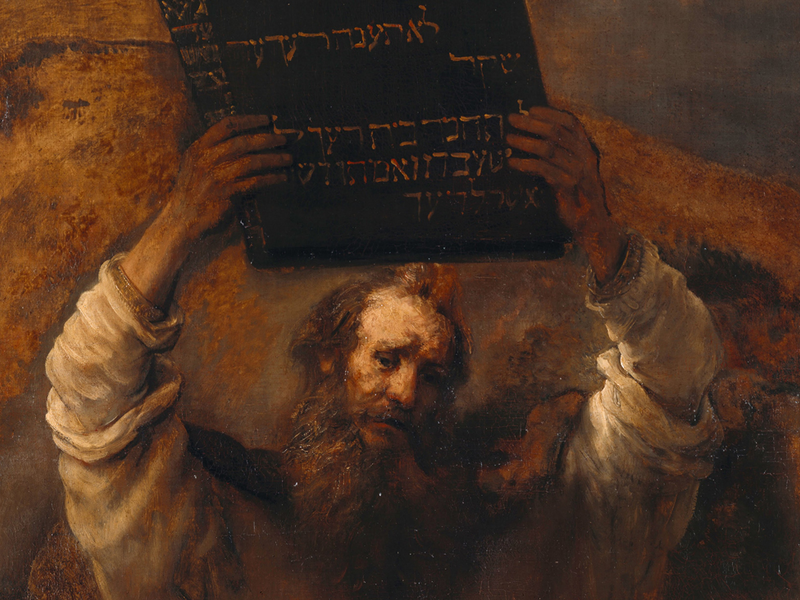
Pamela Tamarkin Reis ("Seeing Moses Plain," VT 55 [2005] 207-31) thinks that Moses' response to Yahweh in Numbers 11 is a model prayer. First, Moses refers to Israel as "this people," which is "a disdainful, arms-length usage employed frequently in the Bible to distance oneself from and to denigrate the…

May 11, 2018

Moses' Missing Repentance

Benjamin Sommer ("Reflecting on Moses," JBL 18 [1999] 601-624) thinks that Numbers 11 weaves together two sources, with very different descriptions of Moses. In narrative A, Moses is petulant, angry, despises his role as leader of Israel, wishes for death. According to B, he is an exemplary prophet, concerned for…

May 11, 2018

Image and Icon

Israel’s sanctuaries were dramatically different from those of other nations. There was no image of Yahweh. The priests maintained Yahweh’s house, but His presence was either invisible or so intense that it was unapproachable. The aniconic worship of Israel was a standing reminder that their God is a different sort…

May 10, 2018

Showing page 70 of 2212

Browse by Category

In Medias Res

Your weekly digest for all things Theopolis.

Donate

Theopolis is nearly 100% donor-supported. Consider joining us on our mission.