Theopolis Logo

Writing

Explore our collection of theological essays, biblical studies, and reflections on faith and culture.

See all
aaron-burden-h8s0pf2rcqs-unsplash
Galatians

The Restoration of the Galatians

While controversies over the writings of Paul continue in various corners of the intellectual globe, the word of God given through Paul and his scribe and all of the church’s interpreters and translators over the last two millennia is still readily available to the lofty and the lowly. Paul, as…

by Grace LangnessMarch 25, 2013

kiwihug-l4gw27xzn1i-unsplash
Deuteronomy

Law and History: How to Read the Law of Moses (Part 2)

The second in a series of studies in Deuteronomy. Deuteronomy 22:30: A man shall not take his father’s wife, and shall not uncover his father’s wing (Hebrew: kanaf ). There are a number of unusual features in this law that mark it out from the previous context, indicating that it…

by Ralph Allan SmithMarch 20, 2013
200403-moss-pilate-tease_pncfq5
History

Victimhood and the Gospel

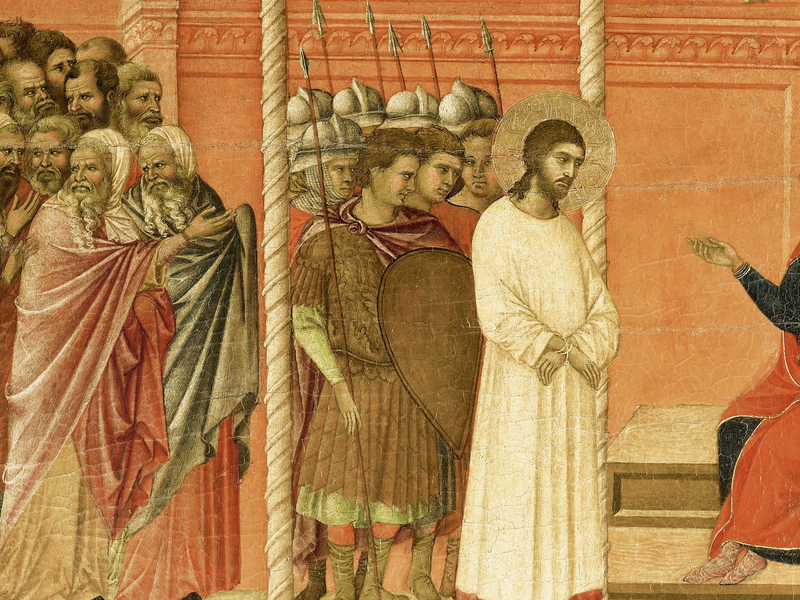
The texts of Christianity have been slowly at work, under the power of the Holy Spirit for 2000 years now. If we could be magically transported back into the world of two millennia ago, modern Americans would be shocked at the cruelty of that world. There was no concern for…

by Richard BledsoeMarch 18, 2013
aaron-burden-1ebsmyrau-s-unsplash
Luke

The Dysfunctional Family of the Gadarene Madman

The Story of the Gadarene Madman is told in all three synoptic Gospels (Matthew 8:28-34, Mark 5:1-20, Luke 8:26-37). Jesus ventures into a Gentile area when He passes over the Sea of Galilee. Upon disembarking from his boat, he is immediately met by a demon-possessed madman. Upon meeting Jesus, he…

by Richard BledsoeMarch 13, 2013
aaron-burden-1ebsmyrau-s-unsplash
Deuteronomy

Law and History: How to Read the Law of Moses

Part 1 of a multi-part series of studies on Deuteronomy 22:30-23:8. Eric Auerbach, in his classic work on Western literature, devotes his first chapter to contrasting Homer with the Bible. Of Homer, he writes of the “need of Homeric style to leave nothing which it mentions half in darkness and…

by Ralph Allan SmithMarch 12, 2013
markus-winkler-aid-xyrtlec-unsplash
Theopolis News

James Jordan in Korea, Japan

Trinity House Fellow James B. Jordan will be a speaker at an International Conference on Biblical Symbolism that will be held in Seoul on Monday, May 27 in 2013. He will address "The Importance of Biblical Symbolism and Symbolic Interpretation of the Bible." The conference will have three other speakers…

by Peter LeithartMarch 9, 2013

Showing page 197 of 309

See all

Showing page 24 of 43

See all

Covenant lawsuit

John’s gospel is a contentious courtroom of a gospel. Legal language dominates the whole gospel - witnesses are called, Jesus promises an advocate, the Jews are constantly trying to put Jesus in the dock. But the whole gospel is really the trial of the Jews, just as what appears to…

February 28, 2006

Hidden Hero

Homer’s prologue to the Odyssey delays the identification of the hero until the end of the prologue, a literary sign that this hero comes hidden, disguised, in craft. That, of course, is precisely how Odysseus behaves throughout the epic. John’s gospel begins with similar techniques. We learn about the Word…

February 28, 2006
Literature

Coriolanus and Christ

Shakespeare’s Coriolanus can be read as dramatizing the Augustinian perspective most recently articulated by Oliver O’Donovan, namely, that “within every political society there occurs, implicitly, an act of worship of divine rule.” Through his dramatization of Roman society, Shakespeare points to another act of worship that constitutes a different sort…

February 28, 2006
Philosophy

J. L. Austin, Deconstructionist?

JL Austin famously distinguished between “performative” and “constative” utterances, the former of which perform the action to which they refer and the latter of which make assertions that can be judged as true or false. Modern philosophy has treated the constative as the norm, and performatives, if considered at all,…

February 28, 2006
Philosophy

structuralism, linguistic and other

How did the linguistic theory of Saussure become a model for anthropologists, sociologists, and analysts of pop culture? Jonathan Culler suggests that this move rests on “two fundamental insights: first, that social and cultural phenomena are not simply material objects or events but objects or events iwth meaning, and hence…

February 27, 2006
Philosophy

Anthropologized science

Foucault, in Canguilhem’s summary, argues that an anthropologization of the sciences took place in the late eighteenth and early nineteenth century, when Kantian philosophy combined with biology, economics, and linguistics to raise the question What is Man? Foucault argues: “From the moment when life, work, and language ceased to be…

February 27, 2006

Showing page 1874 of 2212

Browse by Category

In Medias Res

Your weekly digest for all things Theopolis.

Donate

Theopolis is nearly 100% donor-supported. Consider joining us on our mission.