Theopolis Logo

Writing

Explore our collection of theological essays, biblical studies, and reflections on faith and culture.

See all
puritans
History

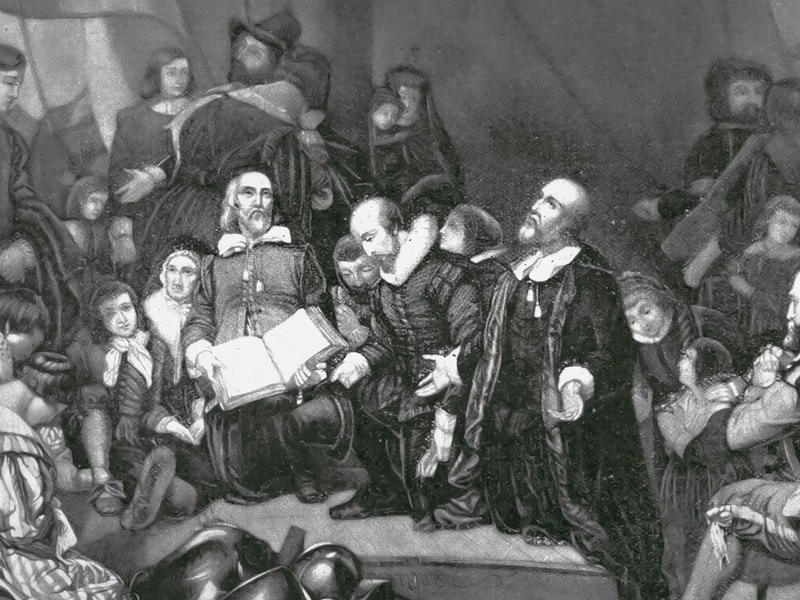
Congregational Theocracy: That Time Theocrats Ran Puritan New England

Timon Cline wrote recently that “theonomists” didn’t run Puritan New England. 1 He is correct, in his major thesis, that the claim that “Puritanism and the natural law tradition are antithetical” is “wildly ahistorical.” Mr. Cline demonstrates that Puritans repeatedly extolled natural law. Besides the Puritan sources Mr. Cline mustered,…

by John CarpenterAugust 9, 2022

screen-shot-2022-08-04-at-9-36-57-am
Mark

The Land of the Walking Trees

The Church is the land of the walking trees. In Mark’s Gospel, the identity of Jesus is slowly and progressively revealed. Though St. Mark announces at the beginning of his narrative that Jesus Christ is “the Son of God” (1:1), this is a reality that must be spoon-fed to His…

by Jackson ShepardAugust 4, 2022
11982-sparrowstockephesians
Ephesians

The Significance of Ephesians (with a comparison to Romans)

All Scripture is of ultimate significance as the word of God, but it may be helpful to think about what makes a book (in this case, a letter) possibly unique within the canon. In this case, the “general” nature of Ephesians should stand out, but it often is not recognized…

by Mark HorneAugust 2, 2022
davide-ragusa-g32g_ibprfa-unsplash
Ecclesiastes

A Time to Kill (Ecclesiastes 3:3)

Where do we draw the lines between what is right and wrong? This question is fundamental to civilization, fundamental to a free society. To put this question in the bluntest and most offense terms: if there is a time to kill — which Solomon says there is — whom shall…

by Ralph Allan SmithJuly 28, 2022
screen-shot-2018-04-12-at-9-48-08-am
Biblical Horizons

Broadening Our View of the Trinity

This article was originally posted in May of 1994. We speak of God as Father, Son, and Holy Spirit. The early Church tended to speak of Him as Father, Word, and Spirit. In this short essay, I want to suggest some other ways to think of the Trinity, ways that…

by James B. JordanJuly 26, 2022
jonahwhale-1552x900
Jonah

Journeying Prophets in Kings

Jonah’s Home The story of JONAH belongs in the book of KINGS. JONAH balances the story of the unnamed Judean prophet (1K13) in KINGS’ literary structure. Each story describes a journeying prophet that crosses land or sea to confront a wayward king. The two stories are located during the reigns…

by Scott FairbanksJuly 21, 2022

Showing page 41 of 309

See all

Showing page 24 of 43

See all

De-Priesting, Re-Priesting

When Aaron and his sons were ordained, they were washed, vested, and anointed (Leviticus 8:6-9). When Aaron approached the Most Holy Place on the Day of Atonement, he puts on linen clothes and washes (16:4). There is no anointing, he removes the garments of glory. The ordination rite goes in…

February 19, 2014

Faith, Not Sight

Faith is the discernment of things unseen. Faith looks for a city yet to come, not made with hands. To any visible arrangement of things, faith stands with Faust in his refusal of “Stay, you are so fair.” Faith says to every human construction, “Good, but not it .” Faith’s…

February 19, 2014

Incinerating enemies

In a contribution to Ancient Mediterranean Sacrifice , David Frankfurter analyzes several contexts of Egyptian religion on the way to a critique of the whole category of “sacrifice.” In some of these contexts, no animals were slaughtered; no violence done. In some contexts, though, animals were killed. He elaborates on…

February 18, 2014

Symbolic rites

Jonathan Klawans asserts in an essay in Ancient Mediterranean Sacrifice that “symbolic action was an undeniably central feature of ancient Israelite culture” (114). As evidence, he points to passages in the Hebrew Bible that highlight the memorial function of rituals. Passover, Sukkot, Sabbath, circumcision, phylacteries are all presents as communicative…

February 18, 2014

Sacrifice or Silence

In his treatise On Abstinence from Killing Animals , Porphyry states a principle of philosophical sacrifice: Different strokes for different deities. For “intelligible gods,” the best worship is “hymn-singing in words,” since “sacrifice is an offering to each god from what he has given, with which he sustains us and…

February 18, 2014

Backfire

John Steven explains at Slate why the ceasefire in South Sudan, like many ceasefires, could well backfire” “The cease-fire is making it worse. Indeed, this uncomfortable truth isn’t even unique to South Sudan. Cease-fires almost always make a conflict worse, delaying political deals, prolonging the killing, and ensuring that the…

February 18, 2014

Showing page 679 of 2212

Browse by Category

In Medias Res

Your weekly digest for all things Theopolis.

Donate

Theopolis is nearly 100% donor-supported. Consider joining us on our mission.