Theopolis Logo

Writing

Explore our collection of theological essays, biblical studies, and reflections on faith and culture.

See all
der_anschlag_von_luthers_95_thesen-1024x589
Church Calendar

Five Misconceptions of Reformation Day

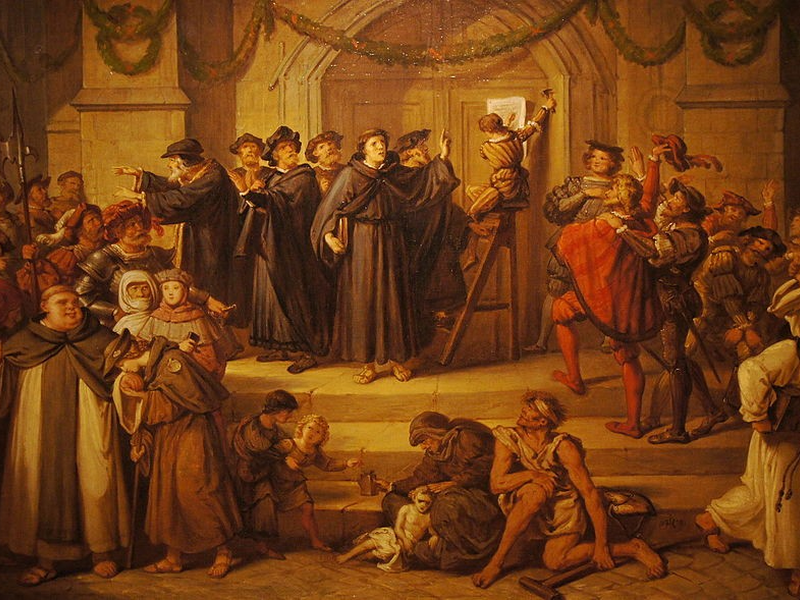
For many people the date October 31 is significant not only for being the Eve of All Saints (All Hallows Eve, Halloween) but as the day in 1517 when Martin Luther nailed his 95 theses to the door of the Castle Church in Wittenburg. These theses were a list of…

by Timothy LeCroyOctober 31, 2017

sacre-bleu-r__kixb0i5m-unsplash
Church Calendar

Concerning Halloween

It has become routine in October for some Christian schools to send out letters warning parents about the evils of Halloween, and it has become equally routine for me to be asked questions about this matter. "Halloween" is simply a contraction for All Hallows’ Eve. The word "hallow" means "saint,"…

by James B. JordanOctober 26, 2017
revelation-john-with-rod
Revelation

Preaching, An Art of Division

The following is an excerpt from Peter Leithart's forthcoming two-volume commentary on Revelation (T&T Clark). Y ou must prophesy again concerning many peoples and nations and tongues and kings,” a voice tells John (Rev. 10:11). Then someone gives him a “reed like a rod” and instructs him to measure (11:1).…

by Peter LeithartOctober 24, 2017
josiah-death

Back To Egypt

Josiah is an ideal Davidic king in many ways. He not only “did right,” but he “walked in the ways of his father David” and “did not turn aside to the right or to the left” (2 Chronicles 34:2). At the age of 16, he began to seek Yahweh, and…

by Peter LeithartOctober 19, 2017
augustine
Augustine

Augustine and the Music of Time

One of the best discussions of Augustine’s views on time comes from Jeremy Begbie’s Theology, Music, and Time (ch. 3). Following Paul Ricoeur, Begbie claims that Augustine’s distentio “is conceived as the three-fold present, and the threefold present as distentio . The distentio consists in the non-coincidence of the mind’s…

by Peter LeithartOctober 17, 2017
img_1043
How to Worship

The Psalter Should be Woven into the Fabric of Worship

This has always been the position of the Christian Church, and from an historical perspective the present situation in evangelicalism is appalling. The early liturgies of the Church, which are still used in Episcopal and Lutheran worship, are laced with psalm phrases. The early hymns, such as the Te Deum…

by James B. JordanOctober 12, 2017

Showing page 104 of 309

See all

Showing page 28 of 43

See all

Objective/Subjective

McGrath notes that Augustine interpreted the genitive in the phrase “righteousness of God” in Rom 1 objectively, so that it was understood as the righteousness that God gives in saving sinners (in “making” them righteous). Ambrosiaster, as I pointed out in an earliet post, interpreted the genitive subjectively - the…

April 20, 2006

Old Perspective on Paul

Ambrosiaster writes, “Iustitia est Dei, quia quod promisit dedit, ideo credens hoc esse se consecutum quod promiserat Deus per prophetas suos, iustum Deum probat et testis est iustitiae eius” (PL, 17.56b). McGrath explains: “God, having promised to give salvation, subsequently gives it, and as a result is deemed to be…

April 20, 2006
History

Unfinished Reformation

Nevin wrote: “There is more a great deal in Christianity, I firmly believe, more in the idea of hte Holy Catholic Church, than has yet been attained, either in the way of knowledge or in the way of life, by the Protestant Reformation.”

April 20, 2006

Factitive Justification

There was a consensus among the theologians of Trent, McGrath argues, that justification was “factitive,” a view that excluded that “a sinner may be justified solely as a matter of reputation or imputation, while remaining a sinner in fact.” But of course that raises the question, What exactly is a…

April 20, 2006

True Lutherans

McGrath traces the odd development in Lutheran Orthodoxy of the notion that regeneration and faith precede justification in such a way that “where Luther had understood justification to concern the unbelieving sinner, orthodoxy revised this view, referring justification to the believing sinner.” This takes Lutheran Orthodoxy back in the direction…

April 20, 2006

Ontological change

McGrath notes, “While justification was universally understood to involve the regeneration of humanity, the opinion that an ontological change is thereby effected within humans is particularly associated with the period of High Scholasticism and the development of the concept of created grace. The earlier medieval theologians expressed the change effected…

April 20, 2006

Showing page 1854 of 2212

Browse by Category

In Medias Res

Your weekly digest for all things Theopolis.

Donate

Theopolis is nearly 100% donor-supported. Consider joining us on our mission.