Theopolis Logo

Writing

Explore our collection of theological essays, biblical studies, and reflections on faith and culture.

See all
jonathan-borba-lgj3qbhoqui-unsplash
Art

Toward a Biblical Definition of Obscenity

My copy of Webster’s New Collegiate Dictionary (1976: not so new, really) defines obscene as (1) "disgusting to the senses; repulsive" and (2) "abhorrent to morality or virtue; specif: designed to incite lust or depravity." Definitions such as this serve a useful purpose only when there is agreement on what…

by Peter LeithartMay 30, 1991
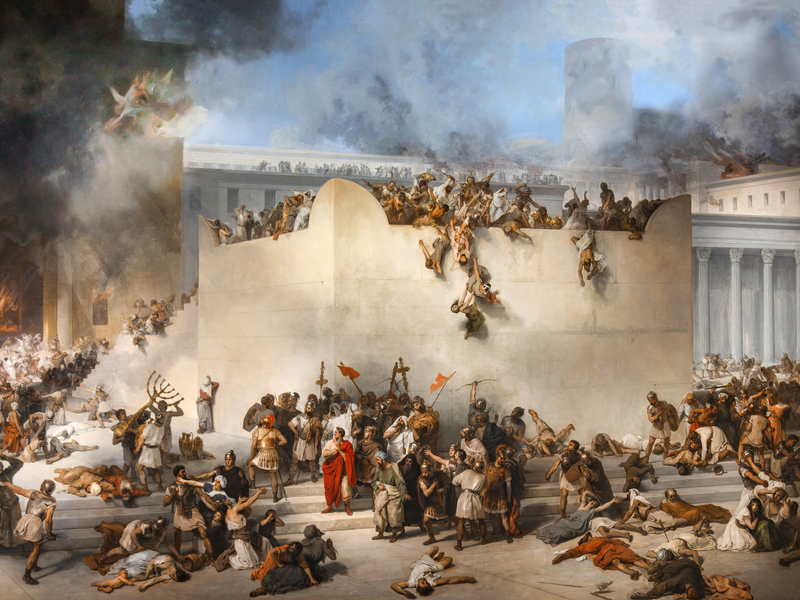
venice-la-distruzione-del-tempio-di-gerusalemme-francesco-hayez-gallerie-accademia-venice
Biblical Studies

The Abomination of Desolation, Part 1

An Overview Here begins a series of studies in the Abomination of Desolation, or Desolating Sacrilege. This month and next I shall set out an overview of what I regard as the best interpretation of the phenomenon. Later essays will look at it in more detail. (The original form of…

by James B. JordanMay 22, 1991
49980-nicolas_poussin_-_the_judgment_of_solomon_-_wga18330-800w-tn
Biblical Studies

Advice From a Sojourner, Part 12

29. There are three things that are stately in their march, Even four that are stately when they walk: 30. The lion is mighty among beasts And does not turn back before any, 31. The strutting cock, The male goat, And a king with his army around him. 32. If…

by James B. JordanMay 22, 1991
tanner-mardis-xuxghzhibn4-unsplash-1-2
Biblical Studies

The Chronology of Ezra & Nehemiah, Part 4

We have seen that it is likely that the Artaxerxes of Ezra-Nehemiah is the same as Darius the Great. If this solution be correct, and I think it is, possibly there is another problem in Ezra that can be resolved by it. In Ezra 4:6 we are told that "in…

by James B. JordanMay 22, 1991
giammarco-zeh-ljawhtg-unsplash
Biblical Horizons

The Weight of Being

Czech novelist Milan Kundera, though hardly a household name in the English-speaking world, has achieved a certain notoriety in America in recent years, largely on the strength of the English translation and film version of his novel, The Unbearable Lightness of Being. 1 The Unbearable Lightness of Being — the…

by Peter LeithartMay 6, 1991
49980-nicolas_poussin_-_the_judgment_of_solomon_-_wga18330-800w-tn
Proverbs

Advice From a Sojourner, Part 11

24. Four things are small on the earth, But they are exceedingly wise; 25. The ants are not a strong folk, But they prepare their food in the summer; 26. The coneys are not a mighty folk, Yet they make their houses in the rocks; 27. The locusts have no…

by James B. JordanApril 22, 1991

Showing page 297 of 309

See all

Showing page 28 of 43

See all
Literature

Michel on Tragedy

Laurence Michel, exploring the “Possibility of a Christian Tragedy,” suggests that the creation account of Genesis opens the possibility for a “tragic sense of life.” How? “To have a world imitative of the simple perfection of God one must have multiplicity and diversity of goods. Various evils and contraries will…

January 15, 2004
Theology

Evil and Good

CS Lewis says in Pilgrim’s Regress : “Evil is fissiparous, and could never in a thousand eternities find any way to arrest its own reproduction. If it could, it could be no longer evil: for Form and Limit belong to the good.” But what then of a Good and Infinite…

January 15, 2004
Literature

Niebuhr on Christianity and Tragedy

In a chapter in Beyond Tragedy , Reinhold Niebuhr considers the relationship between Christianity and tragedy. He denies that Christianity is tragic: “The cross is not tragic but the resolution of tragedy.” In the course of his discussion he makes several intriguing points about the tragic outlook: 1) He highlights…

January 15, 2004
Literature

Weil on Tragedy

Simone Weil offered one of the most thorough-going Christian defenses of tragedy, though that defense comes at considerable cost to her orthodoxy. As Katherine Brueck points out in her study of Weil’s theory ( The Redemption of Tragedy ), Weil recognized that what was at stake in a discussion of…

January 15, 2004

More Thoughts from Segal

Some more thoughts from Segal’s book: 1) He points out the optimism that gripped Athens in the Periclean period, an optimism about the ability of human LOGOS and NOMOS to stave off the savage potential of man’s PHUSIS. But that was short-lived: The Peloponnesian wars broke out, marked by several…

January 15, 2004

civilization in Sophocles

In his study of Sophocles, Tragedy and Civilization , Charles Segal points to several Greek terms that might be translated as “civilization” and that capture various aspects of civilized life: NOMOS = the established institutions, customs, and norms of a people POLITEIA = the form of government, especially the constitutional…

January 15, 2004

Showing page 2136 of 2212

Browse by Category

In Medias Res

Your weekly digest for all things Theopolis.

Donate

Theopolis is nearly 100% donor-supported. Consider joining us on our mission.