Theopolis Logo

Writing

Explore our collection of theological essays, biblical studies, and reflections on faith and culture.

See all
screen-shot-2023-05-02-at-1-14-25-pm
Poetry

Seed-bearing Fruit

Ten-thousand ‘yeses’ and a single ‘no.’ From bough it dangles, beauty to the eyes, For belly, food, a fruit to make one wise. Too soon, they eat; they know; the leaves they sew, But, oh! the Love who asks, “Where did you go?” Confessions flow from under leaf’s disguise; A…

by Marc HaysAugust 16, 2023
screenshot-2023-08-15-at-8-22-28-am
Augustine

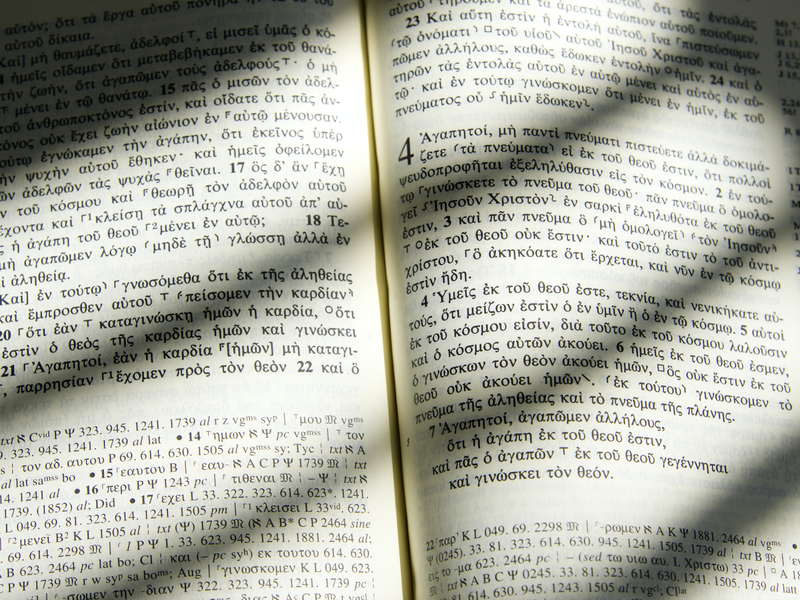
Eternal Life Chiasm in John's Gospel

In his masterful work, De Doctrina Christiana , Augustine of Hippo writes: I would have learned men to know that the authors of our Scriptures use all those forms of expression which grammarians call by the Greek name tropes, and use them more freely and in greater variety than people…

by Doug PonderAugust 15, 2023
screenshot-2023-08-08-at-11-13-28-am
Ruth

Lot, Ruth, and the Work of New Creation

“In accordance with the creation pattern, God sovereignly took hold of Adam and put him to sleep. Then God divided Adam by removing flesh and bone from his side, and restructured humanity into male and female. When Adam awoke, God distributed the woman to him. Adam gazed upon her and…

by Josh JensenAugust 8, 2023
rev-1-barbie-tp-0002-high-res-jpeg-647e152f50df6-2
Culture

The Barbie Movie

Greta Gerwig’s new film, Barbie, has been criticized, probably rightly, for having too many ideas and layers to properly bring in any for a landing. Gerwig herself thought the script was so “ wild and anarchic ” that she was surprised WB agreed to make it. Many see it as…

by Robin HarrisAugust 1, 2023
mariam-soliman-ht5xmeulydg-unsplash-2
Matthew

Why Does John the Baptizer Look Like a Camel?

“Now John wore a garment of camel’s hair and a leather belt around his waist, and his food was locusts and wild honey” (Matt. 3:4). Why is John the Baptizer clothed with camel’s hair? Why does he want to look like a camel? Or at least: what does he expect…

by Jeff MeyersJuly 26, 2023
darwin
Literature

Stinking, Rotten Ministers of the Gospel

In the second greatest story ever told, The Brothers Karamazov , Fyodor Dostoyevsky tells the story of a family plagued by the lasting legacy of sin’s destructive power and the all-surpassing truth that God is Light and in Him is no darkness. The young protagonist, Alyosha, is a monk committed…

by Garrett SoucyJuly 18, 2023

Showing page 29 of 309

See all

Showing page 29 of 43

See all

Roth’s Reversal

Philip Roth famously announced last year that he was quitting. Writing in the TLS , Adan Thirlwell suggests that what he’s actually doing is continuing his career in an inverted fashion. Thirlwell cites a 1984 interview with Hermione Lee, where Roth described his working method: “Making fake biography, false history,…

March 25, 2014

Dostoevsky’s Moral Fiction

In an essay on Dostoevsky and evil in Between Religion and Rationality , Joseph Frank observes that Dostoevsky frequently leads readers into moral horrors, but his “unflinching explorations of evil” don’t leave readers paralyzed. How does that work? Frank traces Dostoevsky’s depiction of evil to his prison experience, recounted in…

March 25, 2014

Irony and Proclamation

In one of his late essays in Speech Genres , Bakhtin traces the secularization of literature to the solvent effects of irony: “Irony has penetrated all languages of modern times (especially French); it has penetrated into all words and forms . . . Irony is everywhere - from the minimal…

March 25, 2014

Augustinian Semiotics

In a 1988 article in the Journal of Literature and Theology (2:1), Milbank sketches the contours of a “theology without substance.” Along the way, he offers a critique of Augustine’s signum-res distinction and the implied metaphysics. On the one hand, Augustine pours some of the foundations for a Christian linguistics…

March 25, 2014

Death Before the Fall

Ronald Osborn’s Death Before the Fall is two books in one, as the subtitle suggests: “Biblical Literalism and the Problem of Animal Suffering.” Part of the book is a critique of “literalism,” especially as expressed in young-earth creationism, the other part is an exegetical defense of the notion that animal…

March 24, 2014

Tossed on a Bed

Jesus threatens to throw the self-appointed prophetess Jezebel onto a bed (Revelation 3:22). The threat carries multiple resonances. The original Jezebel died by being thrown from a window to the ground in front of conquering Jehu. Jesus is the new Jehu throwing Jezebel to her deathbed. It’s fitting that she’s…

March 24, 2014

Showing page 652 of 2212

Browse by Category

In Medias Res

Your weekly digest for all things Theopolis.

Donate

Theopolis is nearly 100% donor-supported. Consider joining us on our mission.