Theopolis Logo

Writing

Explore our collection of theological essays, biblical studies, and reflections on faith and culture.

See all
timothy-eberly-djj49s6ud2o-unsplash
Leviticus

Yahweh's War Against Death

Stories, frankly all human stories are practically always about one thing aren’t they? Death. The inevitability of death. . . . “There is no such thing as a natural death. Nothing that happens to man is ever natural, since his presence calls the whole world into question. All men must…

by Brian MarrApril 14, 2014

screenshot-2023-09-21-at-4-52-42-pm
Matthew

Inescapable Blood

Matthew is organized around 5 discourses, which trace out the history of Jesus as a recapitulation of the history of God and Israel in the Old Testament. Jesus first speaks as a new Moses, instructing His disciples on a mountain about a righteousness that surpasses the righteousness of the scribes…

by Peter LeithartApril 10, 2014
screen-shot-2022-05-12-at-12-07-23-pm
Angels

Did Angels Marry People? The Sin of Cultural Intermarriage

The fall of the Sethites in Genesis 6 is the third fall of mankind, or the third degree of Adam’s original fall. Adam sinned in a Garden against his Father by stealing something he was supposed to wait to obtain. (“Every tree shall be food for you” Genesis 1:29.) Cain…

by James B. JordanApril 7, 2014
sixteen-miles-out-al48tflf4e8-unsplash
Angels

Did Angels Marry People? The Sons of God in Genesis 6

The recent fantasy film Noah and a slightly related blog comment by my friend Douglas Wilson have stirred up again the question of whether the “sons of God” in Genesis 6 who married the “daughters of men” were fallen angels or the priestly line of Seth. Doug argues for angels,…

by James B. JordanApril 4, 2014
kiwihug-l4gw27xzn1i-unsplash
Angels

The Angels of Jude

The prophecy of Jude concerns apostasy. An illustration of apostasy and its consequences is found in verse 6, which the New American Standard Bible translates this way: "And angels who did not keep their own domain, but abandoned their proper abode, He has kept in eternal bonds under darkness for…

by James B. JordanApril 3, 2014
screenshot-2023-09-21-at-4-22-42-pm
Matthew

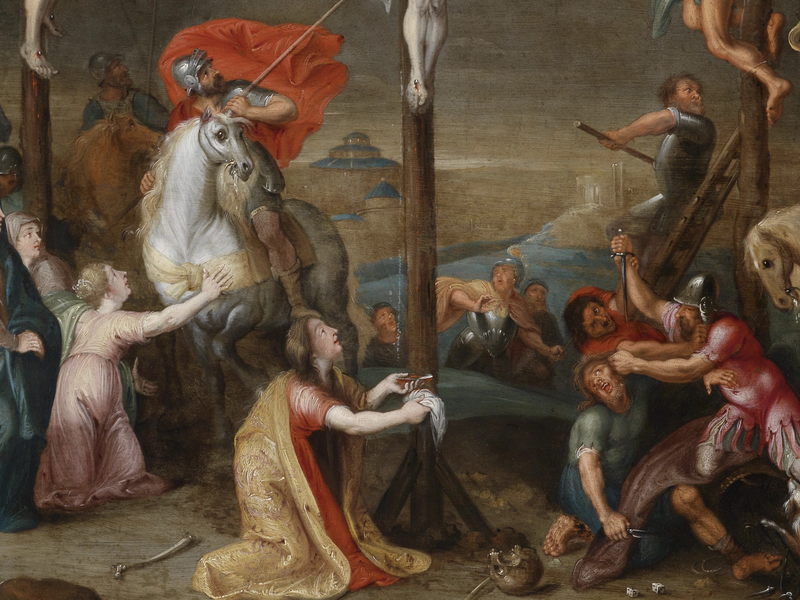
Women at the Cross

At His death, Jesus is surrounded by a Roman centurion and his cohort of Gentile solders. Matthew doesn't say that any disciples are there. But women are, and so is Joseph of Arimathea, identified as a “disciple” but, as John tells us, a “secret disciple for fear of the Jews,”…

by Peter LeithartMarch 31, 2014

Showing page 176 of 309

See all
See all

Sermon Notes

INTRODUCTION After the Olivet Discourse, Jesus “finished all these words” (26:1; cf. 7:28; 11:1; 13:53; 19:1).  His public ministry of teaching Israel is over.  Like Moses (Deuteronomy 32:45), nothing remains for Him but to die. THE TEXT “Now it came to pass, when Jesus had finished all these sayings,  that…

October 26, 2009

Eros Deleted

Protestants agreed with Catholics that the Song elaborates a nuptial analogy to the church’s relation to Christ, but Scheper finds a significant difference between Protestants and Catholics when they explain why that analogy is apt in the first place.  Protestants, consistent with the emphasis on legal categories for justification and…

October 25, 2009

Puritan Prudery

The Puritans were not prudes, but the caricature has some basis in fact. Again the Song of Songs provides a neat barometer.  Scheper juxtaposes a medieval monk’s interpretation of the “breasts” of the Song with that of two Protestant interpreters.  The results are fascinating: “the Cistercian monk Gilbert of Hoilandia does…

October 25, 2009

Medieval Protestantism

the Protestant commentaries almost uniformly adopt a primarily ecclesial allegory, with the tropological dimension as a valid application. But so, in fact, is the medieval tradition built on the foundation of the ecclesial interpretation, and even those commentaries devoted most strikingly to the Christsoul allegory, such as Bernard’s, recognize that…

October 25, 2009

Superlative Song

The modern oblivion of the book has tended to blind us to the really crucial position it holds in exegetic history, not only for the question of allegory but for the central matter of the relation of divine to profane love, and in fact, as Ruth Wallerstein has said, the…

October 25, 2009

Reformation allegory

there is a certain discrepancy between the purity of these theoretical statements, polemical in context, and the actual exegetic practice of the Reformers. Moreover, the rejection of allegory and the insistence on one undivided sense hinged for the early Reformers on maintaining a radical distinction between typology and allegory. But…

October 25, 2009

Showing page 1335 of 2212

Browse by Category

In Medias Res

Your weekly digest for all things Theopolis.

Donate

Theopolis is nearly 100% donor-supported. Consider joining us on our mission.