Theopolis Logo

Writing

Explore our collection of theological essays, biblical studies, and reflections on faith and culture.

See all
800124htsdl
Authority

The Restrainer

When Samuel saw Saul, Yahweh answered him, "Behold, the man of whom I spoke to you! This one will restrain My people" (1 Samuel 9:17) Many English versions of 1 Samuel 9:17 read, "This one will rule over My people," but that is a mistranslation. The Hebrew verb is `atsar…

by James B. JordanDecember 4, 1992

screen-shot-2022-05-12-at-12-07-23-pm
Acts

Chronology of the Gospels

We have arrived at the tentative date of A.M. 3474 for the decree of Cyrus, and we have determined to operate as if the 70 weeks of Daniel 9 are literal years. We also decided that Messiah the Prince arrives at the beginning of the 70th week, after the 69…

by James B. JordanDecember 4, 1992
alex-shute-oz2yqcaszw-unsplash
Biblical Studies

The Dramatic Structure of Proverbs

The book of Proverbs appears as a largely random collection of aphorisms drawn from experience saturated in law. Despite its random arrangement, however, the book does have an over-arching structure that reinforces its main themes. One way to gather clues regarding the structure of a biblical book (or any book)…

by Peter LeithartNovember 17, 1992
sincerely-media-bhaswrjttzw-unsplash-2
Leviticus

Leviticus 27

I recently had the privilege and pleasure of reading the first draught of Gary North’s Economic Commentary on Leviticus , which will be out some time next year. Gary’s comments on Leviticus 27 were stimulating, and caused me to take another look at the passage. The results, which I sent…

by James B. JordanNovember 4, 1992
venice-la-distruzione-del-tempio-di-gerusalemme-francesco-hayez-gallerie-accademia-venice
Daniel

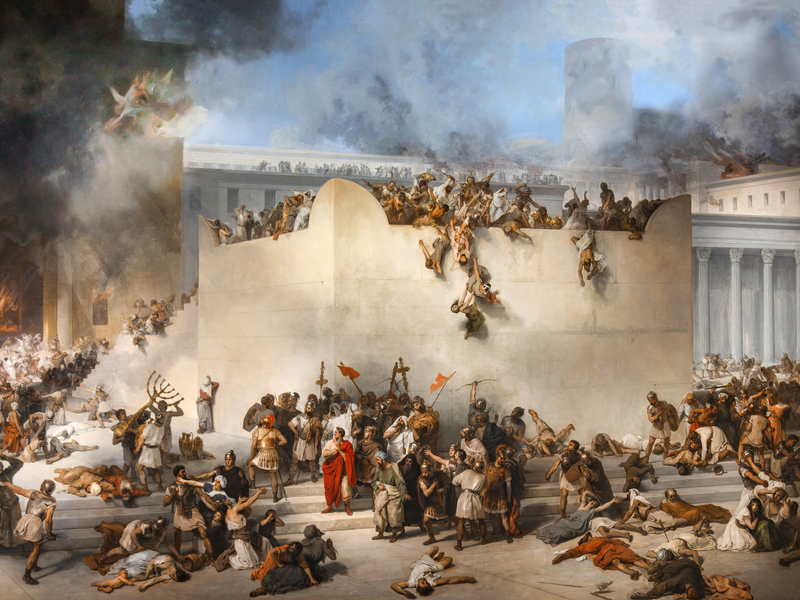
Bridging the Last Gap: Daniel’s Seventy Weeks Revisited

As we have seen in this series, each time there is a new covenant, there is a break in the year-by-year chronology. At the same time, each time the break is crossed by information provided in the text. Thus, the year-by-year chronology breaks down at the birth of Abraham, but…

by James B. JordanNovember 4, 1992
europeana-h-4wme4eooo-unsplash
Art

The Openness of Literature & the Mystery of Art

The Openness of Literature Let’s discuss literature for a moment. There are two ways a story or novel can close. The first is called poetic justice. When a story ends with poetic justice, the bad guys are all punished and the good guys are all rewarded. This kind of story…

by James B. JordanNovember 4, 1992

Showing page 287 of 309

See all
See all

Verdict and Promise

Luther illustrates justification with the image of a mortally sick man and his doctor. The doctor is so certain that he is going to heal the patient that he declares him well already, and tells the patient to consider himself well. The patient trusts the doctor so thoroughly that he…

June 20, 2007

Asking questions

Picking up on my last post . . . So far as I know, no one has challenged my paper on justification exegetically. Perhaps someone has offered a devastating critique, one that shows I’ve misinterpreted every passage I discuss. If such a critique is out there, though, I’ve not seen…

June 20, 2007

My work on justification

The PCA FV Report includes a brief, and fairly accurate, summary of a paper I wrote on justification. This is one of the few things on justification that I’ve published. Since some may read the Report without reading the article, let me summarize what I thought I was doing in…

June 20, 2007

Justification and Judgment

Is it appropriate to use the term “justify” to describe God’s verdict at the final judgment? This has admittedly not been common usage in Reformed theology. “Justify” has normally been reserved for the “already” of God’s verdict rather than the “not yet.” But Paul uses “justify” to refer to the…

June 20, 2007

Jesus the Judge

The Father has put judgment into the hands of the Son (John 5), and God the Father has appointed a day on which the Risen Son will judge all men (Acts 17:31). The judge of all will be a Man, as Paul says in Acts 17. According to the PCA…

June 19, 2007

Trinity and Judgment

Is the denial of judgment according to works implicitly binitarian? If we are judged according to Christ’s imputed righteousness, then at the judgment, Jesus’ works are approved but not ours. the judgment is Father-Son. But where’s the Spirit? If our works are the works of the Spirit in us, then…

June 19, 2007

Showing page 1666 of 2212

Browse by Category

In Medias Res

Your weekly digest for all things Theopolis.

Donate

Theopolis is nearly 100% donor-supported. Consider joining us on our mission.