Theopolis Logo

Writing

Explore our collection of theological essays, biblical studies, and reflections on faith and culture.

See all
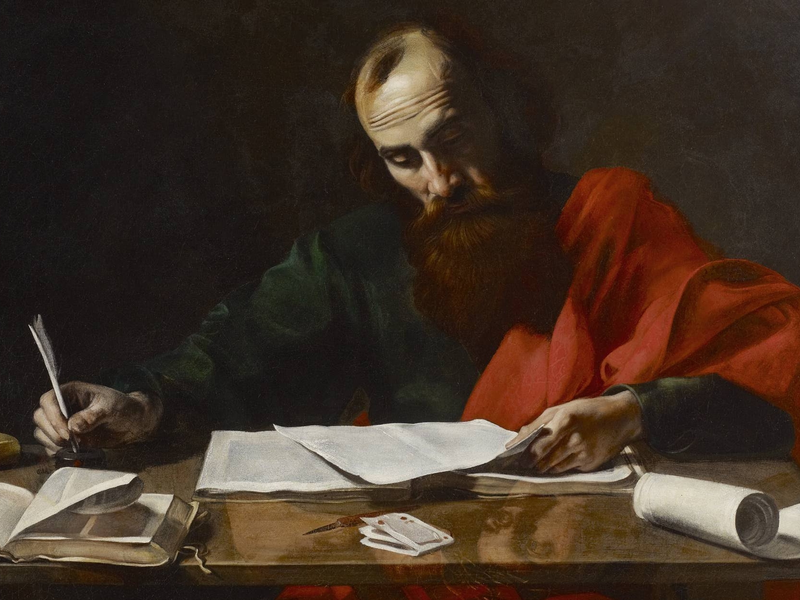
13071-probablyvalentindeboulogne-saintpaulwritinghi-1
1 Corinthians

The Great Exchange: Understanding Second Corinthians 5.21

He made Him who knew no sin to be sin on our behalf, that we might become the righteousness of God in Him. My argument is simple: What Paul means in writing the quotation above in context is the same as what he was telling the Ephesians when he wrote,…

by Mark HorneJune 7, 2004

ben-white-w8qqn1pmqh0-unsplash
Biblical Theology

What is Biblical Theology (Part 3) : The Art of Biblical Theology

THE ART OF BIBLICAL THEOLOGY IN PRACTICE: INTERTEXTUALITY AND TWO PAULINE CASE STUDIES The Art of Biblical Theology: Intertextuality Biblical Theology is really an art. Like other skills of this sort, it is not a matter of following rules (though there are certainly guidelines and techniques). Rather, it’s matter of…

by Rich LuskJune 6, 2004
malcolm-lightbody-tc2f02iq8le-unsplash
Biblical Theology

What is Biblical Theology: (Part 2) The Christotelic Spiral

Click HERE for Part 1 Reading Christotelically Jesus Christ is the heart of God’s plan for creation and history. There is no “hidden plan” or “hidden God” lurking behind Christ; rather, in and through Christ God has revealed himself and his intentions towards the world. In Christ, the Father has…

by Rich LuskJune 6, 2004
aaron-burden-qjdzyt_k8xg-unsplash
Biblical Studies

What is Biblical Theology? (Part 1)

STORY THEOLOGY AND A THEOLOGY OF STORY Defining Biblical Theology What is Biblical Theology? How does it compare to other ways of doing theology, such as Systematic Theology? Geerhardus Vos suggested that whereas Biblical Theology draws a line, Systematic Theology draws a circle. That is to say, Biblical Theology is…

by Rich LuskJune 6, 2004
screenshot-2023-09-21-at-3-59-23-pm
Hebrews

Living by His Faith: Some Rough Thoughts on the Faithfulness of Christ

The gospels strongly imply Jesus lived by faith in the promise of his heavenly Father. How else can his prayer life understood? How else could he have wrestled through the Gethsemane experience? How else could he have committed himself into his Father’s care at death? How could Jesus have presented…

by Rich LuskJune 6, 2004
sixteen-miles-out-al48tflf4e8-unsplash
John

John 3:16

John 3:16 is probably best-known, or at least, best-liked Bible passage in North America: “For God so loved the world, that he gave his only Son, that whoever believes in him should not perish but have eternal life.” This declaration of God’s love of the whole world is greatly comforting…

by Mark HorneJune 6, 2004

Showing page 223 of 309

See all
See all

Age of Silver

D avid's plan for the temple is partly a floor plan. He gives Solomon the pattern for the “porch” and its associated buildings, treasuries, rooms, courts (1 Chronicles 28:11-12). The plan also includes instructions for organizing the priests and Levites (28:13a) and for the utensils of service for the temple…

March 14, 2017

Sources of Inequality

I n his recently-published The Great Leveller , Walter Scheidel summarizes evidence from archeology and anthropological studies to answer the question, Has inequality always been with us? The answer is: Sort of yes. Inequality is a constant in societies that farm and herd. But farming and land ownership weren't the…

March 14, 2017

Classicists and Romantics

D avid gives Solomon the “plan” (Heb. tabnit ) for the temple. Unlike Moses, David doesn't have to climb a mountain to get it (cf. Exodus 25:9, 40). It comes from “the spirit ( ruach ) with him” (1 Chronicles 28:12), and from a “writing” from the Lord that comes…

March 13, 2017

Nietzsche, Destroyer of Idols

I n an essay in the journal European Legacy , Norman Fiering summarizes the thought of Eugen Rosenstock-Huessy on biography. Fiering asks whether there are recurring patterns in the lives of significant individuals, and, relying on Rosenstock-Huessy, calls attention to moments of “conversion” (not necessarily religious) and “grace” (unexpected encounters…

March 10, 2017

Modernist Puritanism

I n his 1971 study of Modernist architecture, The Golden City , Henry Hope Reed observed that Modernists transferred moral categories to architecture. Buildings could be “honest” (if they revealed their structure on the surface) or “false” (if they hid structure under ornamentation). Purity was invoked regularly as a positive…

March 10, 2017

Happy Gothic

W hat is “the Gothic”? Answers vary, and that is, Catherine Spooner argues (in Post-Millennial Gothic ), because Gothic bears “multivalent meanings” and “has adapted and changed with the times” (9–10). This isn't a recent development: “After Gothic's initial phase of popularity fizzled out around 1820, it quickly renewed itself…

March 10, 2017

Showing page 197 of 2212

Browse by Category

In Medias Res

Your weekly digest for all things Theopolis.

Donate

Theopolis is nearly 100% donor-supported. Consider joining us on our mission.