Theopolis Logo

Writing

Explore our collection of theological essays, biblical studies, and reflections on faith and culture.

See all
aaron-burden-h8s0pf2rcqs-unsplash
Galatians

The Restoration of the Galatians

While controversies over the writings of Paul continue in various corners of the intellectual globe, the word of God given through Paul and his scribe and all of the church’s interpreters and translators over the last two millennia is still readily available to the lofty and the lowly. Paul, as…

by Grace LangnessMarch 25, 2013

kiwihug-l4gw27xzn1i-unsplash
Deuteronomy

Law and History: How to Read the Law of Moses (Part 2)

The second in a series of studies in Deuteronomy. Deuteronomy 22:30: A man shall not take his father’s wife, and shall not uncover his father’s wing (Hebrew: kanaf ). There are a number of unusual features in this law that mark it out from the previous context, indicating that it…

by Ralph Allan SmithMarch 20, 2013
200403-moss-pilate-tease_pncfq5
History

Victimhood and the Gospel

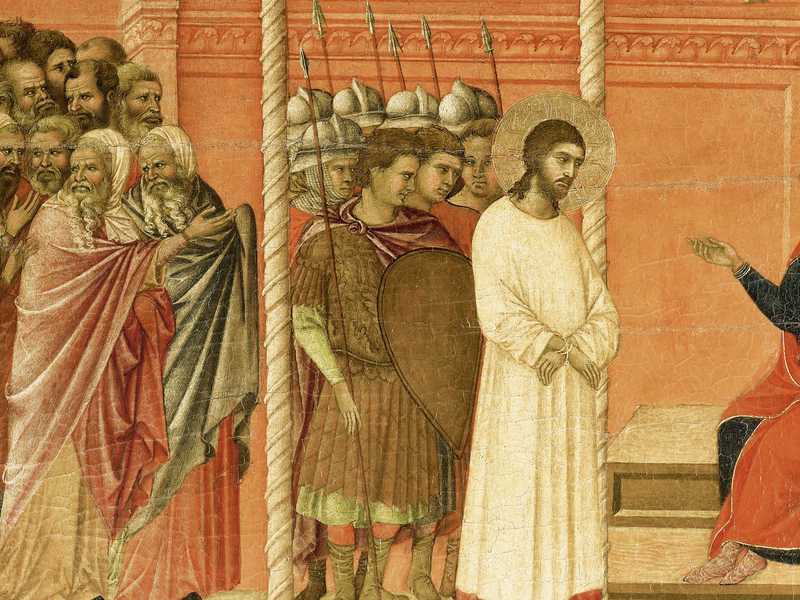
The texts of Christianity have been slowly at work, under the power of the Holy Spirit for 2000 years now. If we could be magically transported back into the world of two millennia ago, modern Americans would be shocked at the cruelty of that world. There was no concern for…

by Richard BledsoeMarch 18, 2013
aaron-burden-1ebsmyrau-s-unsplash
Luke

The Dysfunctional Family of the Gadarene Madman

The Story of the Gadarene Madman is told in all three synoptic Gospels (Matthew 8:28-34, Mark 5:1-20, Luke 8:26-37). Jesus ventures into a Gentile area when He passes over the Sea of Galilee. Upon disembarking from his boat, he is immediately met by a demon-possessed madman. Upon meeting Jesus, he…

by Richard BledsoeMarch 13, 2013
aaron-burden-1ebsmyrau-s-unsplash
Deuteronomy

Law and History: How to Read the Law of Moses

Part 1 of a multi-part series of studies on Deuteronomy 22:30-23:8. Eric Auerbach, in his classic work on Western literature, devotes his first chapter to contrasting Homer with the Bible. Of Homer, he writes of the “need of Homeric style to leave nothing which it mentions half in darkness and…

by Ralph Allan SmithMarch 12, 2013
markus-winkler-aid-xyrtlec-unsplash
Theopolis News

James Jordan in Korea, Japan

Trinity House Fellow James B. Jordan will be a speaker at an International Conference on Biblical Symbolism that will be held in Seoul on Monday, May 27 in 2013. He will address "The Importance of Biblical Symbolism and Symbolic Interpretation of the Bible." The conference will have three other speakers…

by Peter LeithartMarch 9, 2013

Showing page 197 of 309

See all
See all

Ideal Languages

Wittgenstein, Jamie Smith argues, “relativizes the claims of logic without simply rejecting them.” He rejects not logic but “logical foundationalism” that takes logic as an “ideal language” that functions as “the norm for all languages” ( Who’s Afraid of Relativism? 58). It’s possible to see logic as such an ideal…

April 5, 2014

Rorty and Reference

Jamie Smith ( Who’s Afraid of Relativism? ) defends Richard Rorty against the charge that he leaves behind an antirealism that implies we cannot refer to the world, perhaps an antirealism that denies the existence of extra-linguistic things. In Smith’s summary, “realist critics confuse having a theory of reference and…

April 5, 2014

Fireless Sacrifice

Drawing from Pindar’s seventh Olympian Ode, Barbara Kowalzig ( Singing for the Gods , 230-1) argues that the poem provides an etiology for the fireless sacrifice established for Athena at Rhodes. Why a sacrifice without fire, given that “as is nowhere clearer than in Aristophanes’ Birds, on the whole it…

April 5, 2014

War on Amalekites

Israel gets its first taste of war after the exodus when the Amalekites attack the women, children, and stragglers (Exodus 17; Deuteronomy 25:17-19). Yahweh vows to make war against those who make war on the weak, until He blots out “the memory of Amalek from under heaven” (Deuteronomy 25:19). He…

April 4, 2014

Spirits, Stars, Garments

The letter to the angel of Sardis (Revelation 3:1-6) is smoothly cohesive in theme. Jesus begins with a rebuke to the angel at Sardis, charging that despite his reputation for life he is in fact dead. Death and sleep are merged in verse 2, where Jesus calls the dead to…

April 4, 2014

Open Door

Jesus has the key of David to open and shut (Revelation 3:8). He puts an “open door” before the angel of Philadelphia. Which way is the angel to go: In or out? The passage is typically understood with reference to mission. The angel is pictured on the inside of some…

April 4, 2014

Showing page 642 of 2212

Browse by Category

In Medias Res

Your weekly digest for all things Theopolis.

Donate

Theopolis is nearly 100% donor-supported. Consider joining us on our mission.