Theopolis Logo

Writing

Explore our collection of theological essays, biblical studies, and reflections on faith and culture.

See all
lili-popper-lu15z1m_kfm-unsplash
John

Jesus is the Way to the Tree of Life

When Jesus says in the farewell discourse that his disciples know the way to where He is going, Thomas replies: “We do not know where you are going. How can we know the way?” Jesus answers Thomas, but He gives Thomas more than he asked : “I am the way,…

by Josh JensenMay 24, 2023

jordan-wozniak-xp_agmeea6s-unsplash-2
Luke

Beware of the Infection of Hypocrisy

Through the pandemic we learned a lot about infections, how to catch them, what’s contagious, how to protect yourself from getting the infection. I learned a lot of new terms, like “social distancing,” “ppe” (personal protective equipment), N95 masks, and so on. We’ve seen that people are willing to go…

by John CarpenterMay 16, 2023
noah
Biblical Theology

Noah: Man of the Soil

In Genesis 9:20, Noah is called “a man of the soil”. This phrase is a bit of a shock in the Hebrew; though it’s made up of two very common words - 'ish is “man” and 'adamah is “soil” or “ground” - these two words are never used together before…

by Donald LinnemeyerMay 9, 2023
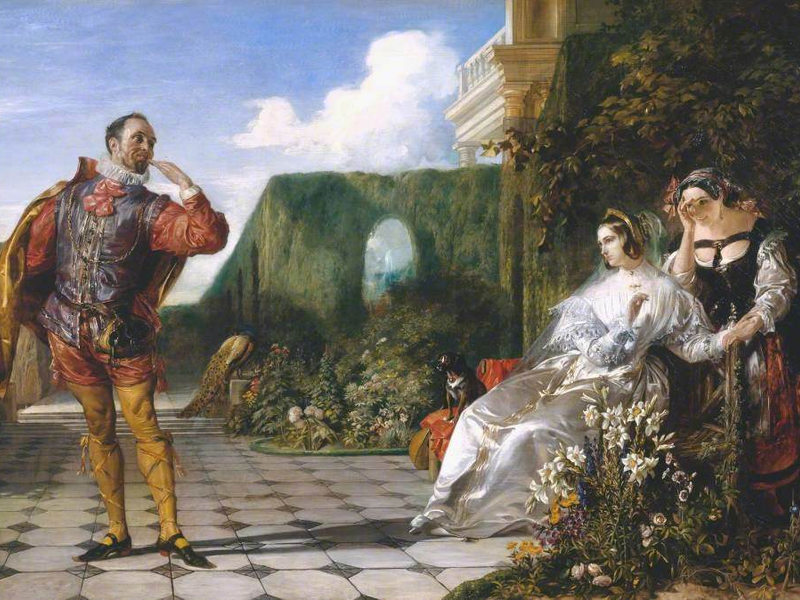
maclise-daniel-1806-1870-scene-from-twelfth-night-malvolio-and-the-countess
Literature

Twelfth Night

Harold Bloom’s discussion of Twelfth Night in his Shakespeare: The Invention of the Human is, as would be expected, insightful. It displays his deep love of poetry, and includes some truly eloquent descriptions of Orsino: “that sublimely outrageous lover of love” and “amiable erotic lunacy.” Bloom is worth reading just…

by Ralph Allan SmithMay 4, 2023
screen-shot-2023-05-02-at-1-14-25-pm
James

A Quadrigatic Reading on Marian Intercession

There have been times when Evangelicals, in an attempt to be clear about the errors of Rome and Constantinople concerning Mary, have been so denigrating of the mother of our Lord that they sounded more like cut and pasted lines from the Babylonian Talmud than they did disciples of Mary’s…

by Garrett SoucyMay 2, 2023
mike-l-8qr1ixi-rmu-unsplash-2
Theology

Awe and the Sensus Divinitatus

Awe is the phenomena experienced when one looks up and lights upon the height, majesty, and mystery of the California Redwoods. It appears the trees pierce heaven itself. Among these giant organisms are the Sequoia–while they are shorter in form, they reserve a width that spans an automobile. These trees…

by Charles JacobiApril 25, 2023

Showing page 31 of 309

See all

Showing page 30 of 43

See all
Philosophy

Mead again

Mead says clock time and calendar time is time only “in a manner of speaking.” He also argues that clock and calendar time is not “absolute” but relative to one’s frame of reference. True that, as my kids say: “Monday” spells gloom within the framework of a certain organization of…

June 19, 2008
Philosophy

Abstract time?

George Herbert Mead focused his thought on temporality (especially in Philosophy of the Present ), and particularly on “time in” events and roles rather than time as a background of events. Time in the strictest sense is the moment of present emergence that reflects into the past and changes its…

June 19, 2008
Science

Scientific laws

Nobel chemist Ilya Prigogine’s work on dissipative structures, complex systems, and irreversibility, Barbara Adam argues, not only challenged particular scientific laws but the classical notion of a scientific law. In classical physics, to arrive at a law was to arrive at a timeless substructure of natural reality. Adam summarizes the…

June 19, 2008
Philosophy

Clock time

Barbara Adam says that the time of clocks is “an idea in practice,” and elaborates: “as a material expression of a particular understanding of the natural world, in which time is conceptualised through motion without change, as a spatial quantity which is infinitely divisible into units, which can be numerically…

June 19, 2008
History

Monastic time

Since Lewis Mumford and Max Weber, historians and sociologists have recognized the importance of the Benedictine monastery in the development of time-keeping, scheduling, and Western notions of time in general. Zerubavel notes that in developing their regulated common life, the Benedictines deliberately broke with the natural and temporal rhythms of…

June 18, 2008
History

Private and public time

We’re used to thinking of privacy in terms of protected spaces, and often hear comments about how isolated individuals and families are in modern society. A guy opens his garage door remotely so his Lexus can slip into the garage, and the door is closed before he’s out of the…

June 18, 2008

Showing page 1503 of 2212

Browse by Category

In Medias Res

Your weekly digest for all things Theopolis.

Donate

Theopolis is nearly 100% donor-supported. Consider joining us on our mission.