Theopolis Logo

Writing

Explore our collection of theological essays, biblical studies, and reflections on faith and culture.

See all
denise-jans-dpemksg59la-unsplash
Art

Glorifications Versus Debasement

Because of sin, the arts sometimes do not serve to glorify but to debase. Sinful men make their environments ugly, and create ugly art to “enhance” their ugly words. But since all men are still God’s images, no men are able to live with such ugliness all the time. Thus,…

by James B. JordanMay 25, 1994

jeremy-yap-j39x2xx_8cq-unsplash
Art

Words and Glory

Arts and literature reviews in most evangelical Christian publications generally approach their subjects in terms of ideology. We are told whether or not the film or book is acceptable in terms of morals, sexual graphicness, and theological accuracy. While there is definitely a place for such reviews, I fear that…

by James B. JordanMay 25, 1994

screen-shot-2018-04-12-at-9-48-08-am
Biblical Horizons

Broadening Our View of the Trinity

We speak of God as Father, Son, and Holy Spirit. The early Church tended to speak of Him as Father, Word, and Spirit. In this short essay, I want to suggest some other ways to think of the Trinity, ways that I have found pastorally helpful in my own life…

by James B. JordanMay 5, 1994
Biblical Studies

Thousands of Generations

I, Yahweh your God, am a jealous God, visiting the iniquity of the fathers on the children, on the third and fourth of those who hate Me, but showing lovingkindness to thousands, to those who love Me and guard My commandments (Ex. 20:5-6). The Second Word forbids acts of ceremonial…

by James B. JordanMay 5, 1994
ben-white-w8qqn1pmqh0-unsplash
Biblical Chronology

The Chronology of the Pentateuch (Part 3)

8. The Table of Nations If we assume births every two years, and about 30 years between generations (cp. Gen. 11:12-24), we can come up with an approximate series of dates for the generations recorded in Genesis 10. We shall assume that all three of Noah’s sons had their firstborn…

by James B. JordanMay 5, 1994
49980-nicolas_poussin_-_the_judgment_of_solomon_-_wga18330-800w-tn
Biblical Studies

The Eighth Month

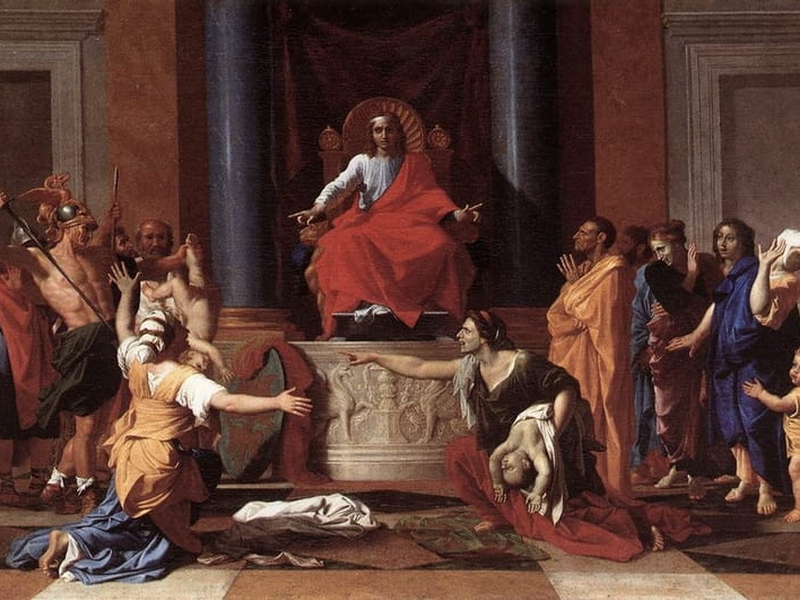
Zechariah’s first prophecy (Zech. 1:1-6) was delivered in the eighth month of the second year of Darius. The notation of this date serves a number of purposes. Most obviously, it relates Zechariah’s prophecies to those of Haggai. By the time Zechariah delivered his first prophecy, Haggai had already chided the…

by Peter LeithartApril 23, 1994

Showing page 279 of 309

See all

Showing page 30 of 43

See all

Yahweh’s Field of Battle

In his commentary on 1 Kings 17-19, M. B. Van’t Veer has this insightful comment about the difference between OT and NT: “We could say that the Lord attacked the powers of darkness, the kingdom of satan on earth [in the old covenant] within the boundaries of Canaan. The land…

February 27, 2005

Yahweh’s Field of Battle

In his commentary on 1 Kings 17-19, M. B. Van’t Veer has this insightful comment about the difference between OT and NT: “We could say that the Lord attacked the powers of darkness, the kingdom of satan on earth [in the old covenant] within the boundaries of Canaan. The land…

February 27, 2005

Law

Perhaps the central dogmatic/systematic challenge raised by the New Perspective on Paul is the claim that Paul’s concerns about “Law” do not have to do with an eternal, unchanging expression of God’s righteousness but with the contingent and temporary institutions and regulations of the Mosaic order. This really does challenge…

February 25, 2005

Regeneration and Justification in Vermigli

Frank James, translator of Vermigli’s treatises on predestination and justification, has these intriguing comments on Vermigli’s views on the relation of justification and regeneration: “Vermigli’s understanding of forensic justification is not particularly unusual. Indeed, it corresponds generally with the Reformed branch of the Reformation. What is unusual is the inclusion…

February 25, 2005

Thick Description

Peter Vermigli offers this charming and helpful comment on the definition of faith as “substance” (Greek, hypostasis ) in Hebrews 11:1: The word “is derived from the verb hyphistamai , which signifies ‘to sustain, receive, not to yield to one rushing blindly.’ Hence, a soldier is called hypostatos if he…

February 25, 2005

Justification and Sacraments

Vermigli discusses the role of works in salvation, arguing that those who do not live uprightly and practice virtue “shall not come to eternal salvation,” yet these works are the “fruits of faith and effects of justification, not causes.” He understands the fathers’ references to “something more” than faith in…

February 24, 2005

Showing page 2002 of 2212

Browse by Category

In Medias Res

Your weekly digest for all things Theopolis.

Donate

Theopolis is nearly 100% donor-supported. Consider joining us on our mission.