Theopolis Logo

Writing

Explore our collection of theological essays, biblical studies, and reflections on faith and culture.

See all
tanner-mardis-xuxghzhibn4-unsplash-1-2
Biblical Studies

Tweets-turned-Notes on the Bible’s Chronology

Summary In what follows, I will consider the “year-stamps” employed in Scripture, i.e., statements of the form, “Such-and-such an event took place in the Xth year of Y.” In the process, I will suggest some ways in which the Biblical narrative might relate to events in the extra-Biblical world, though…

by James BejonJuly 16, 2019
durer-prodigal-son-2
Luke

Perspectives on the Prodigal, (Part 2)

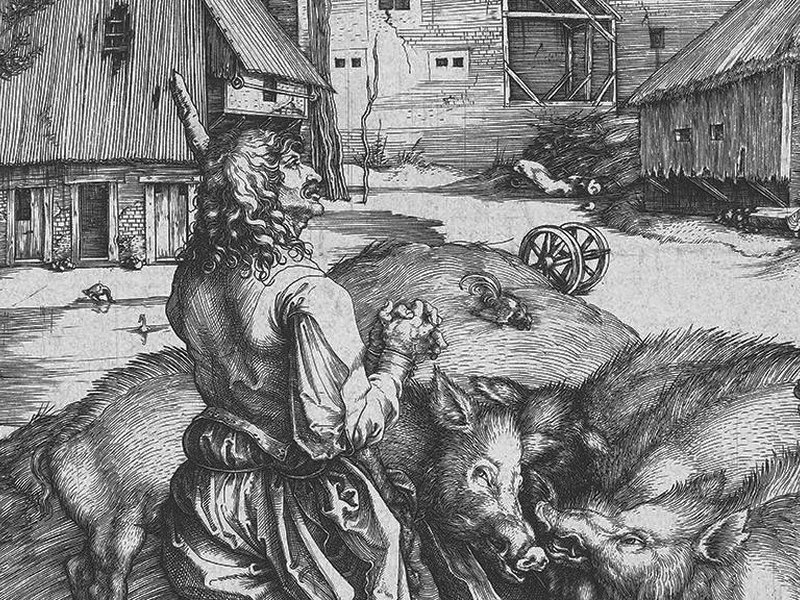
In the first essay on the parable of the Prodigal Son, I suggested that the problems commentators and others encounter in interpreting Jesus three-part parable are not accidental. These are not just problems in our ignorance of cultural background. They are intentional features of the stories —stories designed to poke…

by Ralph Allan SmithJuly 11, 2019
durer-prodigal-son-2
Luke

Perspectives on the Prodigal, (Part 1)

The story of the Prodigal Son is perhaps the most well-known story in the Bible. As others have observed, it may also be one of the most misunderstood. In two short essays, I will point out features of this story that are commonly neglected, aspects of Jesus’ parable that might…

by Ralph Allan SmithJuly 9, 2019
de-rijke-man-en-de-arme-lazarus-by-jacopo-da-ponte-16th-century
Luke

Lazarus and the Rich Man

The parable of Lazarus and the nameless rich man is not an independent story. It is part of a long context that begins in Luke 15:1, where Jesus is eating with tax collectors and sinners and the scribes and Pharisees grumble. In response to their hardheartedness, Jesus tells a three-part…

by Ralph Allan SmithJuly 4, 2019
aaron-burden-uynrnfdkjwg-unsplash
Luke

Everybody has Dropsy - Luke 14:1-24

The Bible is written so that even when a reader cannot pick up on what might be deeper or more detailed aspects of a text, there is virtually always a message to be heard. In the ancient world, where the “reader” of Scripture would likely be a church official facing…

by Ralph Allan SmithJuly 2, 2019
communion
Biblical Theology

Fruit Trees and Grain Plants

The distinction between garden (or vineyard) and field begins in Genesis 2. This relates to the ordering of the formless world. Plants of the field are contrasted with the garden planted by God in Genesis 2:5&8. Later on, under the Old Covenant the Israelites will be required to keep their…

by James B. JordanJune 27, 2019

Showing page 77 of 309

See all

Showing page 30 of 43

See all

Contra Faustum, I

As is well known from Confessions , Faustus played a crucial role in Augustine’s formation. As a young Manichean Auditor and devotee of astrology, Augustine puzzled over philosophical and quasi-scientific conundrums that he wanted to pose to a Manichean master. When Bishop Faustus visited Carthage, Augustine found him affable, humble,…

May 13, 2015

Contra Faustum, II

Though Augustine had the arsenal of the contra Iudaeos tradition at hand in responding to Faustus, he had become dissatisfied with it. After his debate with Fortunatus the Manichean, Augustine had embarked on a deep study of Paul and Genesis and came to recognize the weaknesses of this tradition, whose…

May 13, 2015

Contra Faustum, III

When Augustine turns to the typology of unclean foods in his reply to Faustus, he introduces a linguistic analogy that lays a foundation for the later arguments. Paul’s claim that all things are clean (1 Timothy 4:4) does not contradict the Old Testament, since Paul is talking about the nature…

May 13, 2015

Un-Creation

Revelation 12-14 roughly follows the sequence of the first half of the week of creation. The overall movement is from heaven to sea to earth. Genesis 1 begins with light, then the separation of waters above and below, the formation of sea and land. We can be more specific. Land…

May 12, 2015

Machen and the Monkeys

In The Dome of Eden , Stephen Webb wonders what might have happened if J. Gresham Machen, Princeton theologian and founder of Westminster Theological Seminary, had been at the Scopes trial. In Webb's account, Machen's main concern was to challenge the naturalistic presumptions of Darwinism: “Machen never rejected the basic…

May 12, 2015

Liquid life

In Purity Rabbinic Judaism (46), Jacob Neusner comments on the role of liquidity in the purity system: “Dry inanimate objects or food are not susceptible to uncleanness. What is wet is susceptible. So liquids activate the system.” A dead animal on a pile of grain contaminates only the grain that…

May 12, 2015

Showing page 427 of 2212

Browse by Category

In Medias Res

Your weekly digest for all things Theopolis.

Donate

Theopolis is nearly 100% donor-supported. Consider joining us on our mission.