Theopolis Logo

Writing

Explore our collection of theological essays, biblical studies, and reflections on faith and culture.

See all
25f3baab-e5a9-42ec-aab6-649e53879085-3
Revelation

Rescuing Revelation: Part II

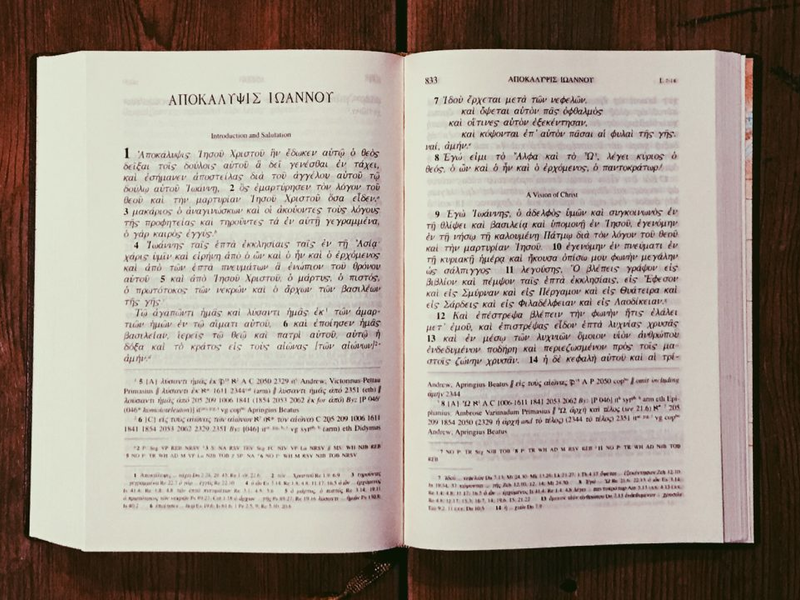
This is Part II of a 2-part essay. For Part 1, click HERE . Covenant context Most Bible teachers apply the teachings of Jesus and the Apostles directly to Christians today without any thought of the historical – and more importantly, legal – context. The ministry of Christ and the…

by Mike BullOctober 10, 2017

25f3baab-e5a9-42ec-aab6-649e53879085-3
Revelation

Rescuing Revelation: Part 1

Introduction The book of Revelation polarises Christians. Some become obsessed with ‘cracking its code’ while others throw it into the too hard basket. Thankfully, recent advances in biblical theology enable us to liberate this enigmatic book from both mistreatment and obscurity. The prophecy is attractive to some because of its…

by Mike BullOctober 5, 2017
aaron-burden-1ebsmyrau-s-unsplash
Biblical Theology

Abraham's Life as a Type

I'm considering the possibility that the life of Abraham as recounted in Genesis contains a typological prophecy of the history of Israel; that is, that the events in Abraham’s life broadly anticipate events in Israel’s history. This kind of pattern is seen in the case of Moses, for instance, because…

by James B. JordanOctober 3, 2017
e99a7787
Culture

Teenagers and the Smartphone Beast

According to this recent article in The Atlantic , teenage promiscuity is decreasing. Apparently there is a general "decline in dating" which also "tracks with a decline in sexual activity." The figures are startling: The drop is the sharpest for ninth-graders, among whom the number of sexually active teens has…

by Steve JefferySeptember 28, 2017
img_4660-2
Matthew

Fulfilling the First Commandment

"Jesus said to him, “‘You shall love the Lord your God with all your heart, with all your soul, and with all your mind.'" - Matthew 22:37 Jesus says that this is the most important commandment: to love God with our heart, soul, and mind. If we obey this command,…

by Lindsey TollefsonSeptember 26, 2017
david-weber-fwuo_zluhnw-unsplash
Eucharist

Strange and Glorious New Rites

At the last supper, Jesus took bread and, having given thanks, He broke it and gave it to His disciples while saying, "Take, eat, this is My body given for you. Do this for My memorial." What Jesus did was recognized by the disciples, because it took place every morning…

by James B. JordanSeptember 21, 2017

Showing page 105 of 309

See all

Showing page 30 of 43

See all

De-Priesting, Re-Priesting

When Aaron and his sons were ordained, they were washed, vested, and anointed (Leviticus 8:6-9). When Aaron approached the Most Holy Place on the Day of Atonement, he puts on linen clothes and washes (16:4). There is no anointing, he removes the garments of glory. The ordination rite goes in…

February 19, 2014

Faith, Not Sight

Faith is the discernment of things unseen. Faith looks for a city yet to come, not made with hands. To any visible arrangement of things, faith stands with Faust in his refusal of “Stay, you are so fair.” Faith says to every human construction, “Good, but not it .” Faith’s…

February 19, 2014

Incinerating enemies

In a contribution to Ancient Mediterranean Sacrifice , David Frankfurter analyzes several contexts of Egyptian religion on the way to a critique of the whole category of “sacrifice.” In some of these contexts, no animals were slaughtered; no violence done. In some contexts, though, animals were killed. He elaborates on…

February 18, 2014

Symbolic rites

Jonathan Klawans asserts in an essay in Ancient Mediterranean Sacrifice that “symbolic action was an undeniably central feature of ancient Israelite culture” (114). As evidence, he points to passages in the Hebrew Bible that highlight the memorial function of rituals. Passover, Sukkot, Sabbath, circumcision, phylacteries are all presents as communicative…

February 18, 2014

Sacrifice or Silence

In his treatise On Abstinence from Killing Animals , Porphyry states a principle of philosophical sacrifice: Different strokes for different deities. For “intelligible gods,” the best worship is “hymn-singing in words,” since “sacrifice is an offering to each god from what he has given, with which he sustains us and…

February 18, 2014

Backfire

John Steven explains at Slate why the ceasefire in South Sudan, like many ceasefires, could well backfire” “The cease-fire is making it worse. Indeed, this uncomfortable truth isn’t even unique to South Sudan. Cease-fires almost always make a conflict worse, delaying political deals, prolonging the killing, and ensuring that the…

February 18, 2014

Showing page 679 of 2212

Browse by Category

In Medias Res

Your weekly digest for all things Theopolis.

Donate

Theopolis is nearly 100% donor-supported. Consider joining us on our mission.