Theopolis Logo

Writing

Explore our collection of theological essays, biblical studies, and reflections on faith and culture.

See all
aaron-burden-h8s0pf2rcqs-unsplash
Galatians

The Restoration of the Galatians

While controversies over the writings of Paul continue in various corners of the intellectual globe, the word of God given through Paul and his scribe and all of the church’s interpreters and translators over the last two millennia is still readily available to the lofty and the lowly. Paul, as…

by Grace LangnessMarch 25, 2013

kiwihug-l4gw27xzn1i-unsplash
Deuteronomy

Law and History: How to Read the Law of Moses (Part 2)

The second in a series of studies in Deuteronomy. Deuteronomy 22:30: A man shall not take his father’s wife, and shall not uncover his father’s wing (Hebrew: kanaf ). There are a number of unusual features in this law that mark it out from the previous context, indicating that it…

by Ralph Allan SmithMarch 20, 2013
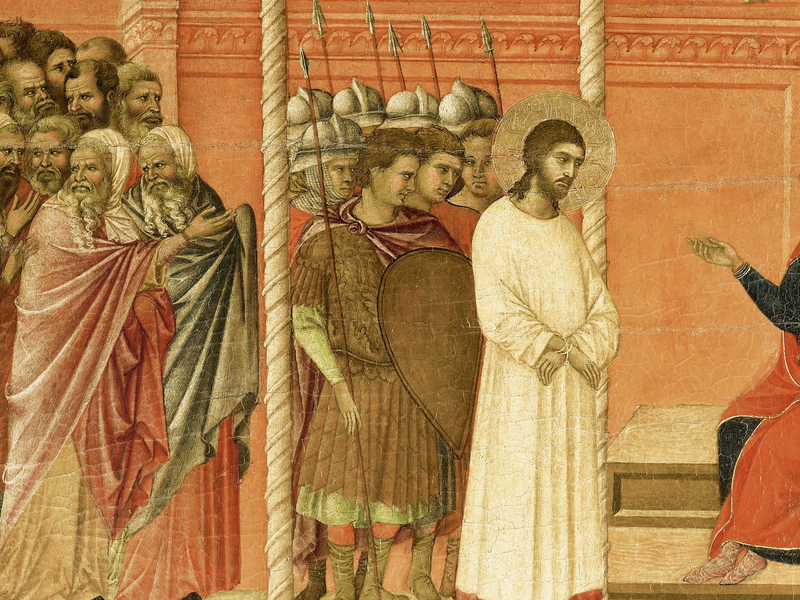
200403-moss-pilate-tease_pncfq5
History

Victimhood and the Gospel

The texts of Christianity have been slowly at work, under the power of the Holy Spirit for 2000 years now. If we could be magically transported back into the world of two millennia ago, modern Americans would be shocked at the cruelty of that world. There was no concern for…

by Richard BledsoeMarch 18, 2013
aaron-burden-1ebsmyrau-s-unsplash
Luke

The Dysfunctional Family of the Gadarene Madman

The Story of the Gadarene Madman is told in all three synoptic Gospels (Matthew 8:28-34, Mark 5:1-20, Luke 8:26-37). Jesus ventures into a Gentile area when He passes over the Sea of Galilee. Upon disembarking from his boat, he is immediately met by a demon-possessed madman. Upon meeting Jesus, he…

by Richard BledsoeMarch 13, 2013
aaron-burden-1ebsmyrau-s-unsplash
Deuteronomy

Law and History: How to Read the Law of Moses

Part 1 of a multi-part series of studies on Deuteronomy 22:30-23:8. Eric Auerbach, in his classic work on Western literature, devotes his first chapter to contrasting Homer with the Bible. Of Homer, he writes of the “need of Homeric style to leave nothing which it mentions half in darkness and…

by Ralph Allan SmithMarch 12, 2013
markus-winkler-aid-xyrtlec-unsplash
Theopolis News

James Jordan in Korea, Japan

Trinity House Fellow James B. Jordan will be a speaker at an International Conference on Biblical Symbolism that will be held in Seoul on Monday, May 27 in 2013. He will address "The Importance of Biblical Symbolism and Symbolic Interpretation of the Bible." The conference will have three other speakers…

by Peter LeithartMarch 9, 2013

Showing page 197 of 309

See all

Showing page 31 of 43

See all

Confessing Trinity

The point of Trinitarian theology is not simply that there are three instead of one. We can’t just plug our pre-conceptions about God into the Trinity, and say that now we are Trinitarian. We can’t assume Deism, the idea that God is a watchmaker who leaves the world to run…

December 15, 2015

The Common-Sensical Bishop Berkeley, 1

. He There is often a gap between the popular perception of a philosopher’s teaching and his own conception of his teaching. But the gap in Berkeley’s case is particularly wide. On the one hand, there is his own professed plan to justify common sense and combat skepticism. He reiterates…

December 15, 2015

Fathers and Sons in Ulysses

Joyce's Ulysses has a pendulum structure. JH Raleigh (in an essay in Joyce's Ulysses , 102) points out the contrast of filius and mater as these are the poles around which the action is organized: “solitary and single vs conjoined, both licitly and illicitly; homeless rover vs statonary huswife (husey);…

December 14, 2015

The God who Predestines

Paul begins the substance of the letter to the Ephesians by “blessing” God (1:3). As is well known, in Greek, verses 3-14 form a single long sentence, with one verb, “Blessed” (v. 3). This reflects a form of Jewish prayer, called the Berekah. It is not a request for God…

December 14, 2015

Rhetoric, Classical and Christian

In his The Invention of Christian Discourse , Vernon Robbins explains how and why Christian discourse and rhetoric diverged from classical models. Ryan Leif Hanson summarizes the argument in Silence and Praise : “Classical rhetoric understands the basic social reality of persons as based in the Graeco-Roman urban environment. In…

December 14, 2015

Retreat from Scripture

Marilynne Robinson is a theological anomaly. A self-confessed Calvinist, admirer of Calvin and Edwards, defender of original sin and predestination (which, she says right, is not determinism), she is also a self-described liberal Christian who tends to take predictably liberal positions on moral and political question and to use sneering…

December 11, 2015

Showing page 341 of 2212

Browse by Category

In Medias Res

Your weekly digest for all things Theopolis.

Donate

Theopolis is nearly 100% donor-supported. Consider joining us on our mission.