Theopolis Logo

Writing

Explore our collection of theological essays, biblical studies, and reflections on faith and culture.

See all
johann-siemens-epy0gbjzzzu-unsplash
Apologetics

A Sabbath Conversation: How Old is the Earth?

As Adam and Eve walked to the center of the Garden of Eden to meet with the LORD on their first Sabbath they conversed about the origin and age of the earth. Adam: You know, honey, we spent a lot of time yesterday making preparations for our house, and we…

by Jeff MeyersOctober 3, 1997

img_1043
Biblical Horizons

Psalms for Exile: The Narrative Progression in the Fifth Book of the Psalter

Some of our forefathers believed in reading/singing the psalms in order. Today, when the psalms are even used at all, they tend to be used randomly, though sometimes tied to a church calendar or to the pastor’s sermon. The Bible does not bind us to any particular practice, but there…

by James B. JordanSeptember 4, 1997
jordan-wozniak-xp_agmeea6s-unsplash-2
Biblical Chronology

The Anthropomorphic Days of C. John Collins, Part 2

Dr. Collins begins his essay with a brief statement of the Day Age view and then a brief statement of the Six Day view, focussing on the challenge to that view posed by modern "science." He ends this discussion by writing: "Two crucial points are at stake here: first, the…

by James B. JordanSeptember 4, 1997
john-salzarulo-wtjrpjzabcq-unsplash
Biblical Horizons

Paperweights and the Puzzles of Secularism

In his The Construction of Social Reality , Berkeley philosopher John Searle puzzles over the ontology of the products of human construction. Certain things – granite, platypi, weeping willows – occur naturally; while other realities – stone walls, zoos and parks, Chase Manhattan Bank – exist only as products of…

by Peter LeithartAugust 27, 1997
ales-krivec-4mibe6zg5r0-unsplash
Biblical Chronology

The Anthropomorphic Days of C. John Collins, Part 1

In the journal Presbyterion 20 (1994):109-130, published by Covenant Theological Seminary, Dr. C. John Collins sets forth a revision of the Day Age approach in his essay, "How Old Is the Earth? Anthropomorphic Days in Genesis 1:1–2:3." Dr. Collins’s essay has been widely accepted in evangelical Presbyterian circles as an…

by James B. JordanAugust 4, 1997
screenshot-2023-09-04-at-10-37-01-am
Biblical Horizons

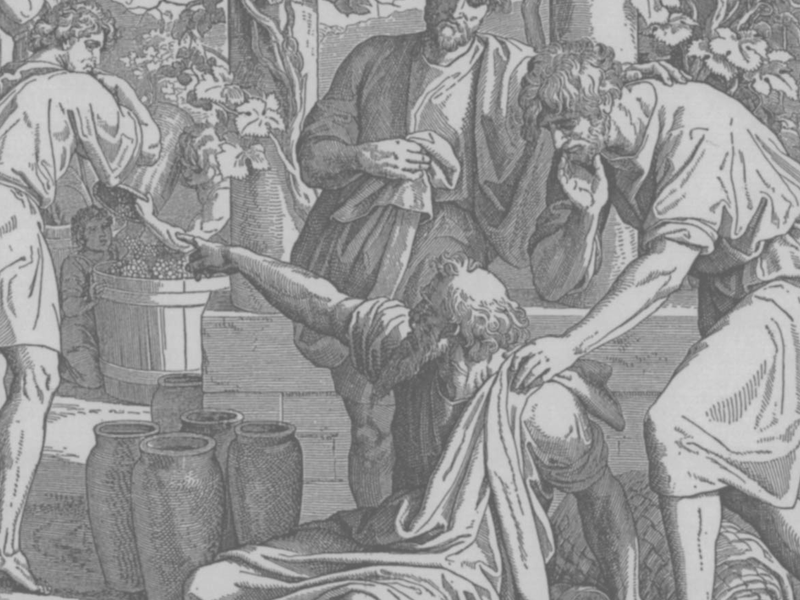
The Sin of Ham and the Curse of Canaan, Part 3 (An Exposition of Genesis 9:20-27)

The Righteousness of Shem and Japheth As noted above, the action of Shem and Japheth was purely symbolic. They did not need to cover Noah with a garment, for he was already covered by the tent. Their action was a symbolic affirmation of Noah’s authority, a symbolic rejection of Ham’s…

by James B. JordanAugust 4, 1997

Showing page 254 of 309

See all

Showing page 31 of 43

See all

Law and Gospel in Public

Drawing on the work of Oliver O'Donovan, Jamie Smith offers a critique of natural law as an adequate grounding for political theology. Positively, Smith argues that “he public task of the church is not just to remind the world of what it (allegedly) already knows (by ‘natural' reason), but to…

April 2, 2015

Symbolizing Reality

At the beginning of his Silence and Praise , Ryan Hansen summarizes several of the recent approaches to understanding the cosmology of the book of Revelation. The most popular today borrows from the sociology of knowledge to suggest that John's writing creates a “symbolic universe” or “worldview” for his readers.…

April 2, 2015

Kept from Women

The emphasis on chastity, virginity, and lack of defilement from women does not have to do with misogyny or asceticism. In biblical perspective, it means that this is both a liturgical and a military assembly. When Israel arrived at Sinai, the men had to keep themselves from women so as…

April 1, 2015
Ecclesiology

Unity First?

In his Gift and the Unity of Being , Antonio Lopez claims that “Christ's kenotic gift of self restores unity with God. The redemption of the gift allows man to see that unity with God is possible and that it generates a whole that is greater than its parts. St.…

April 1, 2015

Nothing Sacred

Douglas Rushkoff's Nothing Sacred is rather all over the place (as one might say if one had a thickly superior British accent). The Judaism he favors isn't a “traditional community with concrete values and well-defined rules” (1) but one that “stresses transparency, open-ended inquiry, assimilation of the foreign, and a…

April 1, 2015

Automatic Writing

Explaining the power of liturgical habit, Paul Griffiths ( Decreation ) offers writing as an example of the self-forgetful, and world-forgetful, character of habit. It's one of the best descriptions of the experience of writing that I have come across. A few preliminaries to make sense of the analysis: Griffiths…

April 1, 2015

Showing page 445 of 2212

Browse by Category

In Medias Res

Your weekly digest for all things Theopolis.

Donate

Theopolis is nearly 100% donor-supported. Consider joining us on our mission.