Theopolis Logo

Writing

Explore our collection of theological essays, biblical studies, and reflections on faith and culture.

See all
johann-siemens-epy0gbjzzzu-unsplash
Apologetics

A Sabbath Conversation: How Old is the Earth?

As Adam and Eve walked to the center of the Garden of Eden to meet with the LORD on their first Sabbath they conversed about the origin and age of the earth. Adam: You know, honey, we spent a lot of time yesterday making preparations for our house, and we…

by Jeff MeyersOctober 3, 1997

img_1043
Biblical Horizons

Psalms for Exile: The Narrative Progression in the Fifth Book of the Psalter

Some of our forefathers believed in reading/singing the psalms in order. Today, when the psalms are even used at all, they tend to be used randomly, though sometimes tied to a church calendar or to the pastor’s sermon. The Bible does not bind us to any particular practice, but there…

by James B. JordanSeptember 4, 1997
jordan-wozniak-xp_agmeea6s-unsplash-2
Biblical Chronology

The Anthropomorphic Days of C. John Collins, Part 2

Dr. Collins begins his essay with a brief statement of the Day Age view and then a brief statement of the Six Day view, focussing on the challenge to that view posed by modern "science." He ends this discussion by writing: "Two crucial points are at stake here: first, the…

by James B. JordanSeptember 4, 1997
john-salzarulo-wtjrpjzabcq-unsplash
Biblical Horizons

Paperweights and the Puzzles of Secularism

In his The Construction of Social Reality , Berkeley philosopher John Searle puzzles over the ontology of the products of human construction. Certain things – granite, platypi, weeping willows – occur naturally; while other realities – stone walls, zoos and parks, Chase Manhattan Bank – exist only as products of…

by Peter LeithartAugust 27, 1997
ales-krivec-4mibe6zg5r0-unsplash
Biblical Chronology

The Anthropomorphic Days of C. John Collins, Part 1

In the journal Presbyterion 20 (1994):109-130, published by Covenant Theological Seminary, Dr. C. John Collins sets forth a revision of the Day Age approach in his essay, "How Old Is the Earth? Anthropomorphic Days in Genesis 1:1–2:3." Dr. Collins’s essay has been widely accepted in evangelical Presbyterian circles as an…

by James B. JordanAugust 4, 1997
screenshot-2023-09-04-at-10-37-01-am
Biblical Horizons

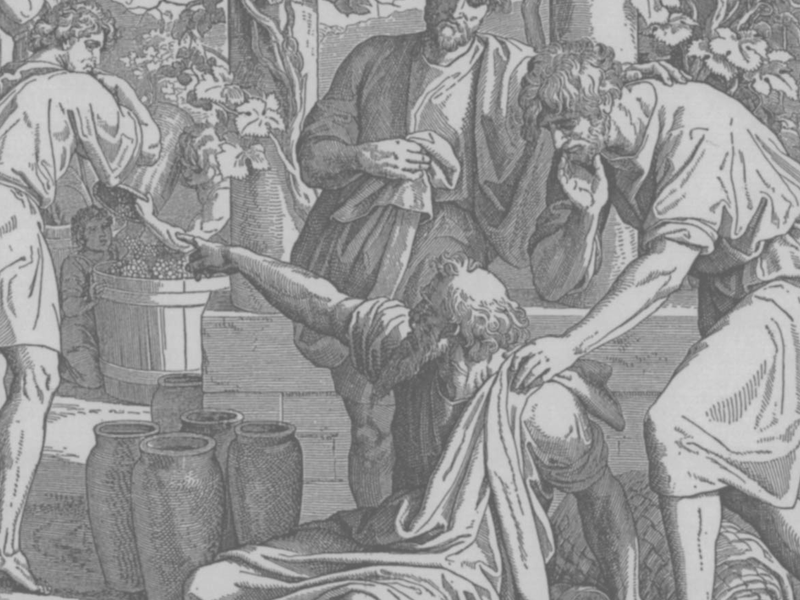
The Sin of Ham and the Curse of Canaan, Part 3 (An Exposition of Genesis 9:20-27)

The Righteousness of Shem and Japheth As noted above, the action of Shem and Japheth was purely symbolic. They did not need to cover Noah with a garment, for he was already covered by the tent. Their action was a symbolic affirmation of Noah’s authority, a symbolic rejection of Ham’s…

by James B. JordanAugust 4, 1997

Showing page 254 of 309

See all

Showing page 31 of 43

See all

Jesus the Carpenter

W hen Jesus begins the Sermon on the Mount, He is sitting on a mountain teaching about the law. He is a new Moses; He is Yahweh. To get the full force of the analogy, we should recalled that God reveals more on Sinai than the Ten Word or moral…

January 6, 2015

Salt of the Earth

Mark Kulansky observes in his Salt: A World History that “Almost no place on earth is without salt. But this was not clear until revealed by modern geology, and so for all of history until the twentieth century, salt was desperately searched for, traded for, and fought over.” Salt’s importance…

January 6, 2015

Who Are The Disciples?

When we read of Jesus’ “disciples,” we naturally think of the Twelve. But that’s not nearly as clear as we try to make it. Many Bibles include the heading “the first disciples” for the episode in Matthew 4:18-22, but the text never uses the word. Peter, Andrew, James, and John…

January 5, 2015

Salty

In a classic essay on the “Symbolic Significance of Salt,” Ernst Jones neatly summarizes how the natural properties of salt lend themselves to social and religious uses: “Salt is a pure, white, immaculate and incorruptible substance, apparently irreducible into any further constituent elements, and indispensable to living beings. It has…

January 5, 2015
Atonement

Social Atonement

H ow, Walter Rauschenbush asked in his Theology for a Social Gospel , does Jesus bear our sins? Unsatisfied with “imputation” as an explanation, he turned to a “social” explanation. Jesus was in solidarity with humanity, and human history is a history of sin. Humanity is bound in a enslaving…

January 5, 2015

Joy of Justification

In her contribution to J ustification in a Post-Christian Society (52), Christine Helmer summarizes the work of Birgit Stolt, who has examined Luther’s vocabulary of justification: “Through careful linguistic analysis, Stolt shows Luther’s doctrine of justification is not couched in the sterile dogmatic vocabulary of a cognitive appreciation for the…

January 2, 2015

Showing page 480 of 2212

Browse by Category

In Medias Res

Your weekly digest for all things Theopolis.

Donate

Theopolis is nearly 100% donor-supported. Consider joining us on our mission.