Theopolis Logo

Writing

Explore our collection of theological essays, biblical studies, and reflections on faith and culture.

See all
screen-shot-2022-08-04-at-9-36-57-am
Matthew

Paul Doesn't Care About Universal Individual Sinfulness or General Revelation

One reason readers assume Paul is trying to prove that all human beings are sinful is that they understand him to be arguing that no one can keep the law. That means, they think, his opponents must believe that human nature is potentially sinless. Taking Paul’s statement that, if you…

by Mark HorneJune 17, 2013

karsten-wurth-imegmbunara-unsplash
Mission

Dreams and Visions

[Note: This post was written prior to our name changing to Theopolis Institute.] What is Trinity House for? Three things: We aim to advance the reformation of the church and, through the church, to promote the renewal of culture; in furthering reformation, we aspire to be a site of fraternal,…

by Peter LeithartJune 12, 2013
sixteen-miles-out-al48tflf4e8-unsplash
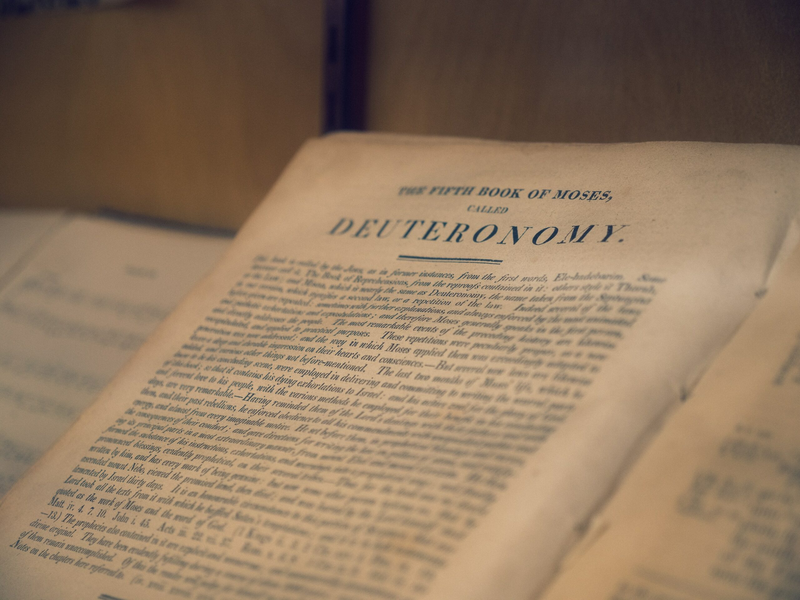
Deuteronomy

Sons to Yahweh your God!

This is the third in a series of studies of the Third Word, and especially of Deuteronomy 14. In 1979 Stephen Kaufman penned a groundbreaking essay on Deuteronomy, arguing that it was a meticulously structured and carefully composed book. In his view, chapters 12 to 26 in particular follow the…

by Ralph Allan SmithJune 10, 2013
kelly-sikkema-gpoh17dxqdm-unsplash
Romans

How is Wrath Revealed?

A large mistake is made in understanding Romans if one assumes that Paul is concerned with proving the fact that no one can ever live without sin—or that all attempts at obeying God’s commands are at least tainted with human sinfulness. The first problem with such an assumption is that…

by Mark HorneJune 5, 2013
chris-bair-ndczc5739ck-unsplash
Deuteronomy

The Third Word

This is the second in a series of studies on the Third Word, and especially on the food laws of Deuteronomy 14. In the second part of this series, I argue that Moses’ reworking of the Ten Words in Deuteronomy 5 includes adding nuance to the Third Word. This prepares…

by Ralph Allan SmithJune 3, 2013
yannis-papanastasopoulos-if_29sed7ta-unsplash
Culture

Turning Babel into a Beast

Recent months have brought a lively discussion of Christian participation in the culture war. On the one hand, the pro-life movement appears to be making some slow progress on the abortion issue. The trial of abortionist and serial murderer Kermit Gosnell has the potential to awaken those who are nominally…

by Joe RigneyMay 29, 2013

Showing page 193 of 309

See all

Showing page 32 of 43

See all

Covenant lawsuit

John’s gospel is a contentious courtroom of a gospel. Legal language dominates the whole gospel - witnesses are called, Jesus promises an advocate, the Jews are constantly trying to put Jesus in the dock. But the whole gospel is really the trial of the Jews, just as what appears to…

February 28, 2006

Hidden Hero

Homer’s prologue to the Odyssey delays the identification of the hero until the end of the prologue, a literary sign that this hero comes hidden, disguised, in craft. That, of course, is precisely how Odysseus behaves throughout the epic. John’s gospel begins with similar techniques. We learn about the Word…

February 28, 2006
Literature

Coriolanus and Christ

Shakespeare’s Coriolanus can be read as dramatizing the Augustinian perspective most recently articulated by Oliver O’Donovan, namely, that “within every political society there occurs, implicitly, an act of worship of divine rule.” Through his dramatization of Roman society, Shakespeare points to another act of worship that constitutes a different sort…

February 28, 2006
Philosophy

J. L. Austin, Deconstructionist?

JL Austin famously distinguished between “performative” and “constative” utterances, the former of which perform the action to which they refer and the latter of which make assertions that can be judged as true or false. Modern philosophy has treated the constative as the norm, and performatives, if considered at all,…

February 28, 2006
Philosophy

structuralism, linguistic and other

How did the linguistic theory of Saussure become a model for anthropologists, sociologists, and analysts of pop culture? Jonathan Culler suggests that this move rests on “two fundamental insights: first, that social and cultural phenomena are not simply material objects or events but objects or events iwth meaning, and hence…

February 27, 2006
Philosophy

Anthropologized science

Foucault, in Canguilhem’s summary, argues that an anthropologization of the sciences took place in the late eighteenth and early nineteenth century, when Kantian philosophy combined with biology, economics, and linguistics to raise the question What is Man? Foucault argues: “From the moment when life, work, and language ceased to be…

February 27, 2006

Showing page 1874 of 2212

Browse by Category

In Medias Res

Your weekly digest for all things Theopolis.

Donate

Theopolis is nearly 100% donor-supported. Consider joining us on our mission.