Theopolis Logo

Writing

Explore our collection of theological essays, biblical studies, and reflections on faith and culture.

See all
aaron-burden-h8s0pf2rcqs-unsplash
Galatians

The Restoration of the Galatians

While controversies over the writings of Paul continue in various corners of the intellectual globe, the word of God given through Paul and his scribe and all of the church’s interpreters and translators over the last two millennia is still readily available to the lofty and the lowly. Paul, as…

by Grace LangnessMarch 25, 2013

kiwihug-l4gw27xzn1i-unsplash
Deuteronomy

Law and History: How to Read the Law of Moses (Part 2)

The second in a series of studies in Deuteronomy. Deuteronomy 22:30: A man shall not take his father’s wife, and shall not uncover his father’s wing (Hebrew: kanaf ). There are a number of unusual features in this law that mark it out from the previous context, indicating that it…

by Ralph Allan SmithMarch 20, 2013
200403-moss-pilate-tease_pncfq5
History

Victimhood and the Gospel

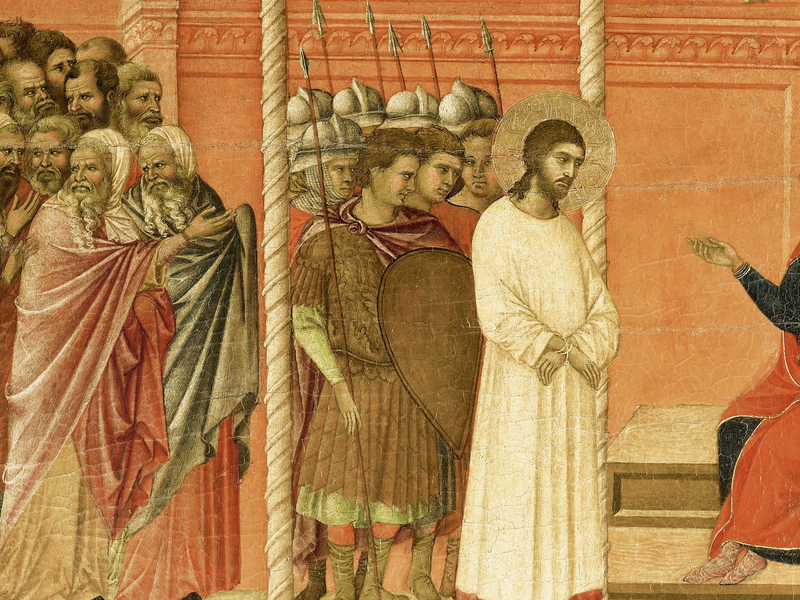
The texts of Christianity have been slowly at work, under the power of the Holy Spirit for 2000 years now. If we could be magically transported back into the world of two millennia ago, modern Americans would be shocked at the cruelty of that world. There was no concern for…

by Richard BledsoeMarch 18, 2013
aaron-burden-1ebsmyrau-s-unsplash
Luke

The Dysfunctional Family of the Gadarene Madman

The Story of the Gadarene Madman is told in all three synoptic Gospels (Matthew 8:28-34, Mark 5:1-20, Luke 8:26-37). Jesus ventures into a Gentile area when He passes over the Sea of Galilee. Upon disembarking from his boat, he is immediately met by a demon-possessed madman. Upon meeting Jesus, he…

by Richard BledsoeMarch 13, 2013
aaron-burden-1ebsmyrau-s-unsplash
Deuteronomy

Law and History: How to Read the Law of Moses

Part 1 of a multi-part series of studies on Deuteronomy 22:30-23:8. Eric Auerbach, in his classic work on Western literature, devotes his first chapter to contrasting Homer with the Bible. Of Homer, he writes of the “need of Homeric style to leave nothing which it mentions half in darkness and…

by Ralph Allan SmithMarch 12, 2013
markus-winkler-aid-xyrtlec-unsplash
Theopolis News

James Jordan in Korea, Japan

Trinity House Fellow James B. Jordan will be a speaker at an International Conference on Biblical Symbolism that will be held in Seoul on Monday, May 27 in 2013. He will address "The Importance of Biblical Symbolism and Symbolic Interpretation of the Bible." The conference will have three other speakers…

by Peter LeithartMarch 9, 2013

Showing page 197 of 309

See all

Showing page 33 of 43

See all

Day of Wrath (Romans 2)

What about taking “day of wrath” in Romans 2 as AD 70? Some arguments: 1) Dunn lists the verses that use similar phrases for “wrath and indignation” and “tribulation and distress,” and most of them are about historical judgments on Israel. There’s a cluster of uses in Deut 28:55ff, which…

November 7, 2003
Theology

Intellectualism and Voluntarism both arise

Intellectualism and voluntarism both arise from the same theological error: from the assumption that there is some realm that is independent and autonomous. This is most obvious with intellectualism: For intellectualists, things have indepdendent value that God recognizes and evaluates. Voluntarists are, however, making the same error. They assume that…

November 6, 2003

Studebaker on Pauw

Steve Studebaker writers in the Scottish Journal of Theology (56:3) about Edwards’s trinitarian theology, and includes an extended critique of Amy Plantinga Pauw’s treatment of Edwards’s incipient “social trinitarianism.” According to Studebaker, Pauw’s analysis only works if one assumes that the history of Trinitarian theology can be sketched out as…

November 5, 2003

The Olive Tree (Romans 11)

In the same issue of JSNT, Philip Esler examines ancient oleiculture to illumine Paul’s use of the olive tree image in Romans 11. When he describes branches being grafted into an olive tree, Paul refers to a common practice. But the normal practice is to graft cultivated olive branches onto…

November 5, 2003

Acts 20:20

Jerome Neyrey has an interesting article on Acts 20:20 in the current issue of JSNT. He examines the cultural background to Paul’s use of the phrase “in public and from house to house” by examining various expressions in Greek and Latin writers that correspond to modern “public” and “private.” These,…

November 5, 2003
Literature

Modernity

To what extent is modernity merely a recovery of the tragic? Tragedy, to my knowledge, simply didn’t exist in the medieval world. Drama revived late in the medieval period, but tragedy was reintroduced by the Renaissance. In Shakespeare, the tragic is set in a larger Christian comic setting, with profoundly…

November 5, 2003

Showing page 2170 of 2212

Browse by Category

In Medias Res

Your weekly digest for all things Theopolis.

Donate

Theopolis is nearly 100% donor-supported. Consider joining us on our mission.