Theopolis Logo

Writing

Explore our collection of theological essays, biblical studies, and reflections on faith and culture.

See all
screen-shot-2023-05-02-at-1-14-25-pm
Poetry

Seed-bearing Fruit

Ten-thousand ‘yeses’ and a single ‘no.’ From bough it dangles, beauty to the eyes, For belly, food, a fruit to make one wise. Too soon, they eat; they know; the leaves they sew, But, oh! the Love who asks, “Where did you go?” Confessions flow from under leaf’s disguise; A…

by Marc HaysAugust 16, 2023
screenshot-2023-08-15-at-8-22-28-am
Augustine

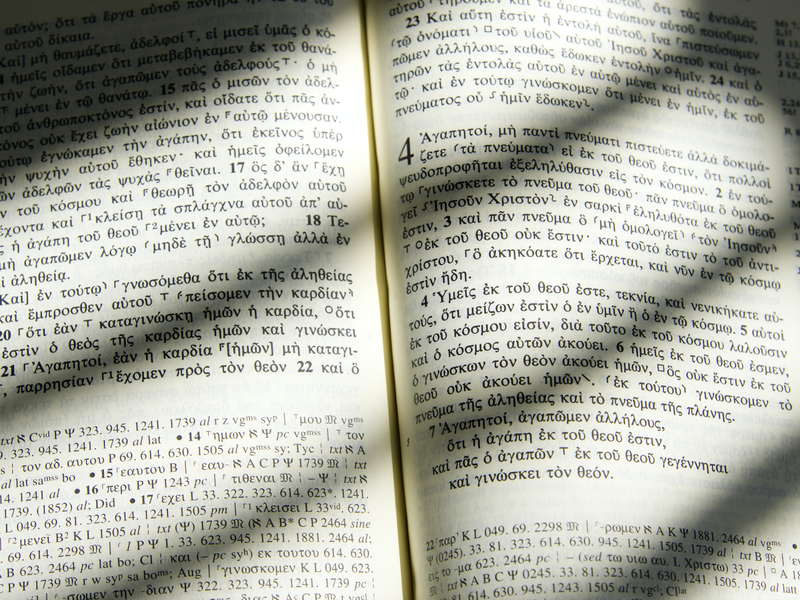
Eternal Life Chiasm in John's Gospel

In his masterful work, De Doctrina Christiana , Augustine of Hippo writes: I would have learned men to know that the authors of our Scriptures use all those forms of expression which grammarians call by the Greek name tropes, and use them more freely and in greater variety than people…

by Doug PonderAugust 15, 2023
screenshot-2023-08-08-at-11-13-28-am
Ruth

Lot, Ruth, and the Work of New Creation

“In accordance with the creation pattern, God sovereignly took hold of Adam and put him to sleep. Then God divided Adam by removing flesh and bone from his side, and restructured humanity into male and female. When Adam awoke, God distributed the woman to him. Adam gazed upon her and…

by Josh JensenAugust 8, 2023
rev-1-barbie-tp-0002-high-res-jpeg-647e152f50df6-2
Culture

The Barbie Movie

Greta Gerwig’s new film, Barbie, has been criticized, probably rightly, for having too many ideas and layers to properly bring in any for a landing. Gerwig herself thought the script was so “ wild and anarchic ” that she was surprised WB agreed to make it. Many see it as…

by Robin HarrisAugust 1, 2023
mariam-soliman-ht5xmeulydg-unsplash-2
Matthew

Why Does John the Baptizer Look Like a Camel?

“Now John wore a garment of camel’s hair and a leather belt around his waist, and his food was locusts and wild honey” (Matt. 3:4). Why is John the Baptizer clothed with camel’s hair? Why does he want to look like a camel? Or at least: what does he expect…

by Jeff MeyersJuly 26, 2023
darwin
Literature

Stinking, Rotten Ministers of the Gospel

In the second greatest story ever told, The Brothers Karamazov , Fyodor Dostoyevsky tells the story of a family plagued by the lasting legacy of sin’s destructive power and the all-surpassing truth that God is Light and in Him is no darkness. The young protagonist, Alyosha, is a monk committed…

by Garrett SoucyJuly 18, 2023

Showing page 29 of 309

See all

Showing page 33 of 43

See all

Difference

Ancient Greeks sacrificed and ate pigs and dogs. Israelites were forbidden to do so. Ancient Greeks made blood pudding from sacrifices. Israelites were not supposed to eat blood. Ancient Greeks sometimes sacrificed pregnant sows. Israelites were commanded not to take both the eggs and the hen. Greek sacrificial goats were…

April 11, 2014

Equality and Privilege

Was sacrificial meat distributed equally or hierarchically in ancient Greece? Some have resolved the question diachronically: Archaic Greece had a more democratic sacrificial distribution that democratic classical Athens. Gunnel Ekroth concludes that the two systems lived side-by-side. Choice pieces were given to dignitaries and priests, but the bulk of the…

April 11, 2014

Hold, Cold, Between

Jesus charges the Laodicean angel with being lukewarm, neither hot nor cold (Revelation 3). This is understandably and rightly taken as a symbol of their indecisiveness and lethargic piety. But there’s a whole lot more going on. Hot and cold match day and night (Genesis 8:22). “Heat of the day”…

April 11, 2014

Thoughts on 1 Samuel 17

A few scattered thoughts on 1 Samuel 17. Saul offers David his armor for battle, but David refuses (v. 39). After the battle, though, David accepts the armor of Jonathan, signifying David’s elevation to crown prince (18:1-4). David kills Goliath with a rock, trusting in Yahweh the Rock. There is…

April 11, 2014

Socially Constructed Self

By the time a child is two, he or she has developed “narrative” memory, the ability to “store” and recall events in story form. This is essential to the development of thought and self-reflection, but it is, Daniel Siegel argues, a shared, social process ( The Developing Mind , 60-1),…

April 10, 2014

Pluralist Paralysis

Millennials aren’t apathetic or lazy, argues Zachary Fine in the NYT . They are simply paralyzed, and pluralism is one of the causes. “The art critic Craig Owens once wrote that pluralism is not a ‘recognition, but a reduction of difference to absolute indifference, equivalence, interchangeability.’ Some millennials who were…

April 10, 2014

Showing page 637 of 2212

Browse by Category

In Medias Res

Your weekly digest for all things Theopolis.

Donate

Theopolis is nearly 100% donor-supported. Consider joining us on our mission.