Theopolis Logo

Writing

Explore our collection of theological essays, biblical studies, and reflections on faith and culture.

See all
25f3baab-e5a9-42ec-aab6-649e53879085-3
John

Israel Redux: The Image of Christ in the Gospel According to John (Part IV)

John 18, 19: Latter Prophets and the Writings John 18 and 19 record the arrest, trial, torture, and death of Jesus as laid out in detail in Isaiah 53. After the Roman soldier pierces Jesus’ side, John quotes Zechariah: “They shall look at him whom they pierced” (Zech 12:10). In…

by Geert HeetebrijDecember 6, 2018

25f3baab-e5a9-42ec-aab6-649e53879085-3
John

Israel Redux: The Image of Christ in the Gospel According to John (Part III)

John 12.12 – John 17: Latter Prophets In the Hebrew Scriptures, Kings is followed by the Latter Prophets. John 12:15 quotes Zechariah 9:9 as having prophesied Jesus’ triumphal entry: “Do not be afraid, O Daughter of Zion; see, your king is coming, seated on a donkey’s colt.” [1] N.T. Wright…

by Geert HeetebrijDecember 5, 2018
25f3baab-e5a9-42ec-aab6-649e53879085-3
John

Israel Redux: The Image of Christ in the Gospel According to John (Part II)

John 6.16-70: Joshua The book of Joshua documents the nation of Israel entering the Promised Land. Consider the order of events: (1) Israel is still receiving the daily miracle of manna; (2) Israel miraculously crosses the Jordan on dry foot; (3) The day after Passover , Israel eats produce of…

by Geert HeetebrijNovember 29, 2018
25f3baab-e5a9-42ec-aab6-649e53879085-3
John

Israel Redux: The Image of Christ in the Gospel According to John (Part I)

Since my educational and professional training have revolved around story and narrative structure, I approach John’s Gospel from a literary and narrative perspective. In doing so, I have noticed structural story patterns and followed them where they seem to lead: the Gospel of John parallels the ordering of the books…

by Geert HeetebrijNovember 27, 2018
white-hall-hospital
Art

The Clouds of Mt. Sinai

The Mt. Sinai Hospital was neolithic on the black hill of Hollow, New Hampshire. Winter dampened the trees and the wind bit at the sparse branches, the sidewalks and stairs were perilous with soggy leaves, and the dim yellow light cast a pallor upon the milky stone building. Ambling inside…

by Remy WilkinsNovember 22, 2018
sodom-and-gomorrah-58ecfa883df78c5162cb92b5
Revelation

Egypt and Sodom, Where the Lord was Crucified

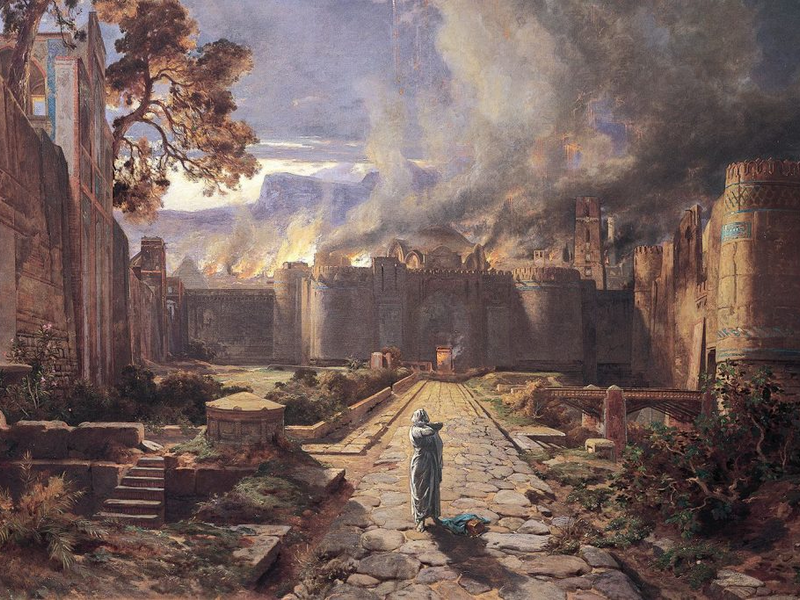
The Revelation can only be understood in the light of Old Testament symbols and sequences. The same is true of the epistle of Jude, which serves as a blistering hors d’oeuvre to John’s fiery feast. Possibly written by the apostle Judas Thaddaeus (Luke 6:16; Acts 1:13; John 14:22), the epistle…

by Mike BullNovember 20, 2018

Showing page 84 of 309

See all

Showing page 35 of 43

See all
Literature

Gilgamesh and Genesis

Some notes cut from a larger project. The story of the first books, as Stephen Mitchell explains in the introduction to his recent translation of the poem, is a story of civilizing. The entire poem is framed by references to the city of Uruk, but the city moves from a…

August 28, 2008

Plunder vessels

Jesus tells the Pharisees who accuse Him of casting out demons by the power of Satan that, on the contrary, He is the stronger man who binds the strong man and comes to plunder the “vessels” of his house (Mark 3). The only other place where Mark uses the word…

August 26, 2008

Edomite Pharisees

NT Wright suggests that Jesus’ response to the Pharisees’ complaint about his disciples “harvesting” on the Sabbath puts them in the role of Doeg the Edomite, who watched David get showbread from the priests at Nob (end of Mark 2). A student points out that the Edomite theme is still…

August 26, 2008

Mark 3

The structure of Mark 3:1-6 seems to be basically chiastic: A. Jesus’ entry to synagogue B. man with withered hand C. heal on Sabbath? D. Jesus to man E. Jesus to Pharisees F. Silence E’. Jesus angry and grieved at Pharisees D’. Jesus to man C’. ?? B’. restored hand…

August 26, 2008
Philosophy

Justification

How can we justify knowledge? Very roughly: Foundationalist justification is justification from the origin. We can’t let the argument stray from the source, lest it meander. Pragmatic justification is justification at the end. We know what is true because it proves true, it works. Foundationalist justification is “tragic.” Pragmatic justification…

August 25, 2008

Protestant hermeneutics

Richard Muller points out the essential continuity of Protestant interpretation with patristic and medieval models: “The Reformers and, indeed, the Protestant orthodox all assumed that the living Word addressed the church directly in and from the text. In other words, they advocated a spiritual and ecclesial exegesis that participated in…

August 25, 2008

Showing page 1478 of 2212

Browse by Category

In Medias Res

Your weekly digest for all things Theopolis.

Donate

Theopolis is nearly 100% donor-supported. Consider joining us on our mission.