Theopolis Logo

Writing

Explore our collection of theological essays, biblical studies, and reflections on faith and culture.

See all
sacre-bleu-r__kixb0i5m-unsplash
Death

Integrity

Integrity seems to have two meanings. It can mean the quality of being honest and having strong moral principles. A man of integrity is a person of honour, rectitude and probity, truthful and trustworthy. Integrity also describes a state – the quality of being whole and undivided. If things are…

by Arthur KayMarch 19, 2015

emmanuel-phaeton-1bwmfmvybi8-unsplash
Psalms

Psalm 32 Commentary

Get the Psalm 32 Translation here Psalm 32 is the first part of Ps. 32-33, ending with a call to praise that is answered by what follows. Ultimately the psalm needs to be considered as a whole, but what we call Psalm 32 does have its own structure and logic,…

by James B. JordanMarch 18, 2015
laughter
Humor

On Crude Humor

You wouldn’t hit a man with glasses would ya? No, of course not. I’d hit him with a bat. In our culture of frivolity it is tempting for Christians to think that solemnity should be our defining attribute. The coarseness of the world impedes us from enjoying any sort of…

by Remy WilkinsMarch 17, 2015
standingonamountain
Creation

Maker of Heaven and Earth, Part 2

Taking a cue in my last post from early Christian apologetics, I suggested that if we wish to articulate and defend a doctrine of creation ex nihilo in contemporary theology, we would do well to offer a thick description of Yahweh’s divine monarchia (his sole rule or sovereignty). Rather than…

by Stephen LongMarch 12, 2015
mountain-top-2
Creation

Catechism of the Universe

I’m not sure we really understand the insidiousness of unbelief. It is not merely to reject the gospel of Jesus, the existence of a Creator God, or to question biblical morality. At its core, unbelief is ingratitude, and by the very nature of this ingratitude, it must ultimately reject every…

by Toby SumpterMarch 10, 2015
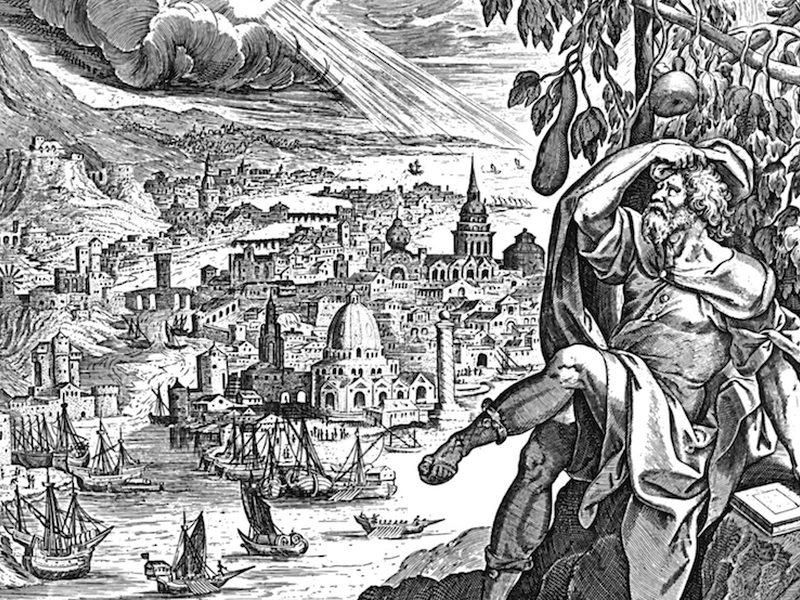
jonah-under-gourd
Mark

The True Jonah and Lenten Fasting

Mark’s narrative of the baptism of Jesus is characteristically brief: “In those days Jesus came from Nazareth of Galilee and was baptized by John in the Jordan. And when he came up out of the water, immediately he saw the heavens being torn open and the Spirit descending on him…

by Arthur KayMarch 9, 2015

Showing page 158 of 309

See all

Showing page 35 of 43

See all
Philosophy

Continental v. analytic

Continuing through Simon Critchley’s book on Continental philosophy, the following analogy seems to capture some aspects of the contrast of Continental and analytic: Continental is Catholic: conscious of tradition, respectful of saints, aware of historical contextualization. Philosophy is the history of philosophy. Analytic is Protestant: deals with de-contextualized philosophical problems,…

September 14, 2006
History

Modernist postmoderns

Postmodern critics of modernity sometimes treat the latter not only as the pursuit and ambition for totality; they treat it as a totality, as an undifferentiated whole. But if postmoderns are right, even modernity was fragmented and frayed at the edges, and the appearance of totality is a modernist ruse.…

September 13, 2006
History

Modernity and dirt

A subsidiary thesis: Modernity is motivated by a desire for purity, by dirt-avoidance - dirt being, as Mary Douglas says, “matter out of place.” Counter-modernity is dirt’s revenge, celebration of dirt.

September 13, 2006
History

Modernity as court culture

Featherstone once again. He points out that sometime in the 18th century, upper class culture divided from lower class culture: “in 1500 the educated strata despised the common people although they shared their culture. Yet by 1800 their descendants had ceased to join spontaneously in popular culture and were rediscovering…

September 13, 2006
History

Romantic ethic and Consumption

In his 1987 book, The Romantic Ethic and the Spirit of Modern Consumerism , C. Campbell attempts to explain the origins of contemporary obsession with novelty, pleasure in the new, self-expression through consumption of goods. He traces it to romanticism’s focus on “imagination, fantasy, mysticism, creativity and emotional exploration” (Featherstone’s…

September 13, 2006
History

Consumption, Body, and the Sacred

A couple of further notes from Featherstone’s very stimulating book. First, citing Pierre Bourdieu, he notes the limits of seeing consumption as an isolated marker of status. The signs “that betray a person’s origins and trajectory through life are manifest in body shape, size, weight, stance, walk, demeanour, tone of…

September 13, 2006

Showing page 1794 of 2212

Browse by Category

In Medias Res

Your weekly digest for all things Theopolis.

Donate

Theopolis is nearly 100% donor-supported. Consider joining us on our mission.