Theopolis Logo

Writing

Explore our collection of theological essays, biblical studies, and reflections on faith and culture.

See all
screen-shot-2020-03-05-at-9-05-54-am
Family

Childbearing as Liminal Space

Notwithstanding she shall be saved in childbearing, if they continue in faith and charity and holiness with sobriety. (1 Timothy 2:15) Years ago, the wife of a prominent American theologian recognized that even in Christian circles mothers were under a kind of social pressure to justify the worthwhileness of their…

by Garrett SoucyMarch 24, 2020

pablo-merchan-montes-wyopqmtdd0w-unsplash
Motherhood

Parenting through Coronavirus

I caught my five year old washing his hands again. He had already washed them several times that hour, so I asked him if he was okay. He told me he didn’t want to get “the virus”. That was before I had told him anything about coronavirus, but we did…

by Lindsey TollefsonMarch 20, 2020
arturo-castaneyra-tpe60ik97qw-unsplash
Discipleship

Take a Walk

Very early in life, I developed the habit of walking and thinking and meditating. I came from a rather strict home, and the only way I could get out of the house at night was to walk the dog. So, I did. I would walk the dog for miles and…

by Richard BledsoeMarch 17, 2020
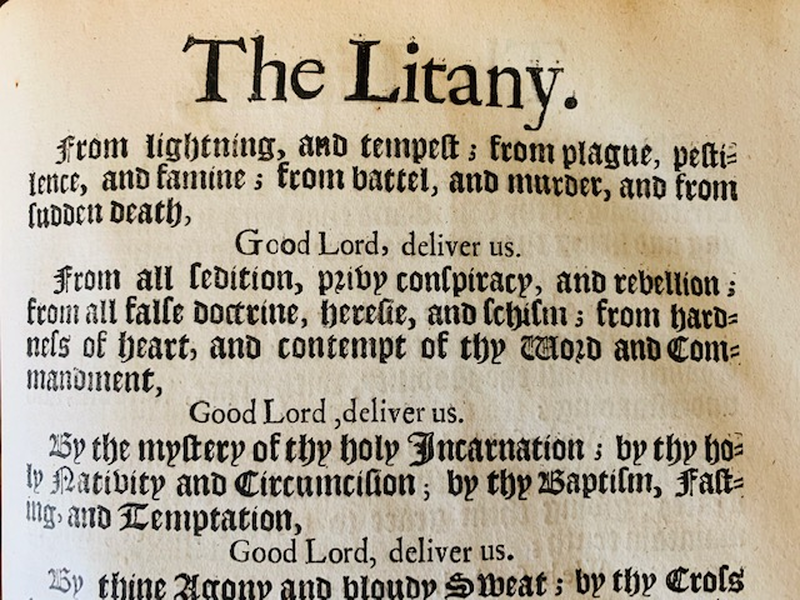
litany-1669-1
Coronavirus

Disease, Deprecations, and Deliverance in an Age of Safe Spaces | Reflections from a University President

From lightning and tempest; from plague, pestilence, and famine; from battle and murder, and from sudden death, Good Lord, deliver us. The Fourth Deprecation from Thomas Cranmer's 1544 Litany 1 A deprecation, such as that above, is a prayer to be spared from disaster, its Latin root deprecari meaning to…

by Alexander WhitakerMarch 16, 2020
lukasz-lada-q7z-aulhpaw-unsplash
Biblical Studies

The Son of Man in the Clouds | Part 2

In the previous essay in this series, we saw that Jesus’ words about coming on the clouds were spoken on more than one occasion, first to the disciples on the Mount of Olives (Matthew 24:30; Mark 11:36; Luke 21:27), then, a few days later, to the high priest and Jewish…

by Ralph Allan SmithMarch 10, 2020
screen-shot-2020-03-05-at-9-05-54-am
Epistemology

Voice and God’s Relational Biology

The following is excerpted from an essay first published at Church Life Journal . We are grateful to the editors for permission to repost here. The word “science” at its root means “to know” and the word “theology” at its root means “to think about God.” Can we know anything…

by Kristin M. Collier MDMarch 5, 2020

Showing page 69 of 309

See all

Showing page 35 of 43

See all
Philosophy

Hermeneutics v. Semiology

According to Michel Foucault, what Marx, Nietzsche, and Freud introduce is an age of interpretation. He develops one of the implications of this by suggesting there is a “fierce war” between semiology and hermeneutics, between treating words as signs and treating them as interpretations. Nietzsche in particular, Foucault claims, develops…

August 26, 2006
Literature

Shakespeare and Bible

Steven Marx’s Shakespeare and the Bible (Oxford, 2000), purports to be the “first book to explore the pattern and significance” of Shakespeare’s biblical allusions. Perhaps. The results are mixed. Each chapter of Marx’s book attempts to show structural, plot, and thematic parallels between a section of Scripture and a play…

August 26, 2006
Literature

Ubiquitous Shakespeare

Exploring Lake Superior in 1840, one Charles W Penny wrote, “We read the Bible I dare say much more than we would have done had we been in Detroit. Shakespeare was duly honoured, as he is every day when we travel. When on the water, some one of the party…

August 26, 2006

Divine Love

The Persons of the Trinity live out an eternal round of self-sacrificing love. If a proof text is needed, John 15 supplies it. 1) Jesus says, “as the Father loved Me, I have also loved you” (v. 9). Jesus’ love for the disciples is modeled on the Father’s for Him.…

August 26, 2006

Queen of the Sciences

John Stuart Mill declared at the beginning of his book on logic that “Logic is the common judge and arbiter of all particulars investigations. It does not undertake to find evidence, but to determine whether it has been found. Logic neither observes, nor invents, nor discovers; it judges.”

August 24, 2006
History

New

Hans Jonas writes in an essay on technological and scientific advance that one of the key cultural shifts in the sixteenth and seventeenth centuries was a, well, new understanding of “new,” and a corresponding revision of traditional ways of thinking about history: “A sign of this spreading mood is the…

August 24, 2006

Showing page 1804 of 2212

Browse by Category

In Medias Res

Your weekly digest for all things Theopolis.

Donate

Theopolis is nearly 100% donor-supported. Consider joining us on our mission.