Theopolis Logo

Writing

Explore our collection of theological essays, biblical studies, and reflections on faith and culture.

See all
hebrew-manuscript-2
Hermeneutics

The Complexity of Biblical Allusion

There is no question about the fact that the book of Deuteronomy is full of literary allusion. But there is a serious problem, even a paradox, of understanding how that allusion works. To begin with, if we assume that Deuteronomy was written by Moses — with some editorial emendations added…

by Ralph Allan SmithJanuary 23, 2018

bladerunner
Culture

The Artificial Resurrection

Genesis and Genetics in Blade Runner 2049 The power of science fiction, and what’s positive about it, is that you’re able to experience the worst-case scenario without actually having to live it. (Actor Ryan Gosling, who plays Officer “K”) (Warning: The following analysis contains spoilers for both Blade Runner films.)…

by Mike BullJanuary 18, 2018
sixteen-miles-out-d40gdcd_-he-unsplash
Biblical Studies

The Battle of Gog and Magog

The battle of Gog and Magog is found in Ezekiel 38-39. My purpose in this brief essay is to propound an explanation for this passage that I have not encountered in any of my commentaries, but that makes more sense to me than any other. I offer it here in…

by James B. JordanJanuary 16, 2018
resurrection

Deep Hope

I. Varlam Shalamov in Kolyma Tales describes his experience of the Gulag, where he spent more than a dozen of years. In a story titled The Life of Engineer Kipreev Shalamov reflects on the theme of hope in the life of a prisoner: “Hope always shackles the convict. Hope is…

by Bogumil JarmulakJanuary 11, 2018
abraham-defeats-kings-g-jollain-2
Biblical Theology

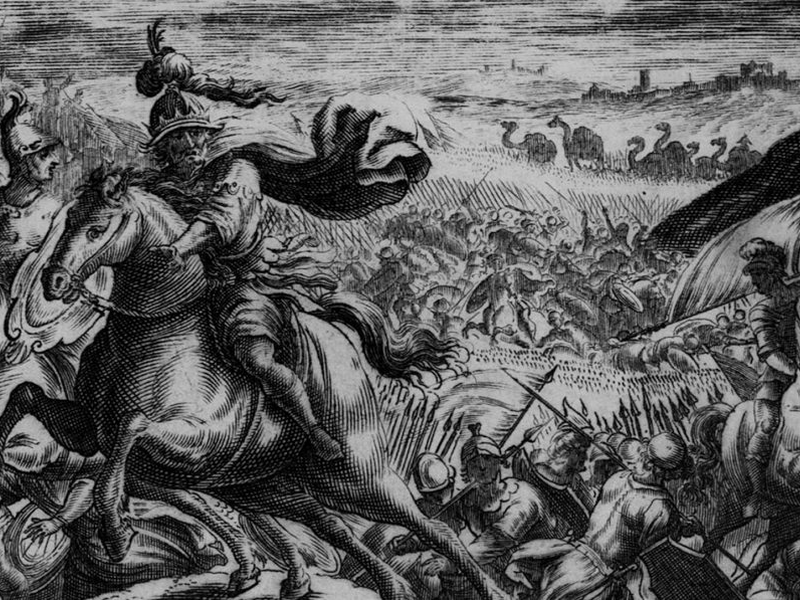
Abram’s 318 Men

Genesis 14:14 says that Abram mustered his trained men, “born in his house,” to rescue Lot, and gives their number as 318. It is clear that the precise number is provided for some reason, but what is it? S. Gevirtz notes that 318 is the sum of all the prime…

by James B. JordanJanuary 9, 2018
tanner-mardis-xuxghzhibn4-unsplash-1
Biblical Studies

The Flying Scroll

And he said to me, "What do you see?" And I answered, "I see a flying scroll; its length is twenty cubits and its width ten cubits" (Zechariah 5:2). Immediately following his vision of the outpouring of the Spirit upon the restoration community (4:1-14), Zechariah saw a flying scroll. The…

by Peter LeithartJanuary 4, 2018

Showing page 100 of 309

See all

Showing page 35 of 43

See all

Moses and the ass

Allison notes the frequent ancient association of Moses with asses. According to Diodorus Siculus, “When Antiochus . . . made war against the Jews he entered the sacred shrine of the god, where only the priest is allowed to go. In it he found a stone image of a thick…

July 6, 2006

Imputation of Righteousness

Waters also says, “Leithart also forthrightly rejects the Reformed doctrine of the imputation of Christ’s righteousness to the believer.” I don’t do that either. What I have questioned, however, is whether we have exegetical grounds for distinguishing “imputation” as an act of reckoning from “justification” as a distinct declarative act.…

July 6, 2006

Imputation: A Narrative Perspective

In his new book on the Federal Vision, Guy Waters claims, “It appears, then, that Leithart has called into question the historic Reformed doctrine of the imputation of Adam’s sin to his posterity.” I don’t. But Waters is right to sense that I’m interested in ways of formulating the doctrine…

July 5, 2006

Creation and Exodus

Allison offers a series of interesting connections between the early chapters of Gen and the early chapters of Ex: 1) Israel is “multiplying” (Ex 2:2) in the way that God commanded the human race to multiply (Gen 1:26-28), concluding, with some help from Samaritan texts, that MOses is another Adam.…

July 5, 2006
Biblical Studies

Immanentized Eschaton

In his book on Mosaic typology in Matthew, commenting on Matt 5:1-2 in particular, Allison reviews some of the Jewish literature that suggests that Moses sat enthroned on Sinai. The idea was based on Deut 9:9, where Moses says “I remained (YASHAB) on the mountain forty days and forty nights,”…

July 5, 2006

Interpretation and the Unstated

Interpretation is, we’re often told, a matter of explaining what’s in the text. Only eisegetes talk about what’s not already there. Discussing Matthew 1:1, Dale Allison offers this, much more accurate, alternative: “The interpretation of this line can be nothing other than the unfolding of what it not stated.” More…

July 5, 2006

Showing page 1829 of 2212

Browse by Category

In Medias Res

Your weekly digest for all things Theopolis.

Donate

Theopolis is nearly 100% donor-supported. Consider joining us on our mission.