Theopolis Logo

Writing

Explore our collection of theological essays, biblical studies, and reflections on faith and culture.

See all
denise-jans-dpemksg59la-unsplash
Art

Glorifications Versus Debasement

Because of sin, the arts sometimes do not serve to glorify but to debase. Sinful men make their environments ugly, and create ugly art to “enhance” their ugly words. But since all men are still God’s images, no men are able to live with such ugliness all the time. Thus,…

by James B. JordanMay 25, 1994

jeremy-yap-j39x2xx_8cq-unsplash
Art

Words and Glory

Arts and literature reviews in most evangelical Christian publications generally approach their subjects in terms of ideology. We are told whether or not the film or book is acceptable in terms of morals, sexual graphicness, and theological accuracy. While there is definitely a place for such reviews, I fear that…

by James B. JordanMay 25, 1994
screen-shot-2018-04-12-at-9-48-08-am
Biblical Horizons

Broadening Our View of the Trinity

We speak of God as Father, Son, and Holy Spirit. The early Church tended to speak of Him as Father, Word, and Spirit. In this short essay, I want to suggest some other ways to think of the Trinity, ways that I have found pastorally helpful in my own life…

by James B. JordanMay 5, 1994
Biblical Studies

Thousands of Generations

I, Yahweh your God, am a jealous God, visiting the iniquity of the fathers on the children, on the third and fourth of those who hate Me, but showing lovingkindness to thousands, to those who love Me and guard My commandments (Ex. 20:5-6). The Second Word forbids acts of ceremonial…

by James B. JordanMay 5, 1994
ben-white-w8qqn1pmqh0-unsplash
Biblical Chronology

The Chronology of the Pentateuch (Part 3)

8. The Table of Nations If we assume births every two years, and about 30 years between generations (cp. Gen. 11:12-24), we can come up with an approximate series of dates for the generations recorded in Genesis 10. We shall assume that all three of Noah’s sons had their firstborn…

by James B. JordanMay 5, 1994
49980-nicolas_poussin_-_the_judgment_of_solomon_-_wga18330-800w-tn
Biblical Studies

The Eighth Month

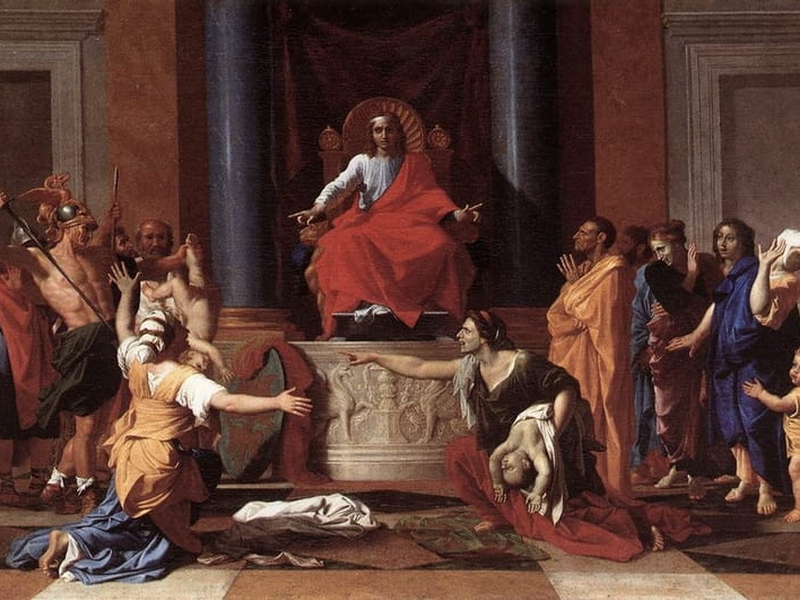
Zechariah’s first prophecy (Zech. 1:1-6) was delivered in the eighth month of the second year of Darius. The notation of this date serves a number of purposes. Most obviously, it relates Zechariah’s prophecies to those of Haggai. By the time Zechariah delivered his first prophecy, Haggai had already chided the…

by Peter LeithartApril 23, 1994

Showing page 279 of 309

See all

Showing page 35 of 43

See all

God's Wounds

J ean-Louis Chretien begins his Hand to Hand with a series of meditations on the story of Jacob wrestling with God, and artistic representations of that episode. He quotes Francois de Sales, who wrote: “Our Lord may turn us and sweep us round to the left or to the right;…

February 10, 2017

Silence of Painting

I n Hand to Hand , Jean-Louis Chretien meditates on silence in painting. He doesn't simply mean that painting is a visual rather than an audible art. Instead, he argues that paintings must not only be viewed but listened to: “To say that painting is silent is to say that…

February 10, 2017

Fair Nature's Second Chance

“G iving oneself up to sleep can constitute the worst of abandonments,” writes Jean-Louis Chretien ( Hand to Hand ), “wherein we abandon another person to his solitude and his distress by withdrawing ourselves from the common world and from our community with him. Our eyelids close upon our weary…

February 10, 2017

The New (Secular) Pragmatism

P aul Collier devotes a long, provocative, stimulating TLS review to a sketch of a “new pragmatism.” The review doubles as an essay on the “future of capitalism.” Along the way, Collier discusses the problems of multiculturalism and gives qualified endorsement to nationalism. Multiculturalism must be “bounded,” partly because Western…

February 10, 2017

Authoritarian Gardeners

D avid I. Smith and Susan M. Felch ( Teaching and Christian Imagination ) want to rehabilitate the symbolism of “gardening” as a model of education. It does require rehabilitation, not least because of Rousseau, who wrote: “God makes all things good. . . . [but] man meddles with them…

February 10, 2017

Horticultural Anthropology

D avid Smith and Susan Felch devote several pages of their Teaching and Christian Imagination (129–134) to a summary of John Amos Comenius's seventeenth-century treatise on education, Great Didactic . Comenius starts where humanity starts, with Eden's garden, and reflects that the garden is not only man's original location but…

February 10, 2017

Showing page 207 of 2212

Browse by Category

In Medias Res

Your weekly digest for all things Theopolis.

Donate

Theopolis is nearly 100% donor-supported. Consider joining us on our mission.