Theopolis Logo

Writing

Explore our collection of theological essays, biblical studies, and reflections on faith and culture.

See all
diego-gonzalez-i8ldurtfao-unsplash
Architecture

Arts and Play, Part 3

Let us now switch gears and move to a discussion of art, literature, architecture, and music. In English, we speak of "playing" games and also of "playing" musical instruments. There is a connection between the two, in that both involve some degree of pleasure and recreation. At the same time,…

by James B. JordanJanuary 23, 1992
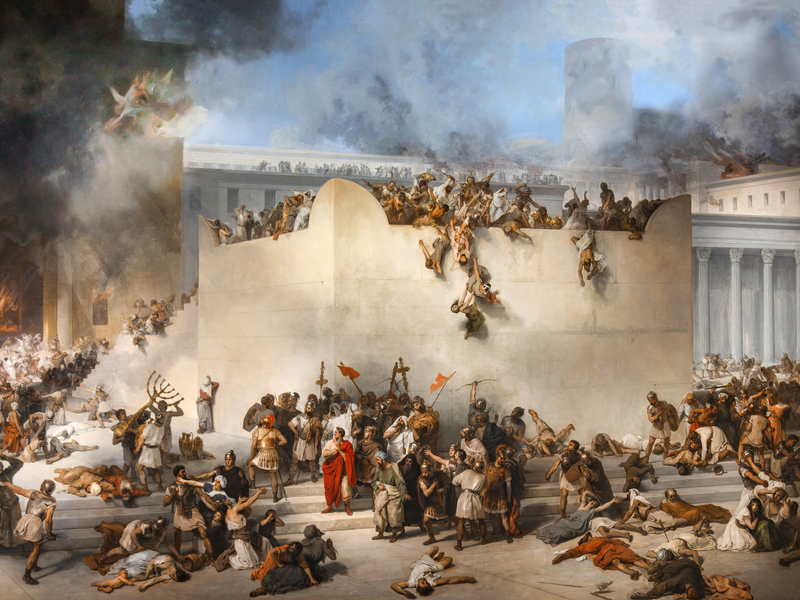
venice-la-distruzione-del-tempio-di-gerusalemme-francesco-hayez-gallerie-accademia-venice
Daniel

The Abomination of Desolation, Part 4b: Abominable and Detestable

Leviticus 20:22-26 22. And you shall guard all My decrees and all My laws and do them, so that the land will not vomit you out, where I am bringing you thither to live in it. 23. And you shall not walk in the decrees of the nation that I…

by James B. JordanDecember 23, 1991
v4mkpbd70x7bkvc7mqvu
American Politics

The Original Low-Down Filthy Male Chauvinist Pig-Dog

For a year or so we have been reading about date rape. It amazes me how many "conservative" commentators have taken the attitude that "boys will be boys," and that it is somehow the girl’s fault if she lets the boy go too far. I have to agree that we…

by James B. JordanDecember 23, 1991
screen-shot-2023-04-04-at-5-01-54-pm
Biblical Chronology

Chronologies and Kings, Part 6: The Formation of the Remnant

According to 1 Kings 16:29, Ahab came to the throne of Israel in the 38th year of Asa of Judah, which was the year A.M. 3087. He reigned 22 years, dying in the year 3108. Ahab married a princess of Tyre named Jezebel (Jeze-baal). Under Jezebel’s influence, Ahab turned away…

by James B. JordanDecember 23, 1991
venice-la-distruzione-del-tempio-di-gerusalemme-francesco-hayez-gallerie-accademia-venice
Luke

The Abomination of Desolation: Part 4, Abominable and Detestable

Part 1 Part 2 Part 3 Most Christians today, when they hear the phrase "abomination of desolation," think of some political figure who is to arrive on the scene some time in the future, and who will oppress God’s people. More careful exegetes have seen that the prophecies concerning "abomination…

by James B. JordanNovember 22, 1991
skyler-gerald-akljfvj5ym4-unsplash
Deuteronomy

Chronologies and Kings, Part 5: Testimonies of Two Witnesses

Deuteronomy 17:6 tells us that a matter is to be regarded as established if it is testified by two or three witnesses. One of the most important characteristics of Biblical chronology is that it is very often supported by more than one witness. A case in point is the fact…

by James B. JordanNovember 22, 1991

Showing page 293 of 309

See all

Showing page 35 of 43

See all

Why Now?

Jesus prayed that the church's unity would reflect the unity of the Father and Son. Paul urged the Ephesians to cultivate the virtues of peace that would express the sevenfold unity of the church (Ephesians 4). That demand is a perennial one. But we've been divided for a long time.…

March 12, 2015

Fragile Fruitfulness

Israel is a vine, transplanted from Egypt (Psalm 80; Isaiah 5). She exists to produce wine that gladdens the hearts of men. Israel is the Dionysian people. Ezekiel brings out another dimension of the vine image: “Son of man, how is the wood of the vine better than any wood…

March 12, 2015

Judgment to the Corners

The oracle of judgment in Ezekiel 14:12-23 is structured as a fourfold judgment: sword, famine, beasts, plague (v. 21). The descriptions of judgment are laid out in four paragraphs that use repetitive, stereotyped language. Throughout, Yahweh says that even the intercession of Noah, Daniel, and Job could not rescue Judah…

March 12, 2015
Fairy Tales

The Political Economy of Fairy Tales

In a TLS review of several recent books on fairy tales, Fracesca Wade points to the political context and economic setting of early folk and fairy tale collections. Inspired by Herder, the Grimms, she observes, intended to recover Germanitas by study of natural German poetry: “Although the brothers drew widely…

March 12, 2015

Remembering the Present

In his Deja Vu and the End of History , Italian philosopher Paolo Virno explores the phenomenology of memory, especially in its relation to philosophies of history. The deja vu of the title isn't a metaphor; following Henri Bergson, Virno argues that it represents “the untrammelled extension of memory's jurisdiction,…

March 11, 2015

Potential, Act, and Violence

Paolo Virno ( Deja Vu and the End of History ) observes that potential and act occur simultaneously. Take language: “The language faculty irrupts into becoming in concomitance with the phrase that I am speaking. It appears precisely now, as I speak, neither before nor afterwards: but, note, right now…

March 11, 2015

Showing page 453 of 2212

Browse by Category

In Medias Res

Your weekly digest for all things Theopolis.

Donate

Theopolis is nearly 100% donor-supported. Consider joining us on our mission.