Theopolis Logo

Writing

Explore our collection of theological essays, biblical studies, and reflections on faith and culture.

See all
johann-siemens-epy0gbjzzzu-unsplash
Apologetics

A Sabbath Conversation: How Old is the Earth?

As Adam and Eve walked to the center of the Garden of Eden to meet with the LORD on their first Sabbath they conversed about the origin and age of the earth. Adam: You know, honey, we spent a lot of time yesterday making preparations for our house, and we…

by Jeff MeyersOctober 3, 1997

img_1043
Biblical Horizons

Psalms for Exile: The Narrative Progression in the Fifth Book of the Psalter

Some of our forefathers believed in reading/singing the psalms in order. Today, when the psalms are even used at all, they tend to be used randomly, though sometimes tied to a church calendar or to the pastor’s sermon. The Bible does not bind us to any particular practice, but there…

by James B. JordanSeptember 4, 1997
jordan-wozniak-xp_agmeea6s-unsplash-2
Biblical Chronology

The Anthropomorphic Days of C. John Collins, Part 2

Dr. Collins begins his essay with a brief statement of the Day Age view and then a brief statement of the Six Day view, focussing on the challenge to that view posed by modern "science." He ends this discussion by writing: "Two crucial points are at stake here: first, the…

by James B. JordanSeptember 4, 1997
john-salzarulo-wtjrpjzabcq-unsplash
Biblical Horizons

Paperweights and the Puzzles of Secularism

In his The Construction of Social Reality , Berkeley philosopher John Searle puzzles over the ontology of the products of human construction. Certain things – granite, platypi, weeping willows – occur naturally; while other realities – stone walls, zoos and parks, Chase Manhattan Bank – exist only as products of…

by Peter LeithartAugust 27, 1997
ales-krivec-4mibe6zg5r0-unsplash
Biblical Chronology

The Anthropomorphic Days of C. John Collins, Part 1

In the journal Presbyterion 20 (1994):109-130, published by Covenant Theological Seminary, Dr. C. John Collins sets forth a revision of the Day Age approach in his essay, "How Old Is the Earth? Anthropomorphic Days in Genesis 1:1–2:3." Dr. Collins’s essay has been widely accepted in evangelical Presbyterian circles as an…

by James B. JordanAugust 4, 1997
screenshot-2023-09-04-at-10-37-01-am
Biblical Horizons

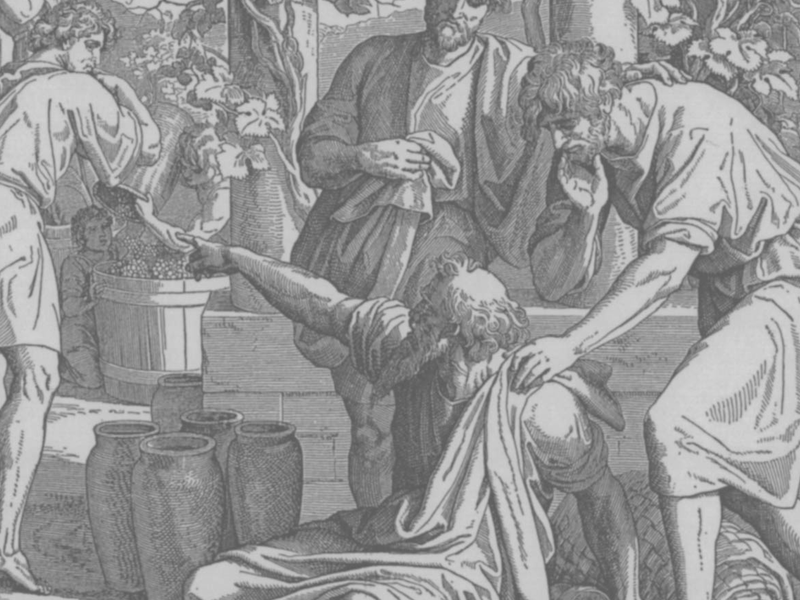
The Sin of Ham and the Curse of Canaan, Part 3 (An Exposition of Genesis 9:20-27)

The Righteousness of Shem and Japheth As noted above, the action of Shem and Japheth was purely symbolic. They did not need to cover Noah with a garment, for he was already covered by the tent. Their action was a symbolic affirmation of Noah’s authority, a symbolic rejection of Ham’s…

by James B. JordanAugust 4, 1997

Showing page 254 of 309

See all

Showing page 36 of 43

See all
Biblical Studies

Critical Scholarship

One of the most annoying things about critical biblical scholarship is the way that every discussion has to contribute to questions of composition, authorship, historical setting, etc. Harrington gives a very intriguing paper on holiness in Ezra-Nehemiah, but the whole thing is part of a “larger” argument about the common…

November 19, 2006

Purity and holiness

Hannah Harrington gave a very fine presentation on the holiness and purity terminology in Ezra and Nehemiah. She showed that these post-exilic texts display an expansion of holy space to encompass the whole city as well as an expansion of the duties of Levites, a closing of the gap between…

November 19, 2006
Biblical Studies

Criterion of antiquity

John Milbank claims that the Wellhausen documentary hypothesis is shaped by what he calls the “liberal Protestant metanarrative,” the view that Christianity moved from a religion of inner simplicity to a religion of complex external ritual (JEDP traces this story). In his SBL presentation, Nick Perrin of Wheaton showed how…

November 18, 2006

Theopoiesis

Carl Mosser of Eastern College gave a superb presentation on deification at the ETS meeting. A large part of the presentation was a study of terminology. He noted that the Greek work THEOS (often thought to be equivalent to “God”) had a broader meaning, referring to powers that were immortal,…

November 18, 2006
History

More from Latour

A few further scattered comments from and on Latour. 1) He disputes the notion that the modern world is disenchanted, claiming that the claim of disenchantment is merely the reflex of the Constitution of modernity and its premise that We are completely different from Them. He also attributes the modern…

November 17, 2006

Remnant, Edom, AD 70

Some reflections based on an ETS talk by Edward Meadors on Romans 9-11. Meadors suggested that “Esau” in Romans 9 refers to Esau as the patriarch of Edom, well-known for its opposition to Israel throughout the centuries. That is Malachi’s focus in the passage Paul cites. And this is set…

November 17, 2006

Showing page 1761 of 2212

Browse by Category

In Medias Res

Your weekly digest for all things Theopolis.

Donate

Theopolis is nearly 100% donor-supported. Consider joining us on our mission.