Theopolis Logo

Writing

Explore our collection of theological essays, biblical studies, and reflections on faith and culture.

See all
preston-goff-xncifslw0jw-unsplash
Biblical Theology

The Old Testament Precursor to the Pastor

WHAT IS THE OT PRECURSOR OF THE NT OFFICE OF PASTOR? HOW DOES THE FORMER ILLUMINATE THE LATTER? The first problem to address is: how do we know that there is an office of pastor in the New Testament? 1 Perhaps the way the question is put may permit me…

by Mark HorneJune 5, 1999

nasa-vhsz50aafas-unsplash
Biblical Horizons

The Geocentricity Question

[This essay was originally published in December, 1981, in The Biblical Educator , a publication of the Institute for Christian Economics, and again with slight revisions in Contra Mundum 7 (Spring, 1993). It is reprinted here as a supplement to my book Creation in Six Days .] In 1979, Dr.…

by James B. JordanJune 4, 1999
screen-shot-2022-05-12-at-12-07-23-pm
Biblical Horizons

Call Me Ishmael, Part 2

Anyone seeking to reverse the meaning of this promise needs to come to grips not only with the phrase "God was with the lad" later on, but also with Hagar’s response in 16:13. She worships Yahweh, putting her trust in Him and obeying Him. In fact, Hagar is at the…

by James B. JordanJune 4, 1999
aaron-burden-h8s0pf2rcqs-unsplash
Biblical Horizons

Call Me Ishmael, Part 1

Ishmael is the narrator of Melville’s fantasy-romance Moby Dick. Melville takes up the traditional view of Ishmael as a wayward son of Abraham, driven out solely because of the Divine "caprice" of election, an angry man with his hand raised against all other men. He is a fitting "anti-hero," or…

by James B. JordanMay 4, 1999
aaron-burden-1ebsmyrau-s-unsplash
Isaiah

Five Cities and Isaiah 19

There were five cities at the center of the Canaanite culture in the circle of the Jordan, a place like the Garden of Eden, like the land of Egypt, before it became the Dead Sea at the destruction of the cities (Genesis 13:10). Genesis 14:2 tells us their names: Sodom,…

by James B. JordanApril 4, 1999
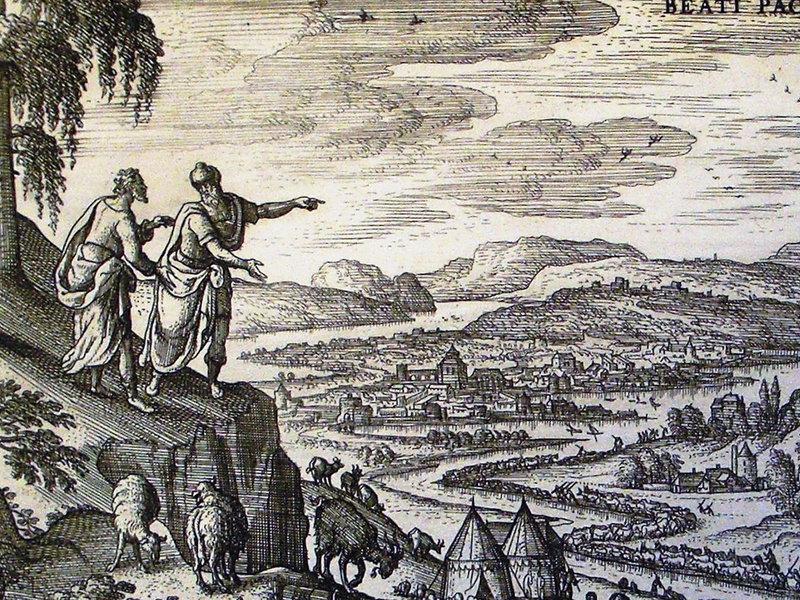
phillip-medhurst-abraham-and-lot
Biblical Horizons

Lot

Meditations by James B. Jordan Genesis 19, the destruction of Sodom and the rescue of Lot, is part two of a story that begins in Genesis 18. These two chapters happen in one 24-hour period: noon and evening in Mamre, and midnight and daybreak in Sodom. God and two angels…

by James B. JordanApril 4, 1999

Showing page 244 of 309

See all

Showing page 36 of 43

See all
History

Hermeticism and gnosticism

In his book on the hermeticist Hegel, Magee gives this helpful sketch of the differences between gnosticism and hermeticism: “Gnosticism and Hermeticism both believe that a divine ‘spark’ is implanted in man, and that man can come to know God. However, Gnosticism involves an absolutely negative account of creation. It…

August 16, 2006
Philosophy

Hegel and Hermes

In a 2001 book (Cornell), Glenn Magee argues that Hegel must be understood as a hermetic thinker. Hegel claims to have moved beyond the ancient notion of philosophy as “pursuit of wisdom” to an absolute knowledge that is simply identical with wisdom. As Magee says, “Hegel’s claim to have attained…

August 16, 2006

MacIntyre on Heroic virtue

In After Virtue , Alasdair MacIntyre provides a neat discussion of the virtue and selfhood in Greek antiquity. The unity of ARETE, virtue, “resides . . . in the concept of that which enables a man to discharge his role,” and refers to “excellence of any kind,” whether in a…

August 16, 2006
Philosophy

Logos: Harmony and Recipe

One Marc Cohen of the University of Washington, offers this account of the “logos” of Heraclitus in an online lecture outline: First, “There is an orderly, law-governed process of change in the universe. (Compare fragment 80 with Anaximander, who equates strife with injustice; for Heraclitus, strife is justice, and is…

August 16, 2006

Life of Heraclitus

Some selections from Diogenes Laertius’ “Life of Heraclitus, from his “Lives and Opinions of Eminent Philosophers: “He was above all men of a lofty and arrogant spirit, as is plain from his writings, in which he says, ‘Abundant learning does not form the mind; for if it did, it would…

August 16, 2006
History

Asocial sociability

Seigel devotes a fascinating section of his book ( Idea of the Self ) to a summary of Mandeville’s Fable of the Bees , in which Mandeville describes what Kant characterized as the “asocial sociability” of human nature. Social in the sense that even in a natural state, prior to…

August 15, 2006

Showing page 1809 of 2212

Browse by Category

In Medias Res

Your weekly digest for all things Theopolis.

Donate

Theopolis is nearly 100% donor-supported. Consider joining us on our mission.