Theopolis Logo

Writing

Explore our collection of theological essays, biblical studies, and reflections on faith and culture.

See all
sacre-bleu-r__kixb0i5m-unsplash
Death

Integrity

Integrity seems to have two meanings. It can mean the quality of being honest and having strong moral principles. A man of integrity is a person of honour, rectitude and probity, truthful and trustworthy. Integrity also describes a state – the quality of being whole and undivided. If things are…

by Arthur KayMarch 19, 2015

emmanuel-phaeton-1bwmfmvybi8-unsplash
Psalms

Psalm 32 Commentary

Get the Psalm 32 Translation here Psalm 32 is the first part of Ps. 32-33, ending with a call to praise that is answered by what follows. Ultimately the psalm needs to be considered as a whole, but what we call Psalm 32 does have its own structure and logic,…

by James B. JordanMarch 18, 2015
laughter
Humor

On Crude Humor

You wouldn’t hit a man with glasses would ya? No, of course not. I’d hit him with a bat. In our culture of frivolity it is tempting for Christians to think that solemnity should be our defining attribute. The coarseness of the world impedes us from enjoying any sort of…

by Remy WilkinsMarch 17, 2015
standingonamountain
Creation

Maker of Heaven and Earth, Part 2

Taking a cue in my last post from early Christian apologetics, I suggested that if we wish to articulate and defend a doctrine of creation ex nihilo in contemporary theology, we would do well to offer a thick description of Yahweh’s divine monarchia (his sole rule or sovereignty). Rather than…

by Stephen LongMarch 12, 2015
mountain-top-2
Creation

Catechism of the Universe

I’m not sure we really understand the insidiousness of unbelief. It is not merely to reject the gospel of Jesus, the existence of a Creator God, or to question biblical morality. At its core, unbelief is ingratitude, and by the very nature of this ingratitude, it must ultimately reject every…

by Toby SumpterMarch 10, 2015
jonah-under-gourd
Mark

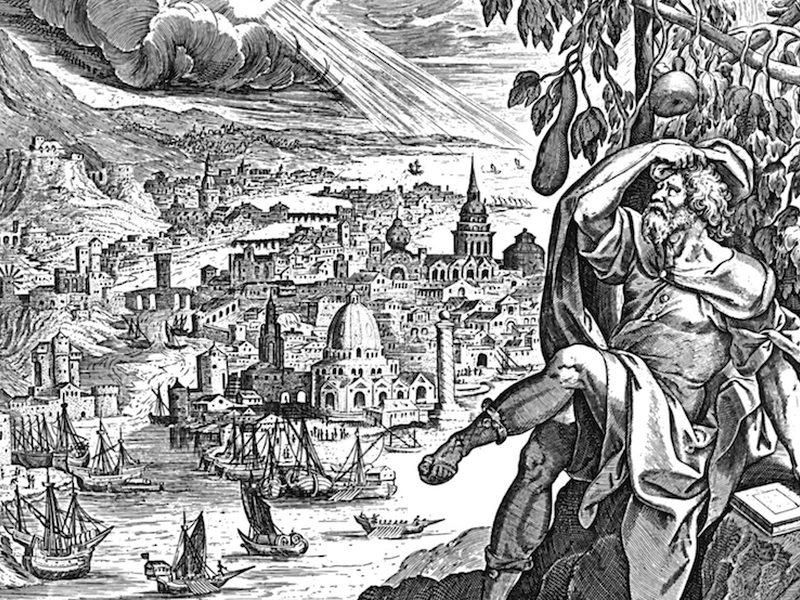
The True Jonah and Lenten Fasting

Mark’s narrative of the baptism of Jesus is characteristically brief: “In those days Jesus came from Nazareth of Galilee and was baptized by John in the Jordan. And when he came up out of the water, immediately he saw the heavens being torn open and the Spirit descending on him…

by Arthur KayMarch 9, 2015

Showing page 158 of 309

See all

Showing page 36 of 43

See all

Reformation Rhetoric

Peter Matheson ( Rhetoric of Reformation ) recognizes that polemic is “both necessary and useful” (8). It enables underdogs to gain a foothold, and “enables us to see things as they are. Its caricatures are nearer to the truth than the smooth rhetoric and facile images beloved of politician, businessman…

April 13, 2017

Ladder to Heaven

2 Chronicles 3-4, the Chronicler's account of the temple, uses the phrase “left and right” several times. Jachin and Boaz, the two pillars, are “left and right” at the porch (3:17). Ten basins are set up in two groups of five on the left and right of the court (4:6).…

April 12, 2017

The Pillars that Huram Built

In her study of Leviticus as Literature , Mary Douglas notes the “house that Jack built” quality of the Levitical descriptions of sacrifice. Priests put animal parts on the wood that is on the fire that is on the altar. Douglas takes this as a sign that Leviticus describes sacrifice…

April 11, 2017

Pollution and Purgation in the Reformation

I n a famous essay on “rites of violence” in sixteenth-century France, Natalie Zemon Davis argued that one motivation behind mob violence was the desire to purge “the community of dreaded pollution. The word ‘pollution' is often on the lips of the violent, and the concept serves well to sum…

April 11, 2017

Creating the Temple

T he Chronicler's account of the construction of Solomon's temple (2 Chronicles 3:1-5:1) follows the creation week of Genesis 1 in general and in specific details. In general, the account moves from a description of the dimensions, materials and adornments of the three zones of the temple (porch, palace, most…

April 10, 2017

Weber the Idealist

R obert Scribner doesn't think Protestantism “disenchanted” the world. Reformers did attack certain forms of medieval “magic.” They rejected “sacramentals,” which were “functional” rituals that could be used as protection against devils. This didn't produce a “buffered” world, impervious to outside influence. No one surpassed Luther in his obsession with…

April 7, 2017

Showing page 187 of 2212

Browse by Category

In Medias Res

Your weekly digest for all things Theopolis.

Donate

Theopolis is nearly 100% donor-supported. Consider joining us on our mission.